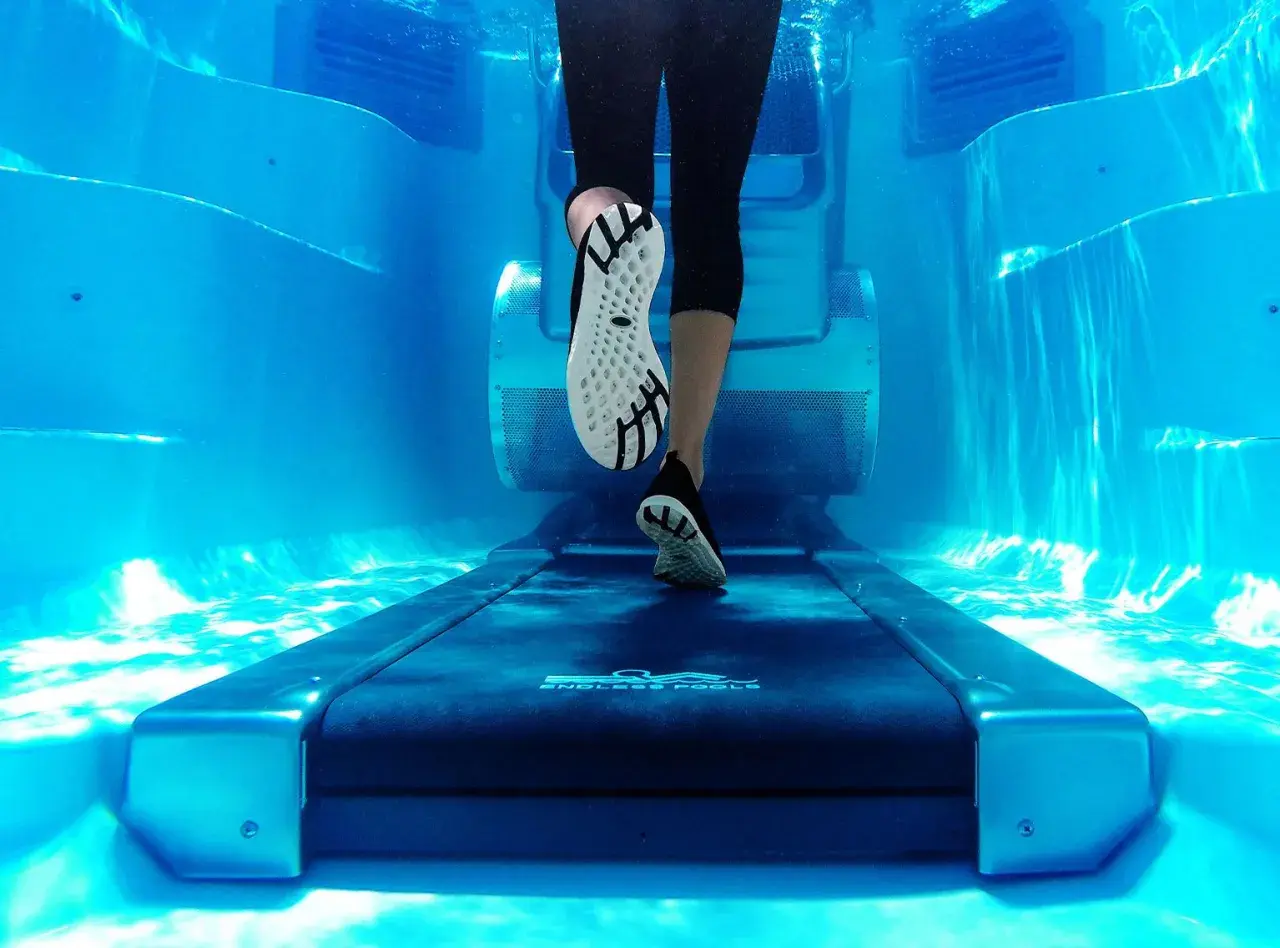
Aqua jogging is one of the most practical ways to keep aerobic work alive when you need less impact than road running or hard pool laps. In this guide I break down what it is, which gear actually matters, how to do it with clean form, and how to turn it into a workout that supports both swim training and general fitness.
Key takeaways for using water running well
- It is a low-impact aerobic session, not a relaxed float in the pool.
- A flotation belt matters more than fancy extras, especially in deep water.
- Good technique keeps your hips up, your cadence honest, and your effort productive.
- Intervals usually build better fitness transfer than aimless laps.
- It works best as a bridge, a rehab tool, or a way to add volume without extra pounding.
Why aqua jogging works for runners and swimmers
The basic idea is simple: you run in the water, usually in the deep end, while the water supports part of your body weight and the drag forces your muscles to work harder than they would in air. That combination is what makes the method useful. It is gentle on joints, but it is not easy if you do it properly.
For runners, the appeal is obvious. You can keep an aerobic engine alive when impact is the problem, whether that means an overuse niggle, a return-to-run phase, or a week where you cannot absorb more pounding. For swimmers, it is a clean way to add conditioning without adding more shoulder-heavy lap work. I also like it for athletes who need extra volume but cannot afford another hard land session.
- Low impact means less stress on knees, shins, feet, and hips.
- Water resistance means each stride has to push against a dense medium instead of empty air.
- Flexible intensity means you can keep it easy, or turn it into a serious interval session.
Done well, pool running can preserve fitness for several weeks without beating the body up, which is exactly why it has a place in serious training plans. Once you know why it works, the next question is what gear is worth buying and what is just clutter.
The equipment that matters most
I keep the kit deliberately simple. The goal is not to outfit a gadget show; it is to make the movement stable, repeatable, and safe.
| Item | What it does | My take |
|---|---|---|
| Flotation belt | Keeps you upright and helps you stay suspended in deep water | Essential for true deep-water running |
| Deep or chest-deep lane space | Lets you stay off the bottom and use a real running motion | If your toes keep brushing the floor, the session changes |
| Timer or watch | Helps you run intervals instead of drifting aimlessly | Important if you want a training effect |
| Optional gloves or cuffs | Add more resistance for advanced sessions | Useful later, not needed on day one |
If you are buying just one thing, buy the belt first. In U.S. retail, a basic flotation belt often lands somewhere around $25 to $60, and that is a reasonable spend because it changes the quality of the workout immediately. I would rather have one good belt and a timer than a bag of accessories that alter technique before it is stable. With the setup sorted, the form cues matter much more than the hardware.

How to build a clean running motion in the pool
The hardest part for most people is not effort; it is posture. Water changes the feedback you get from the body, so you have to be more deliberate than you would on land. I cue athletes to think tall, quick, and compact.
Start with posture
Keep the chest open, the ribs stacked over the hips, and the head neutral. A slight forward lean is fine, but it should come from the ankles, not from collapsing at the waist. If your hips sink, the stride turns into a fight against the water instead of a clean running pattern.
Use your arms on purpose
The arms matter more than most people expect. Swing them rhythmically, close to the body, with a natural opposition to the legs. I want the movement to look like running, not splashing. Big, wild arm circles usually waste energy and throw off balance.
Keep the legs moving like a run, not a bicycle
Drive the knee forward, then recover the foot under the body. The stride should be quick and compact, with enough range to feel athletic but not so much that you start pedaling. If someone tells me they are “kicking hard” during this drill, that is usually a sign the motion has drifted away from running.
Read Also: What is a Good SWOLF Score? - Improve Your Swim Efficiency
Let breathing stay calm
Breathing should be steady and unforced. Water often makes heart-rate data less useful than it is on land, so I pay more attention to perceived effort. RPE, or rating of perceived exertion, is the 1-to-10 effort scale I trust in the pool because it stays useful even when the watch does not.
The cleanest sessions are the ones where posture holds together from the first minute to the last. Once the movement feels natural, the real payoff comes from programming it like a workout instead of a placeholder.
Workouts that actually move the needle
If the session has no structure, it usually becomes too easy. That is the main mistake I see. I want a warm-up, a clear middle, and a real finish.
| Session type | Structure | Best use |
|---|---|---|
| Recovery session | 20 to 30 minutes easy, RPE 3 to 4, with relaxed strides | After a hard swim set or a run that left the legs flat |
| Aerobic builder | 3 x 8 minutes moderate with 2 minutes easy between | Adding volume without extra pounding |
| Threshold work | 6 x 3 minutes strong with 90 seconds easy | Maintaining fitness when you cannot run on land |
| Speed maintenance | 10 to 12 x 30 seconds hard with 30 to 45 seconds easy | Keeping turnover sharp and effort honest |
My default template is simple: 5 to 10 minutes easy, 10 to 25 minutes of real work, then 5 minutes to settle down. For most athletes, 2 to 4 sessions a week is enough. If you are using it to protect a run schedule, the interval work matters more than long, lazy movement because the body responds to purpose, not just time in water. That is useful, but it still does not solve every training problem, which is where the limits matter.
Where it fits best and where it falls short
Water running is excellent when the main issue is impact. It is also useful when the weather is bad, the travel schedule is messy, or a swimmer wants more aerobic work without adding more shoulder volume. In rehab settings, it can help an athlete stay trained while tissue irritation settles down, and I have seen it work especially well when the person already understands their normal running or swimming rhythm.
It is not perfect, and I would not pretend otherwise. It does not load the bones the way land running does, so it should not be the only thing in a long-term plan if you need impact tolerance. It also does not fully replace the neuromuscular specifics of running on land, especially if you are chasing race pace, stride stiffness, or downhill durability. For a trained runner, it can often hold fitness for around 4 to 6 weeks when used intelligently, but after that I want some kind of land reintroduction if the body allows it.
Compared with cycling or the elliptical, it sits closer to running in movement pattern and usually closer to swimming in convenience if you already have pool access. If you need the lowest possible joint stress, it wins. If you need pure aerobic time with no pool logistics, the bike may be easier. The right choice depends on what you are trying to protect and what you are trying to keep.
Once you know those boundaries, the biggest errors become easier to spot and fix.
The mistakes I see most often
A bad session in the pool is usually not a failure of fitness. It is a failure of setup or focus. These are the patterns I correct first:
- Standing too upright - the body becomes vertical and stiff, which kills rhythm. I cue a tiny forward lean and a higher hip position.
- Letting the cadence sag - if the stride gets slow and heavy, the session becomes mediocre. I prefer quick, compact turnover.
- Chasing pace instead of effort - water does not reward land pace logic. I use breathing and RPE as the main anchors.
- Overusing accessories too early - gloves, cuffs, and other add-ons can distort form before the basic pattern is stable.
- Skipping intervals - endless steady movement feels productive, but intervals usually give the better training return.
- Ignoring the warm-up - the first 5 to 10 minutes should wake up the pattern before you ask for intensity.
Most of these fixes are boring, which is exactly why they work. When the movement and the dose are both under control, the method becomes a reliable tool instead of a novelty. With that in mind, the simplest way to use it is to place it where it supports the rest of your week.
How I would slot it into a swim-training week
If I were building a swim-training week around it, I would use it as a bridge, not a headline workout. On a recovery day, I would drop in 20 to 30 minutes easy after the pool. On a conditioning day, I would use intervals and treat it like a real aerobic session. If a runner were coming back from a setback, I would start with two sessions a week and only increase once the body stayed calm for several days after each one.
- After hard swim intervals: 20 to 25 minutes easy to flush the legs without more impact.
- On a mixed cardio day: 3 x 8 minutes moderate to extend aerobic volume.
- During return-to-run work: 6 x 3 minutes strong, then gradually add land running when symptoms stay quiet.
- In a busy week: 10 x 30 seconds hard to keep turnover and effort sharp without adding fatigue from pounding.
The cleanest results come from respecting the difference between low impact and low effort: keep the posture sharp, the intervals purposeful, and the weekly dose just high enough to support the rest of your training.