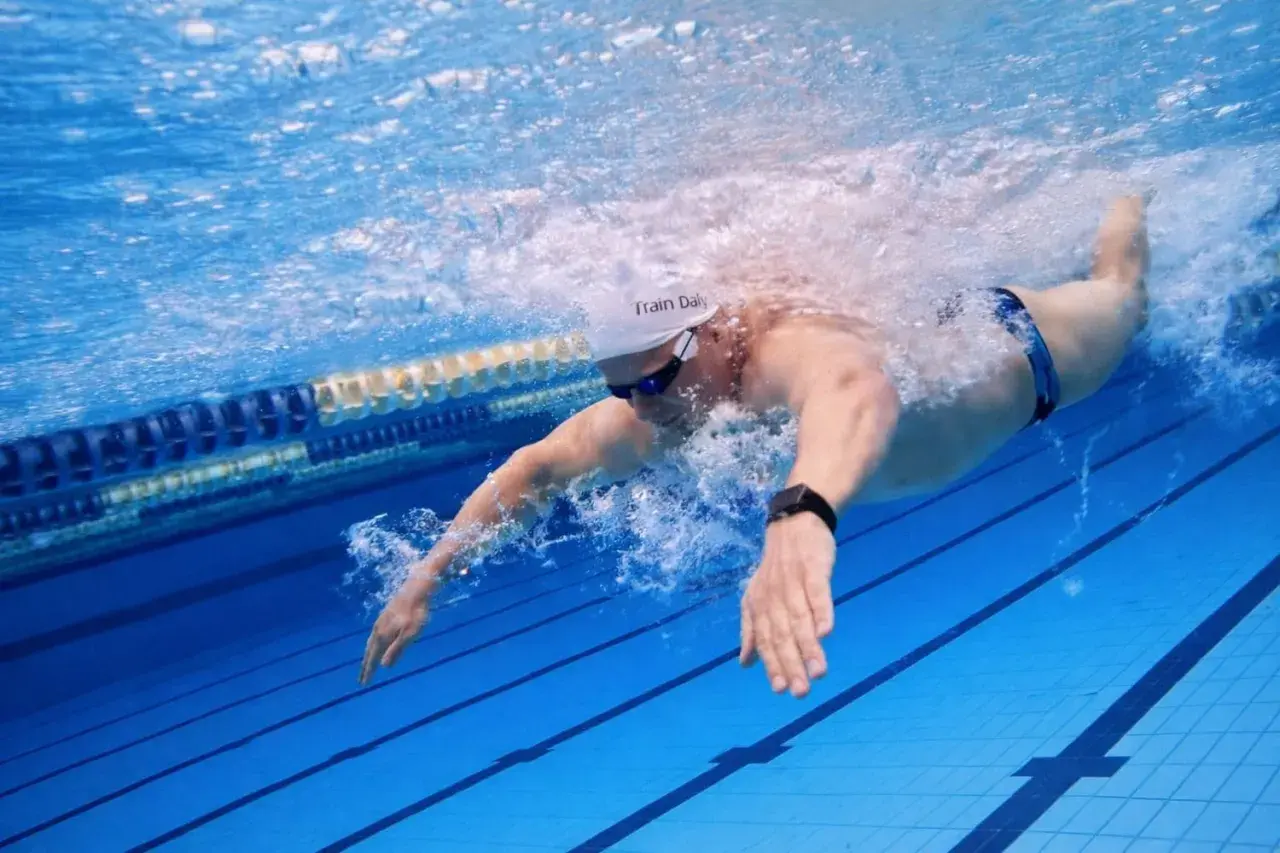
The butterfly stroke is one of swimming’s most demanding skills because speed comes from timing, not brute force. When the chest, hips, arms, and dolphin kick line up, the motion feels smooth; when they drift apart, the stroke punishes every mistake. In this article, I break down the movement pattern, breathing, common errors, and the drills that make the technique hold together in real training.
What you need to know before trying to swim the fly well
- Fly is a symmetric stroke: both arms move together, and both legs kick together.
- The chest starts the wave; the hips finish it.
- Two dolphin kicks per full arm cycle usually create the cleanest rhythm.
- A small, timed breath is faster than a big head lift.
- Short drills and controlled repeats build better technique than long sloppy sets.
Why the fly feels so different from freestyle and breaststroke
The stroke is built around a simple idea: the body moves as one connected wave, and the arms and kick ride that wave instead of fighting it. That is why it can look elegant from the pool deck and feel brutally inefficient when the timing is off. It has also been a standalone Olympic event since 1956, which tells you something important: this is not a side variation of another stroke, but a technique with its own rhythm and demands.
In practice, I think of it as a coordination stroke first and a power stroke second. Strong shoulders help, but they do not rescue a broken rhythm. If the motion is flat, the water pushes back harder; if the motion is connected, the stroke starts to carry itself.
| Stroke | Arm pattern | Kick pattern | Main rhythm clue | Where swimmers usually struggle |
|---|---|---|---|---|
| Fly | Both arms recover together over the water | Simultaneous dolphin kick | Wave from chest to hips | Timing the breath and keeping the hips high |
| Freestyle | Alternating arm recovery | Flutter kick | Steady rotation | Maintaining line without crossing over |
| Breaststroke | Symmetric pull and recovery | Whip kick | Pull, breathe, kick, glide | Finding a legal and efficient glide |
| Backstroke | Alternating arms on the back | Flutter kick | Shoulder rotation and body balance | Staying aligned while rotating |
Once you see the difference this way, the next question becomes mechanical: how do you create that wave without wasting energy? That is where body position comes in.
How the body wave should travel
Undulation is the wave-like rise and fall that starts in the chest and rolls through the hips to the feet. It is not a dramatic bend at the waist. If the chest drops too far, the stroke stalls; if the hips never rise, the kick has to do too much work. The cleanest swimmers create a small, controlled wave that looks calm from above and feels efficient from inside the water.
Start the wave from the chest
I coach swimmers to press the chest slightly downward as the hands enter and extend forward. That tiny motion helps the hips stay closer to the surface, which reduces drag and makes the first kick more useful. Think of it as setting the body line before the pull begins, not as diving the head down.
Keep the arm recovery relaxed
The arms should recover over the water with enough looseness to stay smooth, but not so much slack that the stroke loses shape. The hands travel forward together, usually a little wider than the shoulders, and then enter cleanly without slapping the water. Stiff shoulders make the recovery expensive; soft elbows and a quiet swing make it sustainable.
Read Also: Butterfly Arm Action - Master Your Technique
Drive the kick from the hips, not the knees
The dolphin kick is not a bicycle motion. The movement should start higher in the chain, then flow through the thighs, lower legs, and feet. If the knees are doing all the work, the swimmer gets splash without propulsion. When the kick is connected to the core, it feels smaller but produces more forward motion.
That body pattern is the foundation. Once it is there, breathing and timing can actually start to work instead of scramble the stroke.
Breathing and timing without breaking the rhythm
I usually tell swimmers that the breath should ride the stroke, not interrupt it. The best timing is quick and low: the mouth clears the surface just enough to take air, then the face returns before the line collapses. A high breath is one of the fastest ways to sink the hips and overload the shoulders.
- Press the chest slightly as the hands enter and stretch forward.
- Let the first kick help the body rise into the pull.
- Recover the arms over the water while the second kick finishes the drive forward.
- Take a short breath as the shoulders crest, then return the face to the water quickly.
For many swimmers, breathing every cycle is the safest place to start. More advanced swimmers can space breaths out in training or racing, but only if the body line stays intact. There is no prize for holding your breath if the head lift is destroying speed. In my experience, a smaller and cleaner breath almost always beats a bigger, delayed one.
When the timing is off, the stroke usually shows it immediately. That leads to the most common mistakes I see over and over again.
The mistakes that waste the most energy
| Mistake | What it looks like | Why it slows you down | Better cue |
|---|---|---|---|
| Head lifts too high to breathe | Eyes come straight forward, hips drop | Drag increases and the next pull starts from a worse line | Keep the chin low and let the breath skim the surface |
| Kick comes mostly from the knees | Big splash, little forward movement | The legs churn water instead of sending the body forward | Think hips first, feet last |
| Hands enter too wide or cross in front | Shoulders twist and the pull feels uneven | The catch becomes unstable and the stroke loses symmetry | Enter just outside shoulder width |
| Too much glide after the entry | The swimmer pauses between actions | Momentum dies and the stroke starts from zero again | Keep the motion continuous |
| Recovery is tense and high | Arms look rigid above the water | The shoulders fatigue early and the stroke gets choppy | Swing forward with control, not force |
| Pull goes too deep behind the body | The hands dive under the chest and then stall | The swimmer spends effort moving water down instead of back | Finish the pull under the torso, then release cleanly |
These problems usually do not appear because a swimmer is lazy. They show up because the stroke asks for a level of coordination that most people have never practiced. The good news is that the fixes are trainable, which is why drill choice matters so much.
Drills that teach the stroke instead of just tiring you out
I like drills that solve one problem at a time. If a drill only feels easier while the drill is happening, it has limited value; it should carry something useful back into the full stroke.
- Streamline dolphin kicking on the front teaches the body wave without arm distraction. Keep the neck loose and think of the chest initiating the motion.
- Streamline dolphin kicking on the back shows whether the kick is actually coming from the core. If the movement becomes messy here, the legs are probably doing too much on the front side as well.
- Single-arm fly helps swimmers separate timing from panic. One arm stays extended while the other completes the pull and recovery, which makes the breath and kick easier to feel.
- 3-3-3 builds the transition from isolated control to full rhythm: three right-arm cycles, three left-arm cycles, then three full strokes. It is useful because it bridges drill work and race movement.
- Vertical dolphin kicking exposes weak propulsion fast. If the swimmer cannot stay tall in place, the kick probably lacks connection to the hips and core.
- Short breakout reps train the first 10 to 15 meters after the wall. That matters because the underwater phase often determines whether the rest of the length starts cleanly or feels rushed.
- Short fin sets can help a beginner feel the wave, but I would use them carefully. Fins can mask a weak kick if they become a crutch.
For most swimmers, I would rather see 6 clean 25s than 20 messy ones. Quality reveals the pattern; volume only helps after the pattern is stable.
How I would build it into practice and racing
The fly shows up in 100m and 200m races, and it opens the individual medley, so it needs both speed and enough endurance to stay technically intact under pressure. That combination is why the stroke often looks great early in a set and falls apart late. The challenge is not only swimming fast, but keeping the same mechanics when fatigue arrives.
| Level | Set idea | What it improves | Main caution |
|---|---|---|---|
| Beginner | 6 x 25 with drill work and full rest | Timing and body awareness | Stop before form breaks down |
| Intermediate | 8 x 25 on generous rest | Rhythm under light fatigue | Keep the breath quiet and low |
| Racing | 4 x 50 at race tempo with full recovery | Pacing and breakout control | Do not force extra strokes at the end |
In U.S. competition, USA Swimming rules still cap the underwater phase at 15 meters after the start and each turn, which makes the breakout a real skill rather than a detail. That is why I like training the first few strokes from the wall as deliberately as the middle of the length. A clean breakout gives you free speed; a sloppy one makes the rest of the race harder than it needs to be.
As a racing cue, I would keep it simple: use enough tempo to stay moving, but never so much tempo that the stroke starts to fall apart. The 100 rewards aggression with control, while the 200 rewards patience with a steady rhythm. If the first half is too frantic, the last 50 usually exposes it.
The sequence I would lock in before chasing faster splits
- Press the chest slightly as the hands enter.
- Let the first kick support the pull, not fight it.
- Breathe low and fast, then return the face to the water immediately.
- Keep the recovery relaxed enough to stay smooth, but not so loose that the line breaks.
- Stop the rep when rhythm disappears; do not practice bad timing at speed.