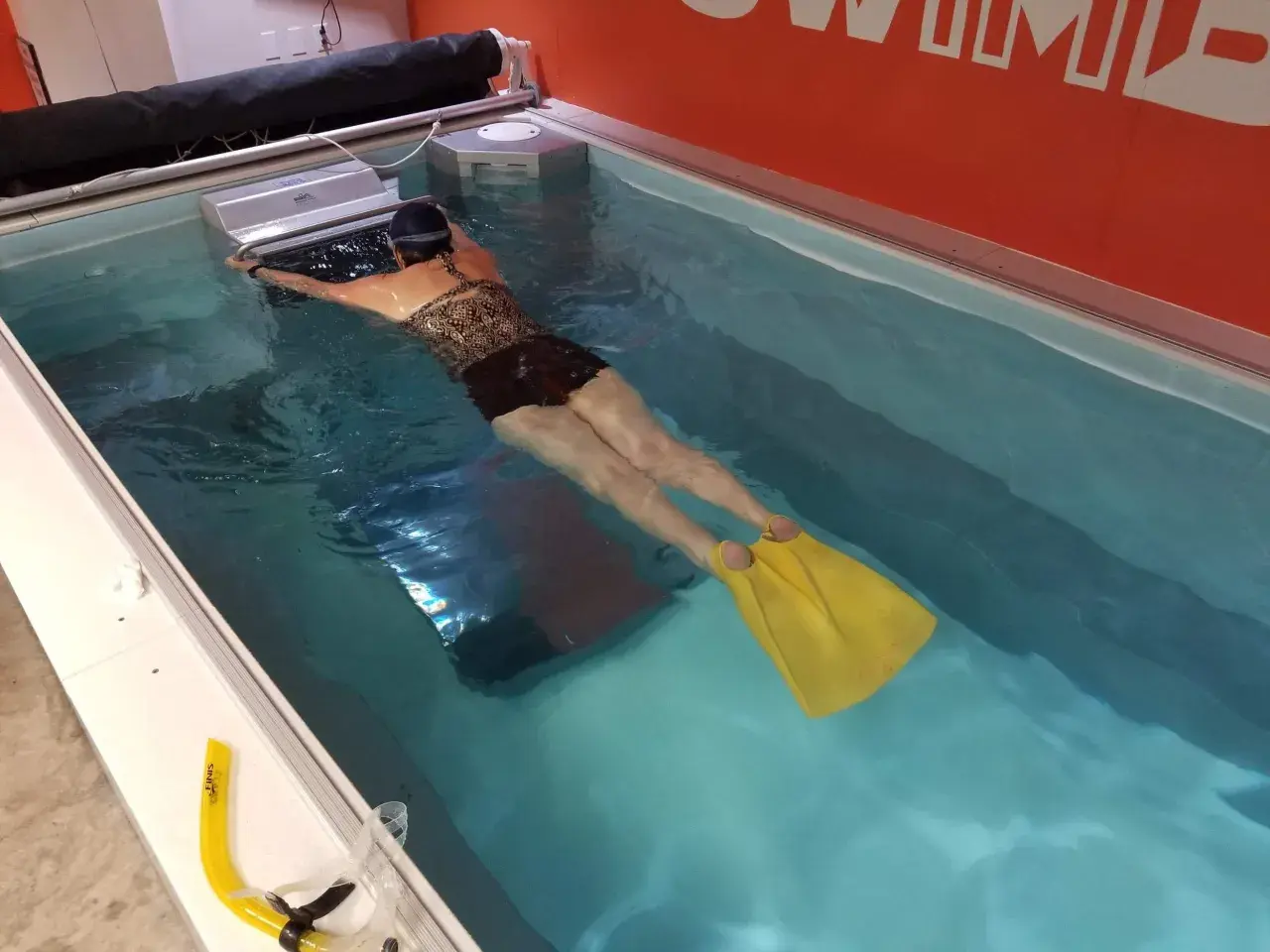
Leg kicking is one of those details that looks simple until you try to make it fast, relaxed, and repeatable across different strokes. In swimming, the legs do more than add speed: they hold the body line, help the hips stay high, and keep the rhythm working when the arms start to tire. This guide breaks down what the kick actually does, how it changes from freestyle to breaststroke and butterfly, and which drills are worth the time in a real pool session.
The kick matters most when it keeps the body long and the rhythm steady
- Front crawl and backstroke use a compact alternating kick; the best version is small, continuous, and relaxed.
- Breaststroke relies on the legs more than the arms for propulsion, so timing matters as much as power.
- Butterfly needs hip-driven undulation, not a knee-led bicycle motion.
- Kickboards, side kicking, streamline work, and vertical kick sets are the quickest ways to improve feel.
- If the kick gets bigger as you fatigue, the problem is usually balance or timing, not effort.
What the kick really does in the water
I usually explain the kick as having three jobs. First, it creates propulsion. Second, it keeps the body stable so the arms can work against a cleaner line of water. Third, it helps the stroke stay timed and connected, especially when breathing or turning starts to disturb the rhythm.
That is why a weak kick does not just make a swimmer slower. It often makes the whole stroke look messy, because the hips sink, the shoulders start compensating, and the arms waste energy trying to hold everything together. Swimming.org’s front crawl coaching guidance, for example, favours a small, continuous kick with relaxed ankles rather than a big up-and-down motion, and that principle carries through almost every pool stroke I teach.
Once you see the kick as part of balance and timing, the next step is understanding that each stroke uses the legs in a different way.
How each stroke uses the legs differently
The biggest mistake I see is treating every kick like the same movement with a different name. The legs do not work that way in swimming. Each stroke asks for a different rhythm, a different body angle, and a different amount of leg contribution.| Stroke | Kick pattern | What it should do | Common trap |
|---|---|---|---|
| Front crawl | Alternating flutter kick | Keeps the body long, supports rotation, and helps the hips stay near the surface | Too much knee bend or a wide, bicycle-like action |
| Backstroke | Alternating flutter kick | Maintains balance on the back and supports a steady body line | Kicking from the knees instead of the hips and arching the lower back |
| Breaststroke | Whip or frog kick | Provides most of the propulsion and sets the timing for the full stroke | Drawing the knees too far forward or letting the kick open too wide |
| Butterfly | Dolphin kick | Drives the body wave from the hips and supports the arm recovery | Trying to kick from the knees only, which makes the stroke heavy and choppy |
| Starts and turns | Underwater flutter or dolphin kick | Preserves speed through the streamline before the breakout | Rushing the breakout and breaking the line too early |
For front crawl, I keep coming back to one simple cue: small, quick, and steady usually beats large and dramatic. That is also why sprint swimmers can afford a stronger 6-beat or 8-beat rhythm, while distance swimmers normally back the rate down and protect their energy for the rest of the race.
With the stroke differences clear, the real work is learning how to build a cleaner kick from the hips down, not from the knees up.How I build a better kick from the hips down
When I am coaching technique, I look at three things first: body line, ankle mobility, and kick timing. If one of those is off, the swimmer can usually kick harder and still go nowhere faster.- Set the line first - a long body position reduces drag before the legs even move.
- Let the hips lead - the kick should start from the upper leg and pelvis, not from a frantic knee snap.
- Soften the ankles - relaxed ankles help the feet act like fins rather than rigid plates.
- Match the size to the distance - sprint work needs more kick rate, while longer swims usually need a quieter pattern.
Front crawl and backstroke usually reward a narrow, efficient flutter. Breaststroke asks for a more technical leg shape: heels draw up, knees stay controlled, feet turn out, and the finish comes back to a tight streamlined position. Butterfly is different again, because the legs work as part of a wave. If the downbeat is coming mainly from the knees, the swimmer usually feels heavy. If it starts from the hips and core, the stroke feels much smoother.
That set-up matters because good mechanics are easier to feel in the right drill than in the full stroke, which is where the next section earns its place.

Drills that translate into better speed
I use drills to make the kick easier to feel, not harder to survive. The best ones expose the weak link quickly, so you know whether the issue is body position, ankle stiffness, or timing.
- Streamline kick on the front or back - do 4 x 25 m with a tight line and relaxed ankles. If the body starts to fold, the kick is probably too big.
- Side kick - swim 4 x 25 m on each side with one arm extended. This teaches balance and helps freestyle rotation without letting the legs wander.
- Vertical kick - work 4 x 20 to 30 seconds. If you sink quickly, shorten the interval before chasing more power.
- Kickboard work - use 4 x 50 m at an easy to moderate pace when you want to isolate the legs. Swimming.org’s coaching materials note that kickboards are commonly used for practising leg action, and that is exactly how I treat them too.
- Underwater push-offs - do 6 strong push-offs with 5 to 10 m underwater kicking. This is where streamline and timing show up immediately.
- Light fin sets - use 4 x 25 m if you need help feeling ankle action. I treat fins as feedback, not a fix.
The best drill is the one that gives you information. If a swimmer only looks good with a kickboard but falls apart in normal swimming, the drill has become a crutch instead of a tool.
The mistakes that waste energy fastest
Most kick problems are not mysterious. They are usually the same handful of errors repeating in different clothes. I see them enough that I can usually predict them before the swimmer finishes the length.
| Mistake | What it does | Better cue |
|---|---|---|
| Big flutter kick | Creates drag and lifts water instead of moving the body forward | Make the motion smaller and quicker |
| Stiff ankles | Turns the feet into brakes instead of useful surfaces | Relax the ankles and lengthen the toes |
| Kicking from the knees only | Loads the front of the legs and usually lowers the hips | Think hips first, knees second |
| Head lifting to breathe | Pushes the legs down and breaks the body line | Breathe with rotation, not by lifting |
| Over-opening the breaststroke kick | Creates a lot of drag for very little gain | Keep the knees controlled and finish tight |
| Ignoring pain signals | Turns a technique issue into a joint or tendon issue | Reduce range, reduce volume, and get the movement checked |
Front crawl has its own trap too: swimmers often think a stronger kick means a bigger kick. In reality, the opposite is usually true. The cleaner the line, the more the feet can work without fighting the water.
That balance between effort and economy is what decides when to push harder and when to back off.
When to push the kick harder and when to ease off
In races, starts and turns deserve more leg speed because that is where free momentum can be preserved. In sprint freestyle and backstroke, a higher kick rate can help hold body position and support turnover. In butterfly, the dolphin kick is part of the stroke’s rhythm, so it cannot be treated as optional. Breaststroke is the exception that proves the rule: the kick is the main engine, so timing and shape matter more than simply adding power.
For longer swims, open-water work, or any session where fatigue is already creeping in, a smaller and steadier kick often gives better results. If the kick becomes frantic, the rest of the stroke usually pays the price. That is why I ask swimmers to notice what happens when they reduce the kick slightly: if the whole stroke collapses, the issue is probably not leg strength alone, but body position and timing.
Aquatics GB’s injury-prevention guidance also points to mobility, stability, and strength work around ankle plantarflexion, hip extension, and knee extension. I like that because it matches what good swimmers already feel in the water: the best kick is not only trained in the pool, it is supported by the joints and movement quality around it.
If kicking causes knee or hip pain, especially in breaststroke, I would not force more volume into it. I would clean up the shape first and keep the range honest.
A simple weekly kick routine that actually carries into the full stroke
When I want kick work to transfer, I keep the session short, specific, and repeatable. You do not need a huge volume to get a real benefit; you need enough quality to notice whether the movement is improving.
- Spend 5 minutes on ankle circles, calf raises, and hip mobility before the pool set.
- Do 4 x 25 m streamline kick on the front, resting 20 to 30 seconds between efforts.
- Do 4 x 25 m side kick, with 2 lengths each side.
- Do 4 x 20 seconds vertical kick, resting 30 seconds between rounds.
- Do 4 x 25 m stroke-specific kick, one each for front crawl, backstroke, breaststroke, and butterfly or dolphin kick.
- Finish with 4 x 50 m easy swim, keeping the same body line you just practised.
If you only have one short slot in the week, I would rather see you do that routine properly than grind through a long kick set with no attention to shape. The fastest improvement usually comes from shrinking the kick until it stays quiet, then building pace without losing the line.
That is the standard I use: compact, balanced, and specific to the stroke in front of you. Once the legs stop fighting the water, the rest of the swim usually becomes easier to hold together.