Pool water and contact lenses are a bad mix, even when the water is heavily chlorinated. The short answer to can you wear contacts in the pool is no, not safely, because water can carry microbes and a lens can trap them against the cornea. In this article I explain the real risks, what to do if you still need vision in the water, and which alternatives make pool days easier without gambling with your eyes.
What matters most before you jump in
- Best practice: take contact lenses out before swimming.
- Main risk: pool water can carry germs that get trapped behind the lens.
- Chlorine is not a free pass: it does not make water sterile.
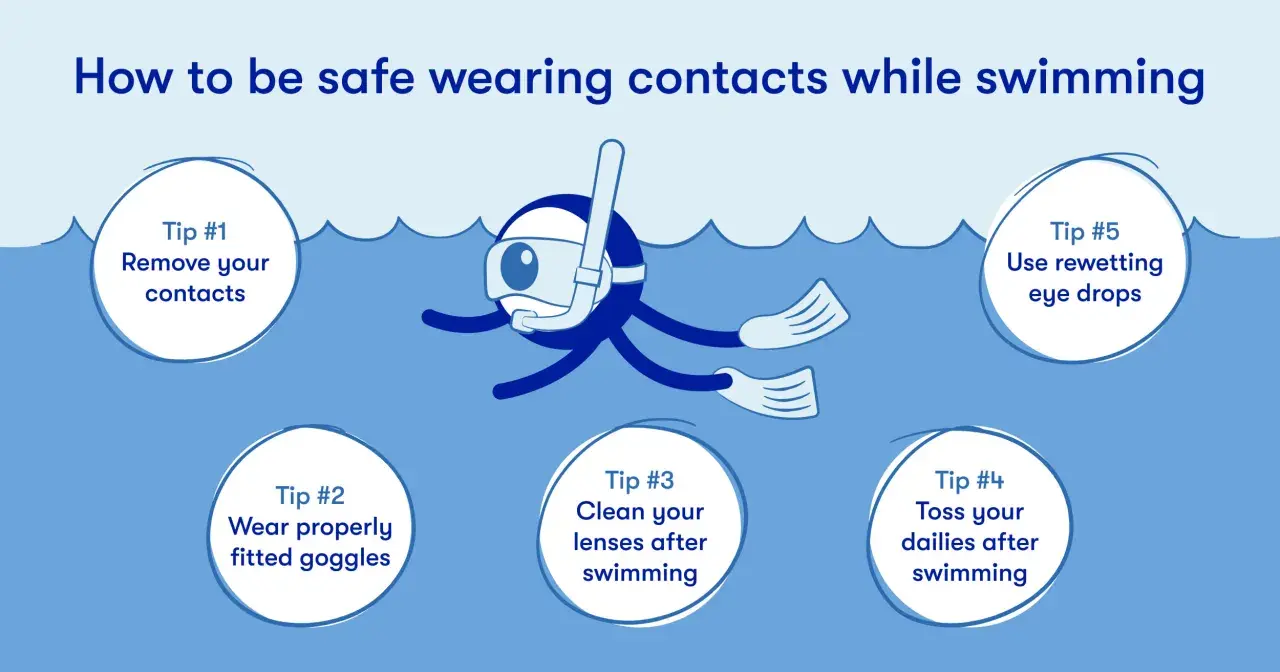
- Least-bad backup: daily disposables with very tight goggles, then throw the lenses away after the swim.
- Best long-term fix: prescription swimming goggles or another vision correction that stays out of the water.
- Watch closely after exposure: pain, redness, blur, light sensitivity, or discharge means get help fast.
Why pool water and contacts are a poor match
I would not trust pool water just because it looks clear. Contact lenses soak up water, which changes how they sit on the eye, and they also act like a small sponge that can hold on to contaminants. Chlorine helps keep a pool sanitary, but it does not make the water sterile, and it does nothing for the water that gets trapped directly against the lens and cornea.
The problem is not limited to swimming pools either. The same logic applies to hot tubs, showers, and any water that can reach the lens surface. When a lens gets wet, the eye loses part of its natural barrier, and that is exactly where infection risk starts to climb.Once that mechanism is clear, the next question is what can actually go wrong if a lens gets wet.
What can happen if your lenses get wet
The common outcome is simple irritation: stinging, blurry vision, a lens that shifts around, or a scratchy feeling that makes it hard to keep swimming comfortably. That alone is reason enough to avoid the habit, especially if you rely on your lenses for training sets, open turns, or keeping a line on the wall.
The more serious concern is infection. Acanthamoeba is a microscopic organism found in water and soil, and the eye specialists worry about it here because it can lead to Acanthamoeba keratitis, a rare but potentially sight-threatening corneal infection linked to water exposure and contact lens wear. I do not say that to scare people; I say it because it is the complication that changes a casual pool habit into a medical problem that can take months to settle.
- Redness that does not settle after the swim
- Pain or a feeling that something is stuck in the eye
- Blurred vision or reduced sharpness that lingers
- Light sensitivity or tearing that feels out of proportion
- Discharge or worsening irritation
If those signs show up, I would treat them as a same-day eye problem, not as normal post-swim discomfort. With the risk in view, the safest habits become much easier to justify.
The least risky way to swim if you rely on contacts
For the question can you wear contacts in the pool, my answer is still no. If I had to rank the options, I would put no lenses in the water at the top, then prescription swim goggles, and only then the awkward backup of daily disposables with very tight goggles if there is absolutely no other way to get through a session.
Why daily disposables? They remove the whole cleaning-and-storage chain from the equation. If water gets on them, you can discard them immediately after the swim instead of trying to salvage a lens that may have been contaminated. That does not make the swim safe in the strict sense, but it does make the aftermath simpler and less risky than reusable lenses.
Goggles matter here, but they are a barrier, not a guarantee. A well-fitting pair that seals properly can reduce exposure a lot; leaking goggles or repeated dives change the picture quickly. If you can avoid underwater work, even better.
That said, if you swim more than occasionally, the better answer is to change the setup rather than keep managing the risk every time you go to the pool.

Better options for regular swimmers
Once you swim more than once in a while, I think the best solution is to stop asking your lenses to survive the pool at all. Moorfields advises against swimming in contact lenses and notes that prescription swimming goggles are available, which matches what I see as the most practical setup for regular swimmers.
| Option | Why it helps | Main downside | My take |
|---|---|---|---|
| No contacts + prescription swim goggles | Clear vision in the water without exposing lenses to pool water | Needs the right fit and the right prescription | Best long-term choice |
| No contacts + regular goggles | Protects the eyes and keeps water out | Vision may still be too blurry for lane work or pace clocks | Fine if your prescription is mild |
| Daily disposables + tight goggles | Useful as a backup when you cannot avoid wearing lenses | Still depends on a perfect seal and quick disposal after the swim | Acceptable only as a fallback |
| Reusable contacts in the pool | Convenient on paper | Highest contamination risk and the most annoying cleanup | Not the route I would choose |
For people who train frequently, prescription goggles usually win because they remove the weakest point in the whole chain: a soft lens that can hold water, germs, and chlorine against the eye. I also like the fact that they keep the pre- and post-swim routine simple; you are not juggling lenses, cases, or solution in a wet changing room.
That leaves the cleanup question for the unlucky day when water gets in anyway.
What to do if you already swam in contacts
If a lens has definitely been exposed to pool water, I would not keep wearing it through the day and hope for the best. The CDC says water and contact lenses are a bad combination and advises removing them as soon as possible; after that, throw away daily disposables or disinfect reusable lenses overnight before wearing them again.
- Leave the pool, then remove the lens as soon as you can.
- Throw away daily disposables. Do not try to re-use them.
- If the lenses are reusable, clean and disinfect them properly before any future wear. I would also be careful with the case and solution, because tap water should never be involved.
- Watch for redness, pain, blur, light sensitivity, or discharge over the next hours and days.
- Get same-day eye care if anything feels off.
If you are not sure whether the lens or case was contaminated, I lean conservative: replace what you can and do not gamble on a lens that is cheap compared with your cornea. That conservative mindset leads neatly to the last thing I want swimmers to think about before they pack their kit.
The pool routine I recommend to most contact lens wearers
My practical routine is boring, and that is exactly why it works: glasses or prescription goggles for vision, contact lenses kept out of the water, and a spare plan for the walk from the locker room to the car. If you need correction after the swim, put fresh lenses in only after your face is dry and your hands are clean, and never use tap water to rinse anything.
- Pack prescription swim goggles if you swim regularly.
- Keep an ordinary pair of glasses in your bag for poolside use.
- Use daily disposables only as a fallback when you truly cannot avoid lenses.
- Bin any disposable lens that has been in the water.
- Take pain, redness, blur, or light sensitivity seriously.
The cleanest answer is still the simplest one: keep contacts out of the pool and choose eye correction that is designed to handle water, not fight it.
