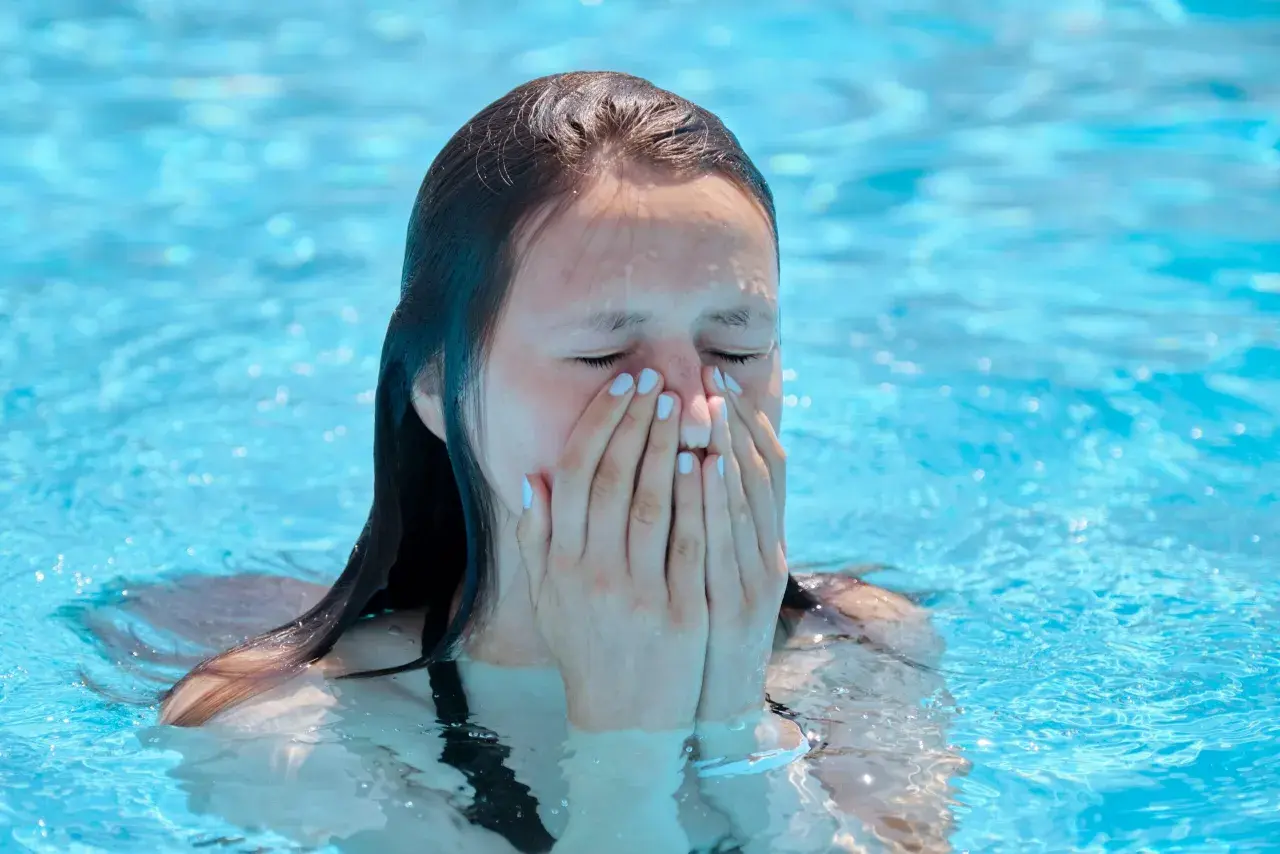
Pool sneezing is usually less about a true allergy and more about irritated nasal passages, chloramines, or an underlying rhinitis problem. When chlorine allergy sneezing starts after a session, the reaction is usually an irritant pattern rather than a true immune allergy. This article explains what is happening, how to tell pool irritation from hay fever or asthma, and which practical steps can keep your training on track.
What matters most before you blame chlorine
- Most pool-related sneezing is irritation, not a true chlorine allergy.
- Indoor pools with weak ventilation and a strong chemical smell are the biggest trigger for sensitive noses.
- If sneezing comes with wheeze, chest tightness, or shortness of breath, think beyond the nose.
- Saline rinses, showering, and better pool choice usually help more than guessing at random remedies.
- If symptoms affect sleep, training, or everyday life, a GP review is sensible.
Why the nose reacts even when this is not a true allergy
I usually start with the simplest explanation: chlorine is a disinfectant, but the nose often reacts to irritation rather than to an allergy. The ACAAI notes that you cannot really be allergic to chlorine in the usual sense; what swimmers feel is more often sensitivity, irritant rhinitis, or another airway issue that the pool exposes. That distinction matters because it changes the fix. If the lining of the nose is simply irritated, the answer is rarely “take more antihistamines and hope.” It is more often about rinsing the nose, reducing exposure to the irritating air, and checking whether the real trigger is chloramines, poor ventilation, or an underlying problem such as allergic rhinitis or exercise-related asthma.In practice, I also pay attention to timing. Symptoms that appear quickly during or right after a swim point me towards pool irritation. Symptoms that show up away from the pool as well make me think more broadly about hay fever, dust mites, or non-allergic rhinitis. That leads neatly into the next question: what does this reaction actually look like?
How to tell pool irritation from hay fever, sinus issues, or asthma
The fastest way to avoid self-diagnosing badly is to compare the pattern, not just the symptom. The NHS describes allergic rhinitis as sneezing, a blocked or runny nose, itchy eyes, and other allergy-type symptoms that usually appear soon after exposure to a trigger. Non-allergic rhinitis is different: the nose is irritated, and sneezing can happen without any true allergy behind it.
| Pattern | What it usually suggests | Typical clues | First move |
|---|---|---|---|
| Sneezing starts in or just after an indoor pool session | Irritant rhinitis from pool air or chloramines | Strong chemical smell, symptoms are worse in crowded lanes or poorly ventilated pools | Try saline rinse, better ventilation, and a different pool |
| Sneezing also happens at home, in spring, or around dust | Allergic rhinitis | Itchy eyes, itchy nose, seasonal pattern, other known allergies | Pharmacist advice, then GP if it persists |
| Nose symptoms plus cough, wheeze, tight chest, or breathlessness | Asthma or exercise-induced bronchoconstriction | Symptoms build during hard sets or shortly after stopping | Medical review, especially if this is new or worsening |
| Blocked nose with fever, facial pain, or thick mucus | Infection or sinusitis | Feeling unwell, symptoms last well beyond the pool session | Do not assume chlorine is the cause |
If I had to reduce it further, I would say this: pool irritation usually stays tied to the pool, while allergy and asthma tend to travel with you. Once you see that pattern, the trigger becomes much easier to manage.

What in the pool air is actually setting it off
In many indoor pools, the problem is not the water alone but the air just above it. Chlorine reacts with sweat, urine, skin oils, and cosmetics to form chloramines, and those by-products are what usually produce the sharp pool smell and irritate the nose. A heavily used pool with average ventilation can feel much harsher than a quieter, better-managed one.
I see this most often in evening lane sessions, school pool times, and compact leisure centres where the air hangs around. If the smell hits you as soon as you walk in, that is worth noticing. A strong chemical smell does not automatically mean the pool is “more clean”; in many cases, it means the air has more irritating by-products in it.
Humidity and temperature also matter. Warm, enclosed air tends to make the irritation feel worse, and repeated deep inhalation during training can push a sensitive nose over the edge. That is why two swimmers can use the same pool and have very different experiences: the water may be identical, but the breathing pattern, session length, and exposure time are not.
Once you understand the trigger, the useful question becomes simple: what can you change before giving up on the pool entirely?
What to do before, during, and after a swim
For most swimmers, the practical win is not one miracle fix. It is a small stack of habits that lowers the irritation enough for normal training to feel normal again.
Before you get in
- Shower before swimming. It helps reduce the sweat, oils, and cosmetics that end up reacting in the pool.
- Choose a better session time if you can. Off-peak swims are often easier on the nose than crowded sessions.
- Try a different pool or an outdoor option if one is available. Better ventilation can make a bigger difference than people expect.
- Use a saline nasal spray or rinse if your nose is already reactive. The NHS recommends salt-water nasal rinses for rhinitis, and I think this is one of the safest first steps to try.
While you are swimming
- Use well-fitting goggles if water getting into your nose seems to start the sneezing.
- A nose clip can help some swimmers, especially in drills, turns, or easy aerobic sets, but it is not essential for everyone.
- If hard efforts seem to worsen symptoms, shorten the most intense work for a week and see whether the reaction is tied to breathing harder rather than to the pool itself.
Read Also: Can You Wear Contacts in the Pool? The Real Risks & Safe Swaps
After the session
- Shower straight away and change out of damp kit as soon as possible.
- Rinse the nose again with saline if symptoms are still active.
- Do not overuse decongestant nasal sprays; if you use them, do not keep them going for more than a week.
- If your skin is also dry or itchy, moisturise after swimming so the irritation does not spread beyond the nose.
Those steps are boring, but they work better than most people expect. If the sneezing settles with a rinse and a better session choice, that tells you the problem is probably irritant-driven rather than a major allergy.
When it is worth seeing a GP rather than pushing through
There is a point where “just manage it” stops being sensible. The NHS advises seeing a GP if your symptoms are getting worse, affecting sleep or everyday life, your asthma is worsening, you are not sure what is causing the problem, or pharmacy treatments are not helping. I would add one more practical rule: if the nose symptoms keep showing up even when you are nowhere near the pool, it is time to stop blaming chlorine by default.
Get checked sooner if the reaction includes wheezing, chest tightness, shortness of breath, facial swelling, hives, or a feeling that breathing is genuinely difficult. That is no longer a simple pool irritation story. A clinician may look at allergic rhinitis, non-allergic rhinitis, asthma, or exercise-induced bronchoconstriction, and that is exactly the right direction if the symptoms are interfering with training.
If you do speak to a GP or pharmacist, be specific. Tell them when the sneezing starts, how long it lasts, whether it happens in every pool, and whether you also get itchy eyes, cough, or chest symptoms. A clear pattern is much easier to work with than a vague “the pool makes me feel awful.”
The swim-day adjustments I would test first over the next two weeks
If a regular swimmer asked me how to handle this without overcomplicating it, I would suggest a two-week test rather than a dozen changes at once. Keep the variables simple: use the same pool if possible, note the session time, and change only one thing at a time so you can see what really helps. In my experience, that is the fastest way to find out whether the issue is the air, the water, or the way you are training.
Start with the basics: shower before and after, use a saline rinse, and avoid the most crowded lanes. If symptoms ease, keep those habits. If they do not, try a better-ventilated pool or an outdoor session and compare. When the same nose reacts badly in one venue but not another, the pool environment has probably told you most of what you need to know.The swimmers who handle this best are usually the ones who treat it as a training variable, not a reason to quit. Once the nose is calmer, breathing rhythm improves, the session feels less distracting, and the pool goes back to being a place to train rather than a place to endure.