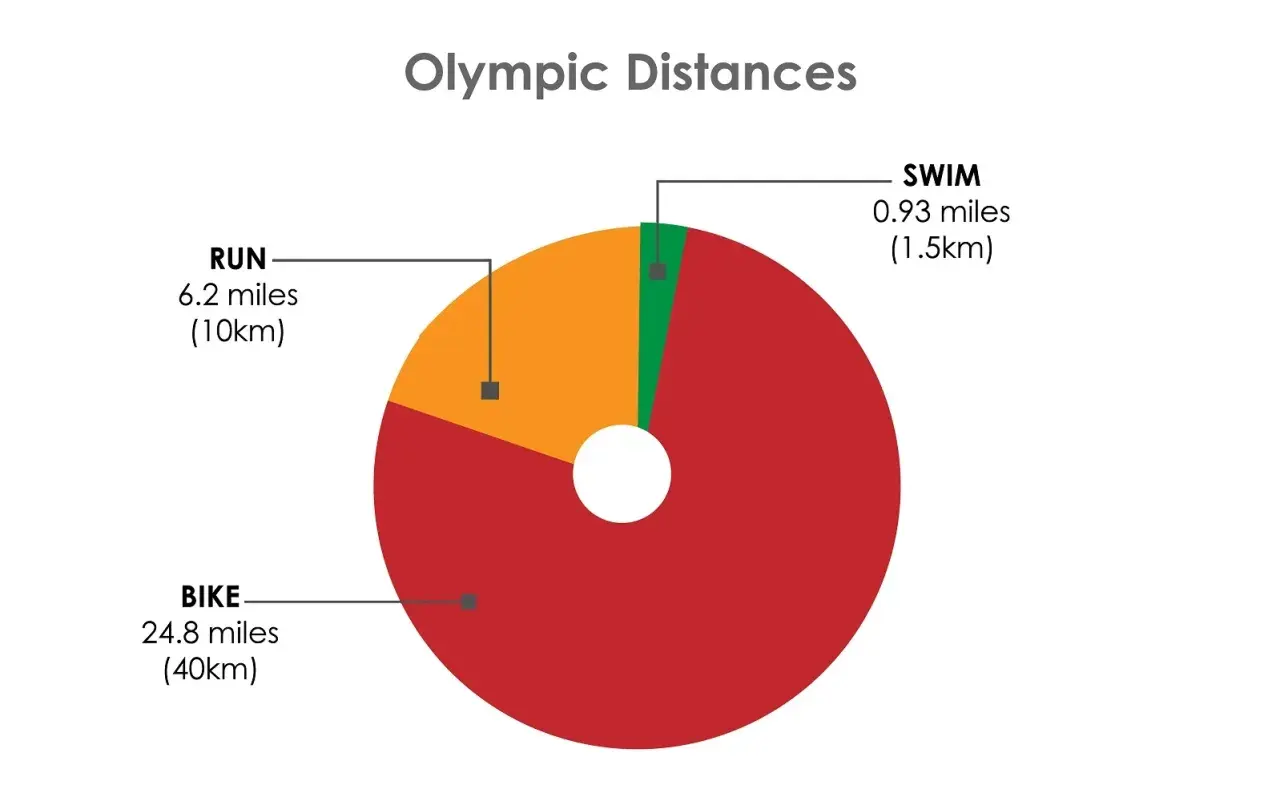
An olympic length triathlon sits in a useful middle ground: it is long enough to punish weak pacing, but short enough that a strong amateur can race it seriously without turning the season into a full-time project. In this article, I break down the standard distance, how it is usually raced in the United States, what kind of training actually prepares you for it, and which gear is worth paying attention to. I also cover pacing mistakes that cost time quickly, especially for athletes who come from swimming or running and underestimate the bike.
The standard-distance version rewards balance, not one strong leg
- The race is 1.5 km swim, 40 km bike, and 10 km run, for a total of 51.5 km.
- In the U.S., many age-group races are non-draft, so the bike leg rewards steady power more than pack tactics.
- A realistic build period is often 8 to 20 weeks, depending on your current fitness and experience.
- The swim rewards calm open-water skills, clean breathing, and smart sighting more than raw fitness alone.
- The bike is where many first-timers lose the most time by riding above their sustainable effort.
- The run matters most when you arrive at it controlled rather than desperate.
What the standard distance actually includes
World Triathlon defines the standard-distance race as a 1.5 km swim, 40 km bike, and 10 km run. In everyday language, that is the race most people mean when they talk about the Olympic-distance format. It is long enough to feel like a real endurance test, but short enough that you can finish with one focused training block instead of years of marathon-style specialization.
I like this distance because it reveals weaknesses cleanly. A shaky swim shows up early, poor bike pacing shows up before the final transition, and a rushed first kilometer of the run can undo a strong first half of the day. That makes it a very honest race, which is exactly why so many age-group athletes return to it season after season.
| Segment | Distance | What it demands |
|---|---|---|
| Swim | 1.5 km | Open-water composure, efficient breathing, and sighting |
| Bike | 40 km | Steady power, disciplined pacing, and good position |
| Run | 10 km | Controlled legs, aerobic strength, and patience early on |
That structure is the reason the race has become the benchmark for a huge part of the sport, and it leads directly into the next question: how does it compare with the shorter and longer options people are usually weighing against it?
How it compares with sprint and long-course racing
If you are deciding where to spend your training time, it helps to see where this format sits in the triathlon ladder. A sprint race is quicker and more explosive. A 70.3 asks for a much deeper endurance base. The standard-distance race sits between them, which is why it is such a smart target for athletes who want a serious challenge without living in long-course fatigue.
| Format | Swim | Bike | Run | Best for |
|---|---|---|---|---|
| Sprint | 750 m | 20 km | 5 km | First-time racers, speed-focused athletes, and busy schedules |
| Olympic / standard | 1.5 km | 40 km | 10 km | Athletes who want balance, pacing skill, and a full but manageable challenge |
| 70.3 | 1.9 km | 90 km | 21.1 km | Racers with a stronger endurance base and more weekly training time |
| Full-distance | 3.8 km | 180 km | 42.2 km | Experienced long-course athletes with substantial training capacity |
For many swimmers, this is the most appealing race category because the swim is meaningful without being overwhelming. You still need efficiency in the water, but you do not have to build your whole season around ultra-long durability. That makes the next issue especially important: the rules you race under can change the feel of the bike leg more than the distance itself.
How draft rules change the race in the United States
In the United States, many age-group races are run as non-draft events, and that changes the entire character of the bike. You are not trying to hide in a pack or sit in someone else’s slipstream for long stretches. Instead, you ride your own effort, hold legal spacing, and focus on smooth power delivery so you still have running legs when you reach T2.
Draft-legal racing is different. It is more tactical, more crowded, and often more chaotic on the bike because positioning matters nearly as much as raw fitness. That means the same distance can feel very different depending on the race rules, course width, and field size. If I were reading an athlete guide, I would pay close attention to drafting rules before I look at almost anything else.
USA Triathlon event labels and local race briefs usually tell you what kind of bike leg you are signing up for, and that matters because a non-draft race rewards rhythm while a draft-legal one rewards awareness and positioning. Once the rules are clear, training becomes a lot easier to organize.
How I would train for it
If I were building toward a first standard-distance race, I would not make training complicated. I would make it consistent. For an already active athlete, 8 to 12 weeks is often enough to sharpen race-specific fitness. If you are starting from a lower base, give yourself 12 to 20 weeks so the work stays controlled instead of rushed.
A practical week usually looks like this:
- 2 to 3 swims with at least one session focused on technique and one on sustained race-pace work.
- 2 bikes, one aerobic and one with tempo or threshold intervals.
- 2 runs, one easy aerobic session and one that includes race-pace segments.
- 1 brick workout, meaning a bike followed immediately by a short run, so your legs learn the transition.
- 1 strength or mobility session to support posture, hips, and shoulder stability.
- 1 real recovery day or an easy swim-only day if fatigue is building.
For the swim, I would focus on relaxed exhalation, head position, and open-water sighting. That is where a lot of athletes leak time without realizing it. For the bike, I would train steady effort rather than chase hero watts. For the run, I would practice holding back for the first 10 to 15 minutes, because the race usually rewards restraint more than bravado. The gear you choose should support that kind of control, which is the next place many athletes either overbuy or underthink.

Gear that matters more than people think
I am selective about gear for this race because the best equipment is usually the stuff that reduces friction, not the stuff that looks impressive. A good setup should make the swim calmer, the transitions cleaner, and the bike safer. Anything beyond that is secondary unless you are already racing near your limit.
| Item | Why it matters | What I look for |
|---|---|---|
| Goggles | They decide how calm you feel in open water | A comfortable seal, spare pair, and lenses suited to the light |
| Wetsuit | It can add buoyancy and warmth when race rules allow it | Good shoulder mobility and a fit that does not trap water |
| Tri suit | It saves time in transitions and helps avoid chafing | Snug fit, breathable fabric, and pockets that do not bounce |
| Helmet | It is mandatory and directly affects safety | Comfort, airflow, and a fit you already trust on long rides |
| Running shoes | They determine how the final 10 km feels under tired legs | Predictable fit, quick setup, and a race-day lacing plan |
| Nutrition | It keeps energy stable across the bike and run | Simple products you have already practiced in training |
My rule is simple: if a piece of gear has not been tested in training, it does not belong on race day. That is especially true for goggles, wetsuits, and nutrition. The next thing that matters is what happens when the gun goes off, because this distance is often decided by discipline rather than peak speed.
Pacing and race-day mistakes I see most often
Most people do not fail this race because they are unfit. They fail because they spend too much energy in the wrong place. A strong first 400 meters in the swim feels useful, but it often turns into a costly spike. The same is true on the bike, where many athletes ride above their sustainable effort simply because the course feels smooth and the legs still feel fresh.
| Mistake | Better approach |
|---|---|
| Starting the swim too hard | Settle the first few minutes, find rhythm, and sight without lifting your head constantly |
| Riding above control on the bike | Hold back early, keep effort smooth, and make the final third of the ride feel repeatable |
| Ignoring nutrition until the run | Fuel on the bike first, then take small, easy-to-digest amounts before you are depleted |
| Attacking the first kilometer of the run | Begin at a controlled pace that feels almost too easy for the first 5 to 10 minutes |
| Wasting time in transitions | Practice your layout, rehearse mounting and dismounting, and keep your setup minimal |
The right next step for a lot of athletes
I think this distance works best for athletes who want a real test without an enormous training footprint. If you can already swim 1,500 meters continuously, ride 40 kilometers comfortably, and run 10 kilometers without crashing afterward, you are in a very good place to start a focused build. If the swim is your limiter, that is not a reason to avoid the race. It is a reason to spend the next few weeks on technique, open-water confidence, and relaxed aerobic sets.
- Choose this race if you want balance across all three disciplines.
- Choose it if you like the idea of racing hard without committing to half-iron or full-iron volume.
- Choose it if you want a distance where swim efficiency and bike discipline both matter.
- Choose something shorter first if you cannot yet hold calm form in open water.
The athletes who do best here are rarely the ones chasing the fanciest kit. They are the ones who arrive with a clear swim plan, a controlled bike, and enough respect for the final 10 km to keep the first half of the run easy. If you build around that logic, the standard-distance race stops feeling intimidating and starts feeling very manageable.