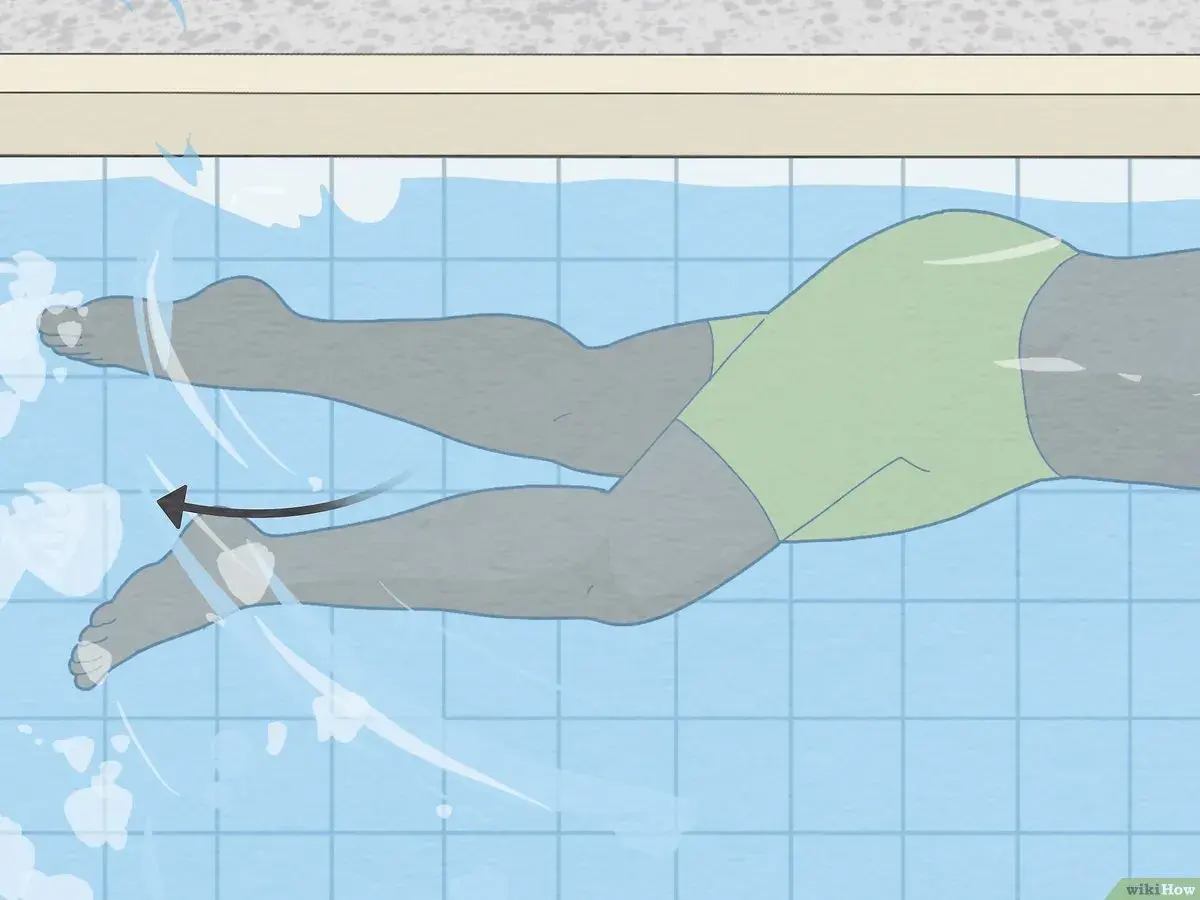
The kick works best when it keeps the body long and quiet
- The kick should start from the hips, not from a knee-driven pedal.
- Keep the range narrow enough that the feet stay inside your body's silhouette.
- The best freestyle kick technique changes with distance and pace.
- Two-beat helps efficiency, six-beat helps speed, and four-beat sits between them.
- Short, focused drills usually fix more than long, hard kick sets.
What the kick is actually doing in freestyle
I coach the flutter kick as a balance and timing tool first. It keeps the legs from sinking, helps the body stay aligned through rotation, and makes the stroke feel connected. U.S. Masters Swimming makes a similar point: the kick may not produce most of the speed, but it holds the whole freestyle stroke together.
That is why swimmers who only try to kick harder often get nowhere. If the hips are low, the head is lifted, or the legs are tense, more effort just creates more drag. A useful kick is compact, rhythmic, and quiet enough that the water stays clean behind you. Once that idea clicks, the mechanics make much more sense.
How to move the legs without fighting the water
The cleanest kick feels like a wave running down the leg. The motion starts at the hip, the knee follows with a soft bend, and the ankle finishes the job with a loose, pointed foot. If it feels like pedaling a bike underwater, the motion is already too big.
- Start from the hip. The thigh should initiate the downbeat; the knee should not lead the movement.
- Keep the knee bend small. A soft bend is normal, but deep knee flexion drops the shin and adds drag.
- Relax the ankle. Stiff feet act like bricks; loose ankles let the foot work more like a small fin.
- Stay narrow. The feet should move within the body's line instead of sweeping wide to the sides.
- Keep the head and chest calm. A lifted head sends the hips down and forces the legs to work harder.
If you feel a big splash or a lot of tension in the thighs, the kick is probably too large. A better target is a smooth, steady pulse that barely disturbs the surface. Once the shape is right, the next decision is rhythm.
Choose the rhythm that matches the swim
I would not give the same cadence to a 50 freestyle sprinter, a 1500-meter swimmer, and an open-water triathlete. The right pattern depends on how much stability you need, how much oxygen you can spare, and whether you are chasing speed or conserving energy. As U.S. Masters Swimming notes, a two-beat rhythm often suits endurance and open-water swimming, while a six-beat rhythm is a common choice when pace and body line matter more.
| Pattern | Best use | Main advantage | Main tradeoff |
|---|---|---|---|
| 2-beat | Long swims, open water, triathlon, easy aerobic pace | Lowest leg fatigue and simplest timing | Less immediate pop and less support if body position is weak |
| 4-beat | Middle-ground training and moderate race pace | More support than 2-beat with less cost than 6-beat | Less common, so it can take time to feel natural |
| 6-beat | 50s, 100s, and fast pool work | Strongest stabilizing effect and the best speed support | Higher oxygen demand and faster leg fatigue |
The mistake I see most often is trying to force a race rhythm into every swim. If your goal is steady open-water pacing, a smaller two-beat pattern usually gives you better return on effort. If you need to hold speed through a hard pool effort, the extra leg turnover of a six-beat kick can be worth the cost. The point is not to pick the "best" pattern once; it is to match the pattern to the job.
Drills that teach the rhythm without teaching bad habits
When I want the kick to improve fast, I break it down into short drills. That keeps the swimmer honest; if the body line collapses, the drill tells you immediately.
- Side kick with one arm extended. Do 4 x 25 yards on each side. This teaches balance, a quiet head, and a narrow kick path.
- Back streamline kick. Do 4 x 15 to 25 yards. Lying on your back makes it easier to see whether the knees are overbending or the feet are crossing the line.
- Vertical kicking. Do 6 rounds of 20 seconds with 20 seconds rest. Because there is no glide, you learn quickly whether the kick is compact enough to support you.
- Single-arm freestyle. Do 4 x 25 or 4 x 50 yards with the non-stroking arm extended. This links the kick to body rotation and timing instead of treating it as a separate exercise.
- 25 kick, 25 swim. Repeat 4 to 8 times. This is the simplest way to carry the feel from the drill back into full stroke.
I also use fins sparingly. Short fins can make it easier to feel rhythm and body line, but they can hide a weak ankle or a sloppy knee bend if you lean on them too much. If the movement only looks good with equipment on, the pattern is not fixed yet.
The mistakes that slow most swimmers down
Most bad kicking problems are not mysterious. They usually come from one of five habits, and each one leaves a clear clue in the water.
| Mistake | What it causes | Quick correction |
|---|---|---|
| Kicking from the knees | Big splash, drag, and tired quads | Think hip-first and practice small kicks on your back |
| Kicking too wide | Scissoring, lost line, and side-to-side wobble | Keep the feet inside your body's shadow |
| Stiff ankles and toes | Water slips past the feet instead of being held | Do 2 minutes of ankle circles and toe-point work before swimming |
| Lifting the head to breathe | Hips sink and the kick has to work harder | Turn the head, do not lift it, and keep the breath quick |
| Trying to fix everything by kicking harder | Leg burn with little extra speed | Reduce size first, then increase rhythm |
The easiest self-check is the sound of the kick. Clean technique stays fairly quiet; sloppy technique usually makes more noise than speed. If the first ten strokes of a length feel controlled but the last ten collapse, the problem is almost always fatigue management, not effort.
What still works when your legs start to fade
The last thing I want to leave you with is practical, because the kick changes when fatigue shows up. In the second half of a set, the winning move is usually to protect body line and rhythm instead of chasing a bigger kick.
- Shorten the kick before you increase force.
- Keep the exhale steady so the chest stays relaxed.
- Let the hips stay high even if the legs feel tired.
- Use the kick as a metronome on easy and moderate swims, and save the stronger cadence for race-pace work.
That is the standard I trust most: clean mechanics first, then the smallest rhythm that still keeps the body stable. When you train the kick this way, it stops feeling like a separate leg exercise and starts functioning as part of the freestyle stroke itself.