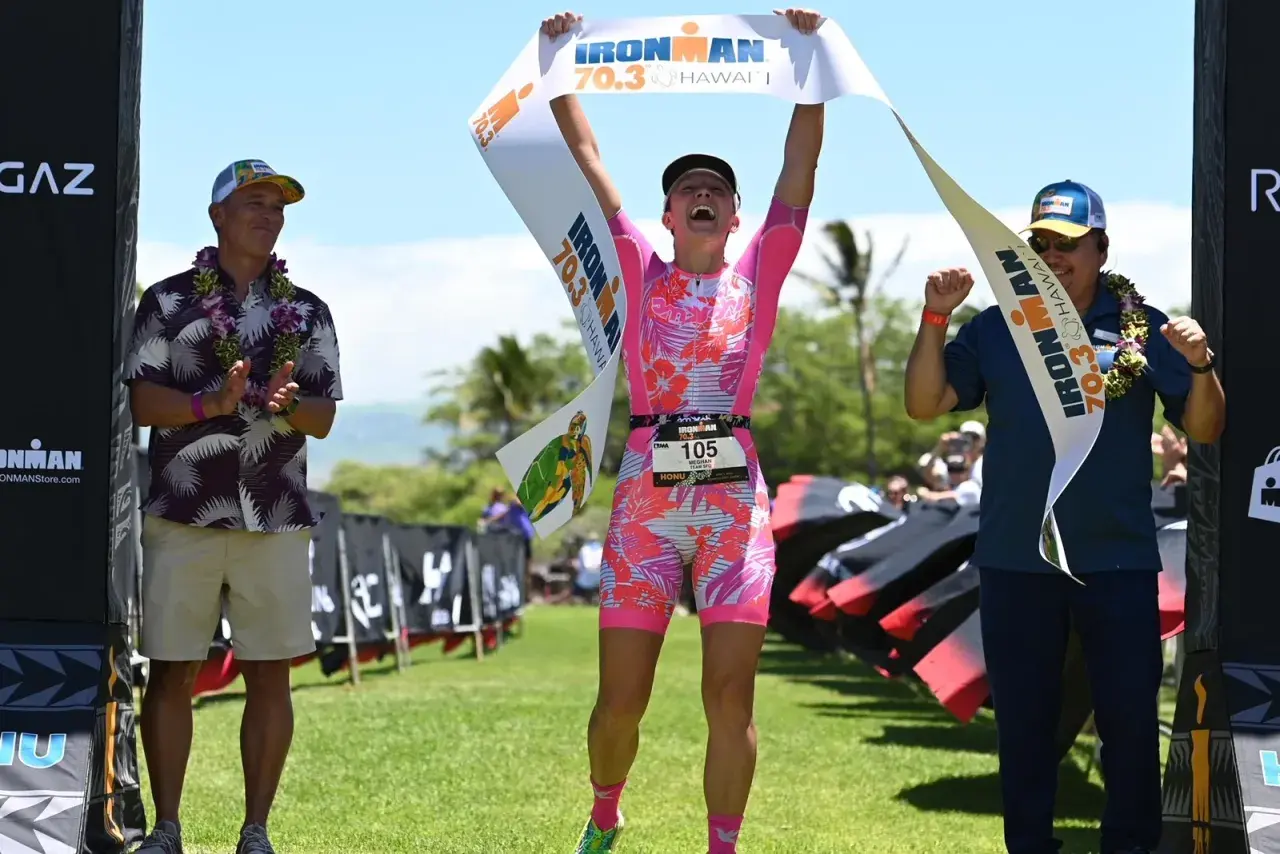
The Hawaii 70.3 race is a half-distance triathlon that looks manageable on paper and gets serious fast once you add ocean water, exposed coastal roads, and a run across lava fields. This guide covers the official course, the race-week details that matter, and the preparation choices I would make if I were racing from the UK. The point is to help you understand what makes the event different and where time is actually won or lost.
What matters most on race day
- The race covers 1.9 km of swimming, 90 km of cycling, and 21.1 km of running.
- The venue is Fairmont Orchid on the Island of Hawaii, with the swim in Pauoa Bay and the finish at Honu Pointe.
- The bike is the separator: rolling hills, exposed sections, and wind punish overpacing quickly.
- UK athletes need to plan for long-haul travel, jet lag, and a hot, early start.
- The 2026 event offered qualification slots for both Nice and Kona, which matters if you are racing for more than a finish.
What the race actually is and how far it really is
IRONMAN 70.3 is the half-distance format: 1.2 miles, or 1.9 km, in the swim; 56 miles, or 90 km, on the bike; and 13.1 miles, or 21.1 km, on the run. I like spelling that out because the number sounds friendly until you stack three disciplined efforts back to back. The official race is centred at Fairmont Orchid, with the swim start at Pauoa Bay and the finish at Honu Pointe.| Leg | Official distance | What matters most |
|---|---|---|
| Swim | 1.2 miles / 1.9 km | Open-water control, sighting, relaxed breathing |
| Bike | 56 miles / 90 km | Pacing on rolling terrain and exposed roads |
| Run | 13.1 miles / 21.1 km | Heat management and restraint in the first half |

Why the course feels bigger than the distance
The swim starts in Pauoa Bay at sunrise, which sounds beautiful because it is, but beauty is not the same as ease. From there, the bike route sends you toward the Kohala Coast and up toward Hawi, where rolling hills, lava fields, and open views leave very little shelter from wind or heat. I would not call this a course where you can bluff your way through the middle miles.
The run has the same character. It is scenic, but the scenery does not reduce the effort, and the exposed terrain on the Mauna Lani Golf Course means pacing discipline matters more than bravado. A lot of athletes lose this race without realising it because they spend matches early and then wonder why the final 10 km suddenly feel brutally long. That is why the swim deserves its own preparation.
The swim rewards calm technique
If there is one place where triathletes give away free energy in Hawaii, it is the first few minutes of the swim. I would approach it as a controlled open-water start rather than a fitness test: settle your breathing, find clean water, and resist the urge to chase the field immediately.
- Practise sighting every 6 to 10 strokes, depending on chop and glare.
- Test goggles in bright light, because sunrise glare can make a good lens choice feel like race insurance.
- Keep your exhale continuous so salt water and nerves do not spike your heart rate.
- Build a few straight, steady open-water repeats into training instead of relying only on pool speed.
- If you are less confident in rougher water, practise a reset routine for when breathing gets ragged.
A strong pool swim helps, but open-water economy usually matters more here. Once the swim feels under control, the real problem becomes the travel and preparation load, especially for anyone coming from the UK.
How I would prepare from the UK
The biggest hidden challenge for British athletes is not fitness, it is disruption. Hawaii is roughly 10 hours behind GMT and 11 hours behind British Summer Time, so if I were targeting this race from the UK I would try to arrive 5 to 7 days early if the budget allowed. That gives your body time to adjust to the time shift, recover from the flight, and settle into the race routine without forcing everything into one frantic week.
| Window | Focus | Why it helps |
|---|---|---|
| 8 to 12 weeks out | Long rides, race-pace bricks, weekly open-water sessions | Builds durability and confidence without pretending the course is flat |
| 5 to 7 days before race day | Travel, sleep, hydration, short acclimation sessions | Lets your body adapt instead of asking race week to do all the work |
| 48 hours before the start | Short swim, easy spin, light run, kit check | Keeps you sharp without carrying fatigue to the line |
Race week details that are easy to get wrong
The official race guide is strict about the practical stuff, and this is the kind of event where missing a deadline has real consequences. Athlete check-in for the 2026 race ran from Thursday, May 28, to Friday, May 29, and there was no race-day check-in. If you did not collect your packet by 4:30 pm on Friday, you were not permitted to race.
| Item | 2026 detail | Why it matters |
|---|---|---|
| Athlete check-in | Thursday, May 28 to Friday, May 29 | No check-in on race day |
| Packet deadline | 4:30 pm on Friday, May 29 | Missing it means no start |
| Mandatory briefings | Thursday at 1:00 pm and 3:00 pm; Friday at 10:00 am and 12:00 pm | Course changes, cut-offs, and weather updates are covered there |
| Race start | 6:25 am on Saturday, May 30 | Early start means early transport and nutrition planning |
| Entry requirements | Photo ID and USA Triathlon coverage or a one-day licence | Admin is non-negotiable |
There are smaller details worth respecting too. The wristband stays on during race week, shuttles do not take bikes or luggage, and transition opens at 4:30 am on race morning. I would also pay attention to the briefings, because they cover the kind of late weather-related adjustments that can change how the day feels. If you make it to the start line with that information clear, the next question is whether the race has anything bigger to offer than just a finish.
Why the finish still matters beyond the medal
The 2026 race offered slots to both the 2026 IRONMAN 70.3 World Championship in Nice, on September 12 and 13, and the 2026 IRONMAN World Championship in Kona, on October 10. That makes the event more than a scenic half-distance race for athletes chasing a bigger season goal. If you qualify, you have to claim your slot in person at the roll-down ceremony, show photo ID, and make payment on the spot.
I also think the slot structure changes how the front of the field races. Age-group winners can earn automatic spots, but the performance pool keeps the rest of the field honest, which means one strong age group can still reshuffle the broader allocation. For most athletes, that does not change the core problem, but it does explain why the last hour of the day can be so intense. The final piece is the simplest one: race the course rather than your ego.
The race-day plan I would trust on this course
For most age-group athletes, Hawaii 70.3 is less about one brilliant split and more about stacking disciplined decisions for six hours or so without wasting energy. If I were writing a race plan for this course, it would be brutally simple.
- Swim smoothly for the first 400 to 500 metres and let the field settle before you start forcing the pace.
- Ride the bike by effort, not by what the riders around you are doing on the climbs or in the wind.
- Keep the first 5 km of the run conservative, even if the legs feel suspiciously fresh.
- Drink and take fuel before you feel behind, not after the first signs of fade appear.
- Use open-water skill, pacing restraint, and calm transitions as the real performance multipliers.
If you keep those priorities straight, the Hawaiian race stops looking like a trap and starts looking like a course that rewards patience, control, and good swim-bike-run basics in equal measure.