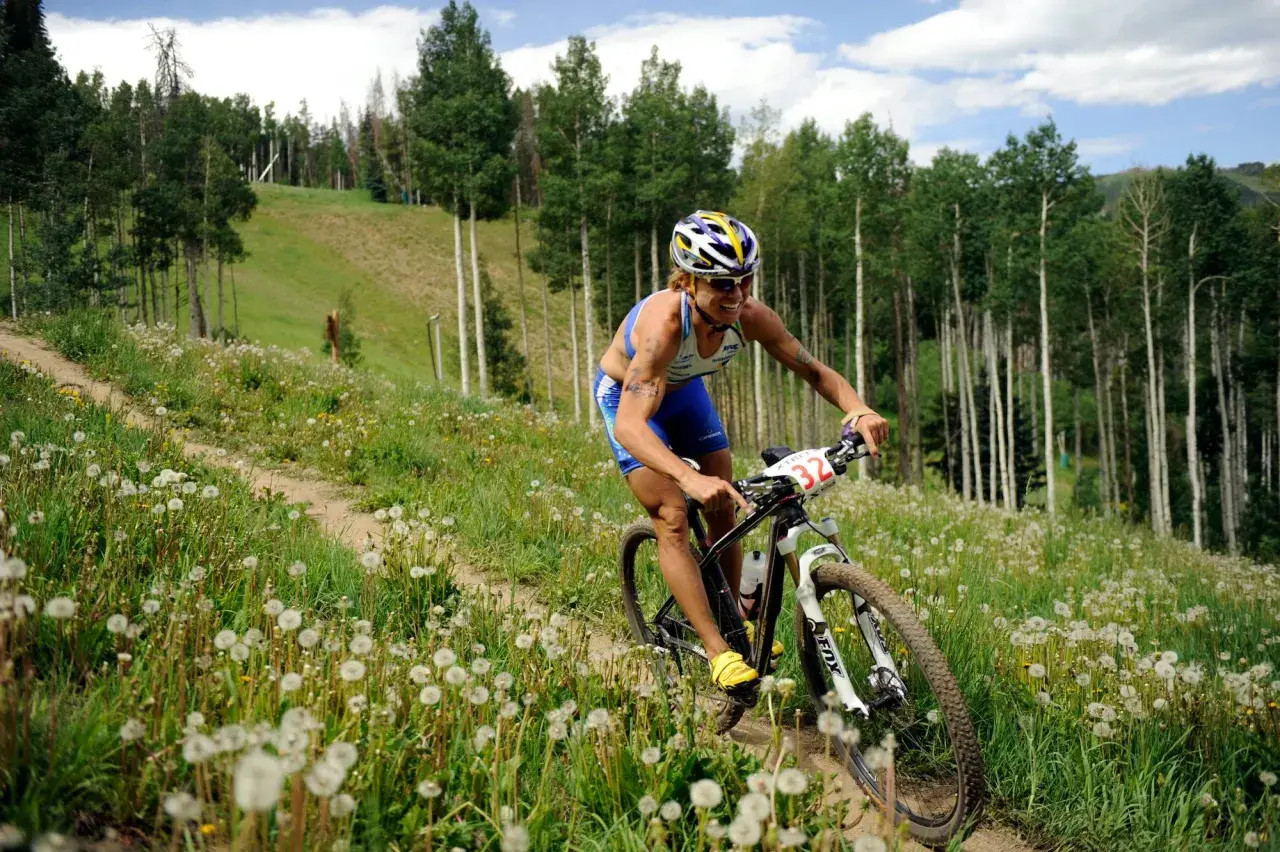
The bike leg rewards skills as much as fitness
- Off-road triathlon is usually called cross triathlon or off-road triathlon, and the bike section is often the hardest part to master.
- Technical descending, cornering, and traction control can matter more than pure power output.
- A mountain bike is the sensible baseline; a road bike is the wrong tool for a genuinely rough course.
- Training should include trail handling, open-water confidence, and short runs off the bike.
- UK championship and qualifier standards can be stricter than casual local events, so check the event rules early.
What changes when the bike leg goes off-road
In a road triathlon, the bike leg is mostly about maintaining speed. In off-road racing, I think of it as a moving problem-solving exercise. You are still trying to ride fast, but you are also reacting to loose surfaces, roots, rocks, mud, camber, and sudden gradients, often within the same minute.
| Road triathlon | Off-road triathlon |
|---|---|
| Built around smooth tarmac and steady rhythm | Built around terrain changes, short surges, and repeated braking |
| Main limiter is usually power and aerodynamics | Main limiter is usually handling, traction, and recovery from surges |
| Best bike is normally a road or tri bike | Best bike is normally a mountain bike, often hardtail or short-travel full suspension |
| Pacing is relatively even | Pacing is more elastic, with hard efforts after corners and on climbs |
| Small mistakes cost time | Small mistakes can cost time, traction, and confidence all at once |
The practical takeaway is simple: fitness helps, but it does not rescue poor technique. If you can keep the bike upright, choose clean lines, and avoid pointless panic braking, you usually gain more time than you would by chasing a slightly higher average power number. Once that distinction is clear, the course itself becomes the next thing to study.

Why the bike course changes the whole race
A technical course changes how I would prepare, because the bike leg stops being a pure endurance block and starts behaving like a series of mini-efforts. You accelerate out of corners, settle over short straights, then hit another climb or obstacle before your heart rate has fully come down. That repeated pattern is what makes off-road triathlon so punishing and, for the right athlete, so rewarding.
The skills that matter most are straightforward but easy to underestimate:
- Braking before the turn rather than inside it, so the bike stays balanced.
- Line choice through roots, ruts, and loose corners, where the smoothest path is rarely the most obvious one.
- Climbing traction, which means staying seated, keeping pressure on the tyre, and not smashing every hill in a big gear.
- Descending vision, where you look further ahead than you would on the road and let the bike flow underneath you.
- Discipline around dismounts, because a messy transition on a steep or narrow section can destroy momentum quickly.
I would rather lose five seconds by walking a nasty patch than lose thirty seconds by dabbing, sliding, or crashing. That is not conservative racing; it is efficient racing. The better you read the trail, the more energy you save for the final run, which is why the next job is building the right kind of training week.
How to train for the swim-bike-run mix
If you already come from road triathlon, the biggest change is not fitness volume, it is specificity. An off-road event asks for the same aerobic base, but it also needs better trail running, stronger stabilisers, and enough bike handling confidence that you stop burning mental energy on every corner.
For a first race, I like a simple weekly structure built around five elements:
- One open-water or skills-focused swim with sighting practice, controlled starts, and a few hard efforts so race-day chaos feels familiar.
- One trail or gravel bike skills ride where the goal is not speed but smooth braking, cornering, and body position.
- One mixed-terrain bike session with short climbs or repeated surges, because off-road racing rarely settles into a constant pace.
- One run off the bike on uneven ground, even if it is only 20 to 30 minutes, so your feet learn to handle fatigue and quick decision-making.
- One strength session focused on single-leg work, calf strength, hips, and core stability, which all matter more than people expect when the trail gets rough.
If you are starting from scratch, I would give yourself 8 to 12 weeks of off-road-specific work before race day, even if your general triathlon fitness is already decent. That does not mean endless volume; it means repeated exposure to the exact stresses of the course. The point is to arrive with habits, not just hopes, and that leads directly into the gear choices that support those habits.
The kit that actually matters on race day
Gear should make the race easier to finish well, not simply more expensive. For most athletes, the bike is the biggest decision, but tyre choice, pressure, and a few control-point items often make more difference than carbon upgrades.
| Item | What to prioritise | Why it matters |
|---|---|---|
| Bike | Hardtail for smoother courses, short-travel full suspension for rougher courses | Control and comfort usually beat a tiny weight saving |
| Tyres | Good grip, tubeless if possible, and a tread pattern suited to mud, roots, or loose hardpack | Traction changes cornering, climbing, and confidence immediately |
| Tyre pressure | Low enough to grip, high enough to avoid rim strikes | Too much pressure makes the bike skitter; too little makes it vague |
| Pedals and shoes | Whatever lets you control the bike under fatigue | Some athletes prefer clipless pedals, others prefer flats on technical debut races |
| Hydration | Bottle cage or small pack, depending on course length | On rough trails, carrying fluid securely is often better than reaching for an aero bottle |
| Protection | Glasses, gloves, and sometimes light protection for elbows or knees | Visibility and contact with the trail both improve when you are not worried about every branch |
I would not buy extra aero gadgets before I had the tyres and suspension sorted. On a technical course, the fastest setup is usually the one that lets you stay calm and keep pedalling. Once the equipment is sensible, the next advantage comes from pacing the race properly instead of trying to win it in the first ten minutes.
How to pace technical courses without blowing up
The fastest off-road athletes often look a bit boring early in the race. They do not attack every climb, they do not over-brake every corner, and they do not treat the first bike section like a time trial. That restraint matters, because the course keeps asking for sharp efforts later.
My race-day pacing priorities would be these:
- Swim under control, especially in cold or busy water, so your heart rate does not spike before the bike.
- Use short surges, not long drags, because technical terrain rewards repeated acceleration more than brute force grinding.
- Brake early and release smoothly, which preserves grip and helps the bike track properly through loose corners.
- Spin climbs when possible, because overgearing on rough ground wastes energy and makes handling worse.
- Walk the worst run sections if needed, especially if running hard would destroy your rhythm or ankle stability.
What UK racers should know before entering
For UK athletes, the label changes less than the challenge. British Triathlon’s 2026 championship guidance points to exactly how demanding these races can be: one example uses a 1 km open-water swim, an 18 km technical mountain bike, and a 9 km trail run, and age-group qualification is expected on a mountain bike rather than a gravel or cyclocross bike. That matters because it tells you the sport is still judged as an off-road discipline, not a road race with a looser bike rule.
UK courses also change faster than many people expect. A dry woodland trail can become slippery and root-heavy after one wet week, and clay-based sections can turn from manageable to messy very quickly. I always tell athletes to check the recent weather, recent race reports, and the course map before deciding how aggressive to be with tyre choice or pacing.
When I look at a British event, I want answers to four questions before I commit:
- How technical is the bike course really, not just in the headline description?
- Does the organiser allow a course recce, and if so, when?
- Are there steep descents, mud pits, or narrow singletrack sections that will force traffic management?
- Is the race a true off-road challenge or a more relaxed local multisport event with a mountain-bike leg?
If you know the answer to those questions, you can choose a course that matches your current skill level instead of discovering the hard way that a “friendly” race is actually a full test of trail judgement. That is the perfect point to narrow everything down into a first-race checklist.
A simple first-race checklist for a better debut
Before I enter any off-road event, I want the course, equipment, and expectations to line up. If even one of those is badly mismatched, the race gets harder than it needs to be.
- Choose a shorter race first if you are new to technical trails.
- Ride the bike you already control well, not the one that only looks fast on paper.
- Test tyres, pressure, and braking on similar ground before race day.
- Practise running off the bike on uneven paths, not only on flat pavement.
- Check whether the event has cut-offs, required bike standards, or compulsory equipment.
- Arrive expecting a skills race as much as an endurance race.
If the course map looks honest, the climb profile is manageable, and your bike setup matches the terrain, you are probably looking at a good first outing. That is the version of the sport that teaches you the most without overwhelming you, and it is usually the one that makes you want to race another off-road event soon after.