Key things to know before you start training
- Most newcomers do best with a simple rhythm of two swims, two bikes, and two to three runs each week.
- Technique matters more than volume in the swim early on, especially if open water still feels intimidating.
- Short brick workouts help your legs adapt to running off the bike without turning every session into a slog.
- Recovery is part of the plan, not an extra. A lighter week every fourth week keeps progress moving.
- A sprint race is usually the smartest first target because it is demanding enough to be real but not so large that the training takes over your life.
What a beginner plan should actually accomplish
I do not start by asking how much training a new triathlete can tolerate. I start by asking what the training needs to produce by race day: calm swimming, steady bike fitness, and a run that still works after the ride. That is a very different goal from chasing big weekly mileage.
For the first several weeks, the main win is consistency. You want workouts that are short enough to repeat, easy enough to recover from, and specific enough to build the sport skills you will actually use. USA Triathlon notes that beginner swimmers often do well with two to three sessions per week, and that matches what I see in practice: when technique is still improving, more frequent but controlled exposure beats occasional hard sessions.
- Build an aerobic base without feeling wrecked the next day.
- Learn the logistics of swim, bike, and run with as little friction as possible.
- Keep one or two sessions each week focused on skill, not effort.
- Leave room for a recovery day before fatigue starts to pile up.
Once that goal is clear, the weekly layout becomes much easier to set, and the next step is deciding how the schedule should actually look in real life.

A weekly schedule that fits real life
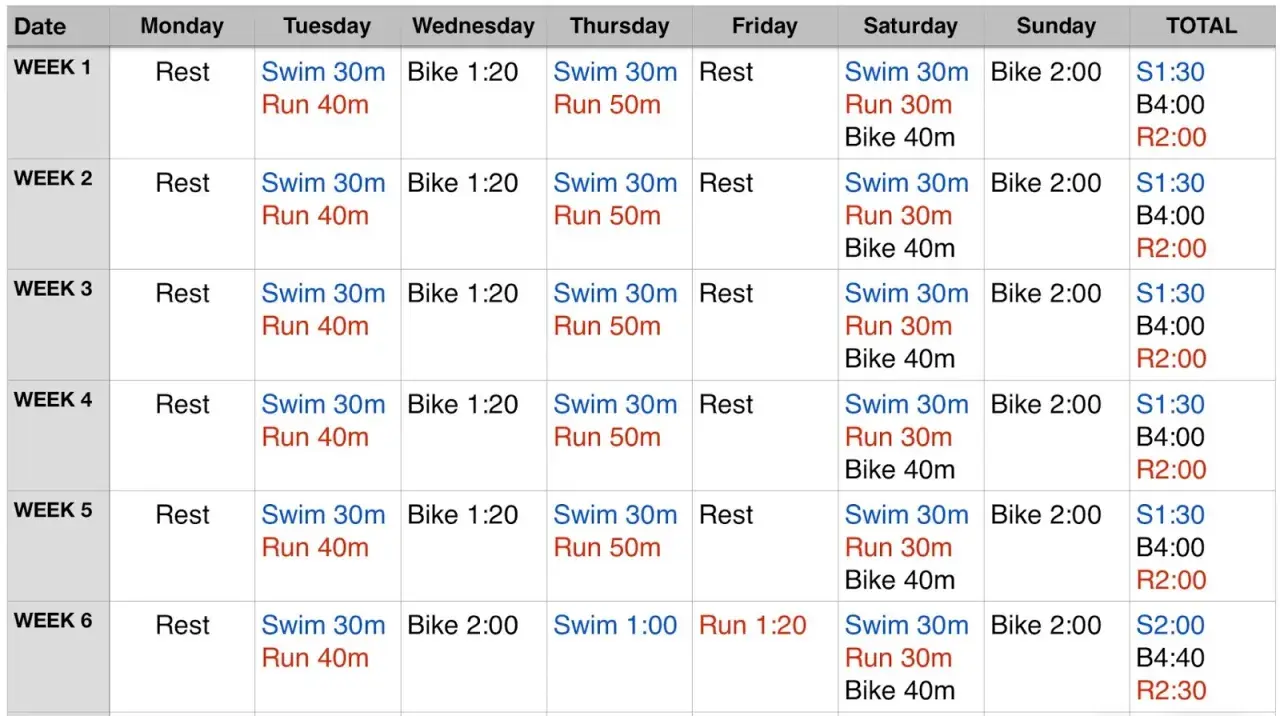
I like to give beginners a structure they can follow without needing to think too hard. The week below is simple, realistic, and flexible enough for most sprint-distance builds. If you only have five training days, keep the swim sessions, the long bike, the brick, and one run, then trim the rest.
| Day | Session | Purpose | Notes |
|---|---|---|---|
| Monday | Rest or light mobility | Recover and reset | 20 minutes of easy mobility, walking, or stretching is enough. |
| Tuesday | Swim technique, 30 to 40 minutes | Improve efficiency in the water | Use drills, short repeats, and relaxed breathing. |
| Wednesday | Bike 45 to 60 minutes plus a 10-minute brick run | Build bike fitness and transition feel | Keep the ride at about 5 to 6 out of 10 effort. |
| Thursday | Easy run 30 to 40 minutes plus strength work | Develop aerobic support and durability | Keep the run conversational and the strength session short. |
| Friday | Swim endurance, 35 to 45 minutes | Turn technique into repeatable fitness | Mix steady swimming with a few short efforts. |
| Saturday | Long bike, 60 to 90 minutes | Build the biggest aerobic session of the week | Stay smooth, fuel early if the ride pushes past an hour. |
| Sunday | Long easy run, 40 to 60 minutes | Teach the body to stay comfortable under fatigue | If needed, use run-walk intervals instead of forcing pace. |
This kind of schedule works because it spreads the stress across the week instead of stacking hard sessions back to back. I also like that it protects the two sessions most beginners underestimate: the long bike and the short run that follows it. Once the weekly rhythm is in place, the next question is how each sport should be trained so the load stays manageable.
How to train each discipline without burning out
Swim with technique first
The swim is where many first-time triathletes lose confidence, so I keep the early sessions simple. One workout each week should be mostly technique, and the other should be a little more continuous so you can feel what steady swimming actually looks like. If your breathing falls apart, the pace is too aggressive.
Focus on one or two drills at a time, not a long list of them. I like work that improves body position and breathing control, because those changes show up quickly and save energy on race day. A calm, efficient stroke will do more for most beginners than trying to power through every length of the pool.
Bike with control, not ego
The bike usually gives beginners the most room to build fitness safely. Use one ride for easy endurance and another for slightly longer, steadier work. Most of the time, an effort level around 5 to 6 out of 10 is plenty. You should finish feeling trained, not crushed.
Bike fit matters more than many people expect. If your position hurts, your training will suffer before your fitness has a chance to grow. I would rather see a new athlete on a well-fitted bike with average equipment than on a flashy setup that makes every ride feel awkward.
Run carefully and keep most of it easy
Running is the most punishing part of triathlon training for many beginners, so this is where patience matters most. A run/walk method is not a sign of weakness; it is a practical way to build volume without forcing your legs to absorb too much too soon. The goal is to stay healthy long enough to adapt.I like two straight-forward run patterns for new triathletes: one easy standalone run and one short brick run after the bike. That combination teaches your body to handle both fresh running and running on tired legs, which is exactly the problem triathlon creates.
Strength work should support the plan, not compete with it
Keep strength sessions short and focused. Two rounds of core work, glute activation, single-leg balance, and basic lower-body strength is usually enough. Early on, lighter resistance and higher reps are the safer choice because your body still needs to absorb the swim-bike-run load.
I rarely want beginners chasing soreness from the gym. I want them building resilience. If a strength session leaves you too tired to swim well the next day, it is too much.With the sports themselves under control, the next layer is learning the small race-day skills that make the whole experience feel less chaotic.
The race-day skills beginners overlook
Transitions are a real skill
IRONMAN’s beginner guidance puts transition practice high on the list, and that is exactly right. T1, the move from swim to bike, and T2, the move from bike to run, are small on paper but easy to fumble if you have never rehearsed them. A messy transition can waste time and spike your stress level before you even settle into the next leg.
Practice laying out your gear in the same order every time. Helmet first, then shoes, then glasses, then race belt if you use one. The more automatic the sequence feels, the less mental clutter you carry into the race.
Brick workouts make the bike-to-run shift feel normal
A brick workout is any session that links two disciplines with almost no break, usually bike to run. The first version does not need to be long. Ten minutes of easy running after a 30- to 45-minute ride is enough to teach your legs what happens after the bike.
I usually add bricks gradually rather than turning every week into a test. The point is adaptation, not punishment. When the transition starts to feel less strange, you know the workout is doing its job.
Open-water swimming changes the equation
Pool fitness and open-water confidence are not the same thing. In open water, you have to deal with sighting, crowded starts, waves, and the lack of lane lines. Sighting simply means lifting your eyes just enough to check direction without breaking your stroke rhythm.
If your first race includes open water, practice it before race week. Swim with a buddy, use a visible swim buoy, and get used to looking up regularly so you stay on course. That one habit can save more energy than most beginners realize.
Read Also: Paula Newby-Fraser: Ironman Legacy & Triathlon Lessons
Fuel and hydration should stay simple
For sessions that run over an hour, I like to keep fueling basic: water, a small amount of carbohydrate, and nothing exotic. A practical starting point is about 16 to 24 ounces of fluid per hour and around 200 calories if the workout pushes beyond an hour. The exact amount depends on heat, intensity, and how much you sweat.
The main rule is simple: do not experiment on race day. Test whatever you plan to eat and drink during training so your stomach has already met it. That habit removes a lot of avoidable anxiety later.
Once those race-specific skills are in place, progress becomes a matter of timing and load, not guesswork.
How to progress from week 1 to race week
I prefer a three-phase build for a first sprint or short-course race: base, build, then race-specific work. A recovery week every fourth week helps keep fatigue from piling up and gives you a better read on whether the plan is working. You do not need to chase every possible workout; you need to arrive healthy and confident.
| Phase | Weeks | Main focus | Typical weekly load | What I would avoid |
|---|---|---|---|---|
| Base | 1 to 4 | Consistency, technique, and easy aerobic work | About 3 to 4.5 hours | Hard intervals, long run sessions, or aggressive bike efforts |
| Build | 5 to 8 | Longer aerobic sessions and short bricks | About 4 to 5.5 hours | Stacking hard swim, bike, and run work in the same 48 hours |
| Race-specific | 9 to 11 | Transition practice, pacing, and nutrition rehearsal | About 4 to 6 hours | New gear, new shoes, or untested fuel choices |
| Taper | 12 | Reduce fatigue and keep the legs sharp | Reduce volume sharply | Trying to make up missed fitness with extra workouts |
If you only remember one thing from this section, remember this: fitness grows when you recover from training, not while you are doing every session. I would rather have a beginner undercook the volume slightly than stumble into race week tired, flat, or injured. The final stretch is about sharpening, not chasing lost fitness.
The final stretch before your first start should feel calmer, not louder
By the last few weeks, the job is to remove uncertainty. I want the athlete to know their gear, know their pacing, and know what a normal effort feels like in each discipline. That way, race morning is a logistics day, not a discovery day.
- Do at least one open-water swim if the race course allows it.
- Complete one or two short bricks each week, then keep them easy.
- Check your bike, helmet, goggles, shoes, and race kit early enough to replace anything that feels off.
- Practice the breakfast and mid-workout fueling you plan to use on race day.
- Lay out transition gear in the same order you will use it in the race.
- Cut training volume in the final week and protect sleep like it matters, because it does.
If you keep the plan modest, repeatable, and specific to sprint-race demands, you will arrive fitter and calmer than most first-timers. That combination is usually enough to make the first triathlon feel less like a gamble and more like the start of something you can actually build on.