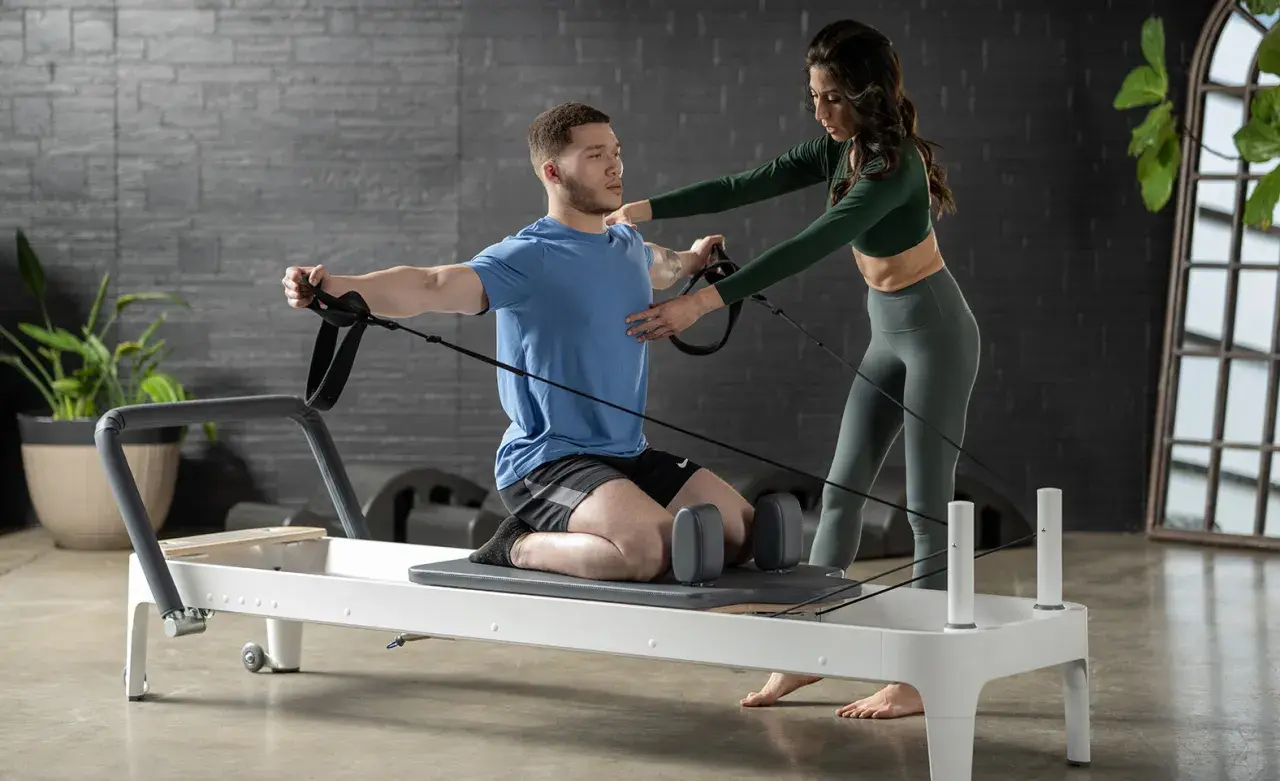
Swimming performance is rarely limited by fitness alone. A cleaner body line, steadier rotation, better rib-cage control, and shoulders that can repeat the same action without complaint are usually what separate efficient swimmers from merely tired ones. In that sense, Pilates for swimmers is not a side hobby; it is a practical way to improve how the body supports the stroke.
The practical gains you should expect first
- The biggest carry-over usually comes from better trunk control, shoulder blade stability, and rib-cage mobility.
- For most swimmers, two focused sessions a week is enough to make a real difference if the movements stay precise.
- The most useful drills are the ones that resemble swimming positions: prone extensions, dead bugs, bridges, side planks, and rotational work.
- Expect cleaner technique, less drag, and better tolerance to training before you expect dramatic time drops.
- Recent core-stability research suggests the clearest performance gains appear in short-distance events, not as a universal shortcut for every swimmer.
Why swimmer-specific Pilates changes the stroke
I think of swimmer-focused Pilates as a bridge between mobility and force transfer. In the pool, the arms and legs do the visible work, but the torso decides whether that force travels cleanly or leaks out through wobble, over-rotation, or a dropped hip line. That is why U.S. Masters Swimming has long made the same point in plain language: core strength, streamline, and turns matter more than flashy dryland work.
The best Pilates work for swimmers is not about doing endless crunches. It is about keeping the trunk stable while the limbs move, teaching the rib cage to move without the lower back taking over, and giving the shoulders enough control to recover overhead without pinching. That matters across all strokes, but it shows up differently depending on how you swim.
| Swimming problem | What Pilates trains | Why it matters |
|---|---|---|
| Body wobbles side to side in freestyle or backstroke | Anti-rotation core control | The stroke stays straighter, so less energy is lost to unnecessary sway |
| Legs drop when breathing or tiring | Deep core engagement and hip extension | The body line stays higher in the water, which reduces drag |
| Shoulders feel tight in recovery | Scapular control and thoracic mobility | The arm can travel overhead more smoothly with less strain on the front of the shoulder |
| Breathing feels rushed or cramped | Rib-cage expansion and controlled exhalation | Breathing becomes calmer, which helps timing and relaxation under fatigue |
| Lower back takes over in butterfly or breaststroke | Glute support and trunk positioning | The movement is spread through the whole chain instead of being dumped into one area |
That is the real value: Pilates does not replace swim technique, but it can make good technique easier to hold under pressure. Once that idea clicks, the next question is which exercises deserve a place in the week and which ones are just noise.

The exercises that actually earn their place in your week
I would not build a swimmer’s programme around generic ab burnouts. The most useful mat work is controlled, repeatable, and close to the positions you need in water. Start with exercises that teach alignment, then layer in more shoulder and hip demand only when the shape stays clean.
| Exercise | What it trains | Why it transfers to swimming | Common mistake | Practical dose |
|---|---|---|---|---|
| Dead bug | Deep core control and rib-cage position | Keeps the trunk quiet while the arms and legs move, which is useful for breathing and stroke timing | Letting the lower back arch off the floor | 2-3 sets of 6-8 slow reps per side |
| Side plank with reach | Obliques, lateral stability, shoulder support | Helps resist side collapse and improves control through rotation | Sinking into the shoulder or twisting the hips open too early | 2-3 holds of 20-30 seconds per side |
| Shoulder bridge | Glutes, hamstrings, posterior chain | Supports hip drive, starts, turns, and body position when the legs begin to tire | Pushing the movement into the lower back instead of the hips | 2-3 sets of 8-10 controlled reps |
| Prone swimming or dart | Back-body endurance and shoulder extension control | Builds the shape and stamina needed for freestyle and butterfly recovery work | Cranking the neck or over-arching the lumbar spine | 2-3 sets of 20-30 seconds |
| Book opener | Thoracic rotation and rib mobility | Supports freestyle and backstroke rotation, and can make breathing feel less forced | Forcing range through the lower back instead of the upper back | 6-8 reps per side, slow and smooth |
| Bird dog | Cross-body control and pelvic stability | Useful for keeping opposite arm and leg actions coordinated without trunk wobble | Rushing the reach and losing balance | 2-3 sets of 6-8 reps per side |
If you have access to a reformer or bands, you can progress later with resisted pulling or leg work, but the rule stays the same: if shape breaks, the load is too high. I would rather see a swimmer own six clean movements than fake twelve advanced ones and call it training. From here, the next issue is timing, because even the best exercise can be placed badly in the week.
How to fit the work around swim sessions
A recent meta-analysis on core stability training, not Pilates alone, found the clearest gains in short-distance swimming, with the most effective programmes generally running for about 8 weeks, using up to 3 sessions per week, and lasting roughly 30 to 60 minutes per session. I would not treat that as a strict prescription for every swimmer, but it does tell us something useful: consistency beats random intensity.For most club swimmers, I prefer shorter sessions that are easy to repeat. Two 15-25 minute sessions a week is usually enough to start, especially if one happens on a lighter pool day and one on a rest or recovery day. If you are already carrying a heavy swim volume, a third session may be more than you need.
| When to do it | Best use | What to avoid |
|---|---|---|
| Before a technique-focused swim | Activation, alignment, and gentle mobility | Fatiguing core circuits that blunt water quality |
| After a hard pool session | Controlled strength, breathing, and shoulder reset work | Chasing exhaustion when the stroke is already sloppy |
| On a rest day | A fuller mat session with more detail and slower tempo | Turning it into a second hard workout that delays recovery |
| Race week | Short activation only, mainly mobility and patterning | New exercises or anything that leaves you sore |
There is one simple rule I use here: if your next swim set matters, Pilates should leave you more organised, not more tired. That leads straight into the most common mistakes, because swimmers often get the benefits only after they stop doing the work in ways that fight the sport.
Common mistakes that make the work less useful
Most problems I see are not about the exercises themselves. They come from doing the right drill with the wrong intention, the wrong range, or the wrong dose.
- Turning every session into an ab burn. Fatigue is not the goal. Control is. If the exercise becomes a fight to survive, the technique usually stops resembling swimming.
- Letting the lower back take over. This is the classic mistake in prone extensions, bridges, and any overhead pattern. The goal is to organise the trunk, not collapse it into extension.
- Ignoring the shoulder blades. Swimmers often think about lats and arms first, but scapular control is what keeps the shoulder stable through the pull and recovery phases.
- Using too much range too soon. A bigger movement is not automatically a better one. A smaller, cleaner range usually gives the better training effect.
- Stacking too much work before a key swim set. If the pool session is quality-focused, keep the dryland work light and neural. Heavy Pilates before a hard swim is usually a bad trade.
- Training through pain that feels sharp or repeatable. Tightness is common; joint pain that returns every session is not something to ignore.
When the shoulder pinches, the neck stays tight, or the lower back keeps complaining, the answer is not more determination. It is usually a simpler movement choice, a smaller range, or an assessment from a qualified professional. Once those mistakes are removed, swimmers tend to notice the payoff much faster.
What you should notice in the pool after a few weeks
The first changes are usually subtle. You may feel more stable on the breath, less twisted through the body line, or less likely to overreach with the shoulders when fatigue rises. Those are not glamorous wins, but they are the kind that often lead to better sessions and fewer compensations later in the week.
| Early change | What it feels like | What it means in the water |
|---|---|---|
| Cleaner body line | Less wobble when you kick or rotate | Reduced drag and easier streamlining |
| Calmer breathing | Less neck tension and less panic on the exhale | Smoother timing under fatigue, especially in freestyle and breaststroke |
| Better turn control | More awareness of the tuck and push-off position | Tighter, more repeatable turns without extra wasted movement |
| Fewer sore spots | Less lingering tightness in shoulders, upper back, or lower back | More consistent training because you are not constantly managing overload |
The honest caveat is that Pilates is rarely the thing that slashes times on its own. The clearest performance gains are usually seen when dryland work supports good technique, sensible pool volume, and stroke-specific practice. In other words, it helps you hold your swimming together, which is often what the stopwatch rewards first.
The simplest way to make it pay off in the pool
If I were building this into a swimmer’s week, I would keep it simple: two non-consecutive mat sessions, each around 20 minutes, built around dead bug, side plank, shoulder bridge, prone swimming, and a rotation drill such as book openers. Keep the effort around a 6 out of 10, stop before the shape degrades, and re-check how you feel in the water after 4 weeks, then again at 8 weeks.
- Use Pilates to sharpen body awareness, not to collect fatigue.
- Match the session to the swim week: lighter before key pool work, fuller on easier days.
- Prioritise shoulder control, rib-cage mobility, and anti-rotation strength over generic crunches.
- Track practical signs of progress, such as streamline quality, stroke count, turn consistency, and shoulder comfort.
Done properly, this kind of dryland work does exactly what swimmers need most: it makes the body steadier, cleaner, and easier to organise in the water. That is why I would treat it as part of swim training, not as an optional extra.
