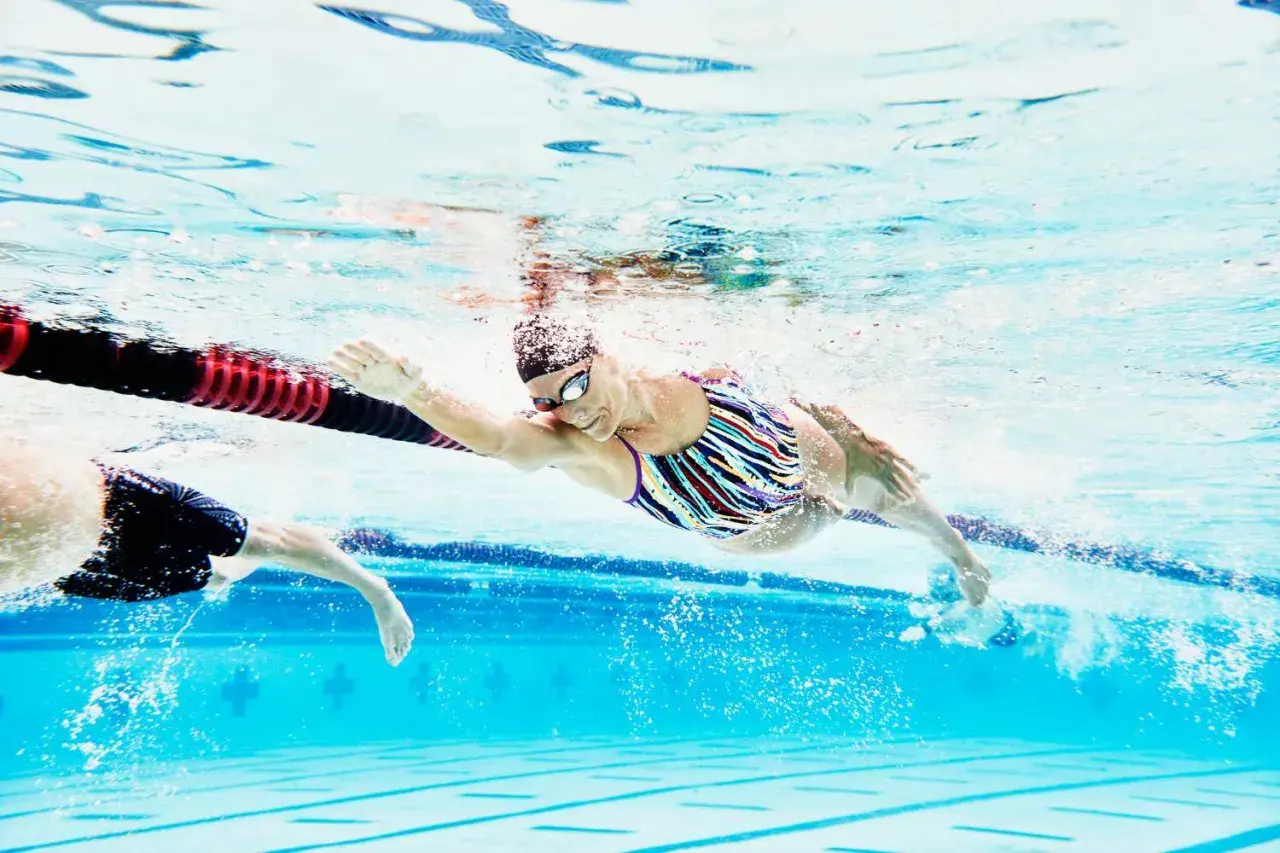
The best recovery swims are short, easy, and deliberately boring
- Keep the effort at about 2-3 out of 10; you should be able to speak in full sentences.
- 15-30 minutes is enough for most swimmers, and 400-1200 metres covers the typical range.
- Use smooth swimming, gentle drills, and long cool-downs instead of sprints or heavy equipment.
- Leave the pool feeling looser and calmer than when you got in.
- If pain sharpens or your stroke falls apart, stop and treat it as a warning sign.
What a recovery swim is meant to do
I think of recovery swimming as active recovery. The aim is to keep blood moving, restore range of motion, and reduce stiffness without asking tired muscles to perform again at training intensity. The water helps here because it supports bodyweight, reduces joint stress, and lets you move through long, easy strokes without the pounding you get on land.
That is why a good session often feels underwhelming in the moment. It should not leave your shoulders pumped or your breathing ragged. Swim England's Masters guidance points to 200 to 800 metres of easy swimming after a hard set, and that range is sensible for most club swimmers who simply want to loosen up and be ready for the next session.
In practice, I judge the value of a recovery session by how I feel when I step out of the pool, not by how impressive the set looks on paper. If the answer is “looser, warmer, better,” it has done its job. That also tells you how to build the session, which is where the real detail starts.How to build a session that actually helps
A good easy session has three parts: a gentle start, a calm middle, and a proper cool-down. I usually keep the total time between 15 and 30 minutes, or roughly 400 to 1200 metres depending on how tired I am and how much time I have. If you like numbers, keep it around RPE 2-3/10, where RPE means rate of perceived exertion, the simple scale for how hard the effort feels. The pace should stay conversational; if you cannot speak in full sentences between lengths, it is no longer recovery.
| Part | What I want | What it should feel like |
|---|---|---|
| First 5 minutes | Easy swim or mixed strokes | Breathing settles, shoulders open, no rush to the turn |
| Main block | Short repeats with generous rest | Effort stays smooth, never straining |
| Last 5 minutes | Long cool-down | You finish calmer than you started |
If you want a simple rule, this is the one I use: the set should feel like movement therapy, not conditioning. Choose strokes that stay relaxed, rest long enough to keep the effort low, and skip anything that forces you to “work through” fatigue. A recovery session is allowed to be dull. Dull is often exactly what helps. Once that structure is clear, the next step is choosing a session that fits how tired you are.

Three sessions I would actually use after hard training
Different kinds of fatigue need slightly different sessions. Heavy legs after a run call for a different reset than tight shoulders after pull work, and I do not try to treat them the same way. These examples stay easy on purpose.
| Session | Length | What it looks like | Best for |
|---|---|---|---|
| Very light reset | 400-600 m, 15-20 min | 100 easy swim, 4 x 50 drill/swim, 4 x 50 relaxed backstroke or choice stroke, 100 easy cool-down | General stiffness, light fatigue, or the day after lifting |
| Standard recovery | 800-1000 m, 20-25 min | 200 easy, 4 x 100 smooth swimming with generous rest, 4 x 50 easy kick or mixed strokes, 200 easy | After intervals, a hard club night, or a long run |
| Low-load reset | 1000-1200 m, 25-30 min | 300 easy, 6 x 50 relaxed drills, 4 x 100 smooth swim with plenty of rest, 100-200 cool-down | When you want time in the water but do not want a hard session |
The main thing I want from every version is the same: finish with cleaner technique than you started with. If your strokes get messy halfway through, the volume is too high or the rest is too short. On a bad day, even half of the shortest session is enough. From there, the real question is whether swimming is the right recovery tool at all.
When swimming beats complete rest and when it doesn’t
Swimming is a strong choice when you feel stiff, slightly flat, or a bit beaten up from training but not actually injured. It is also useful after a heavy lower-body session, because the water lets your legs move without impact. For many swimmers, a short pool visit feels better than sitting still because the body warms up, the hips and shoulders open, and the mind calms down.
I would not force it if the problem is sharper than ordinary soreness. Sharp joint pain, swelling, a worsening shoulder, illness, dizziness, chest tightness, or unusual breathlessness are all reasons to stop and get advice rather than trying to swim through the issue. If you are coming back from injury or surgery, follow the guidance of your GP, physio, or specialist before you improvise your own plan.
There is also a middle ground. If full swimming feels like too much, easy aqua walking or a very short gentle session can give you movement without the same load. Aqua walking is simply walking against water resistance, usually in the shallow end. That is often enough to keep recovery moving in the right direction. The catch is that it only works when you avoid the habits that quietly turn it into another workout.
The mistakes that quietly turn recovery into another hard session
- Starting too fast - the first 50 should calm you down, not test you.
- Using paddles or hard pull work - these add load quickly and usually defeat the point.
- Chasing pace on the clock - recovery is about low strain, not proving fitness.
- Keeping the session too long - once you feel fresh enough to push, you have probably gone past the recovery zone.
- Ignoring turning stress - aggressive push-offs and constant flip turns can make an easy set feel surprisingly demanding.
- Leaving without rehydrating - even a gentle swim still costs fluid, especially in a warm pool.
The version of this I see most often is the swimmer who insists the workout is easy but leaves with tight shoulders and a slightly cooked heart rate. That is not recovery. It is just a smaller training session wearing a softer label. The easiest way to protect the session is to make a few smart choices before you even get in the water.
Small choices that make a recovery swim easier in a UK pool
Pool context matters more than people admit. A quiet lane, a pace that matches yours, and enough space to keep moving without stopping every two lengths can change the entire feel of the session. In a busy leisure-centre lane, I would rather swim a little slower in the right lane than force a perfect plan in the wrong one.
- Choose the calmer lane - if everyone around you is pushing pace, your “easy” swim will drift upward.
- Keep kit simple - well-fitting goggles and a cap are usually enough; training toys are optional, not essential.
- Use a snorkel only if you already know it - it can reduce neck movement, but it is not a shortcut to recovery.
- Pick a slightly warmer pool when you can - cold water can feel refreshing, but if you are already tense it may make you tighten up.
- Respect lane etiquette - steady pacing, sensible passing, and brief rests at the wall make recovery sessions much less stressful.
The point is not to build a perfect environment. It is to remove friction. The fewer small annoyances you fight in the pool, the easier it is to keep the session genuinely restorative. The final check is simple: make sure the swim actually leaves you better than it found you.
How I know the swim actually helped
I call a recovery session successful when three things happen: I feel looser within minutes of getting out, my next workout starts more smoothly, and I do not feel more beaten up the next day. If any of those fail, I look at volume first, then intensity, then the amount of equipment I used. In most cases, one of those variables is the real problem.
- Looser shoulders, hips, or back after the session
- Breathing settled rather than forced
- No fresh soreness from the water itself
- Normal appetite and hydration after the swim
- Better movement in the next session or the next morning
If you still feel flat after 24 hours, I would cut the next session by 25-40% and keep it purely easy. I also like to jot down the metres, the pool, and how my body felt that evening, because the patterns show up quickly once you stop guessing. A recovery swim is useful when it helps you train better tomorrow, not when it wins points for effort today.