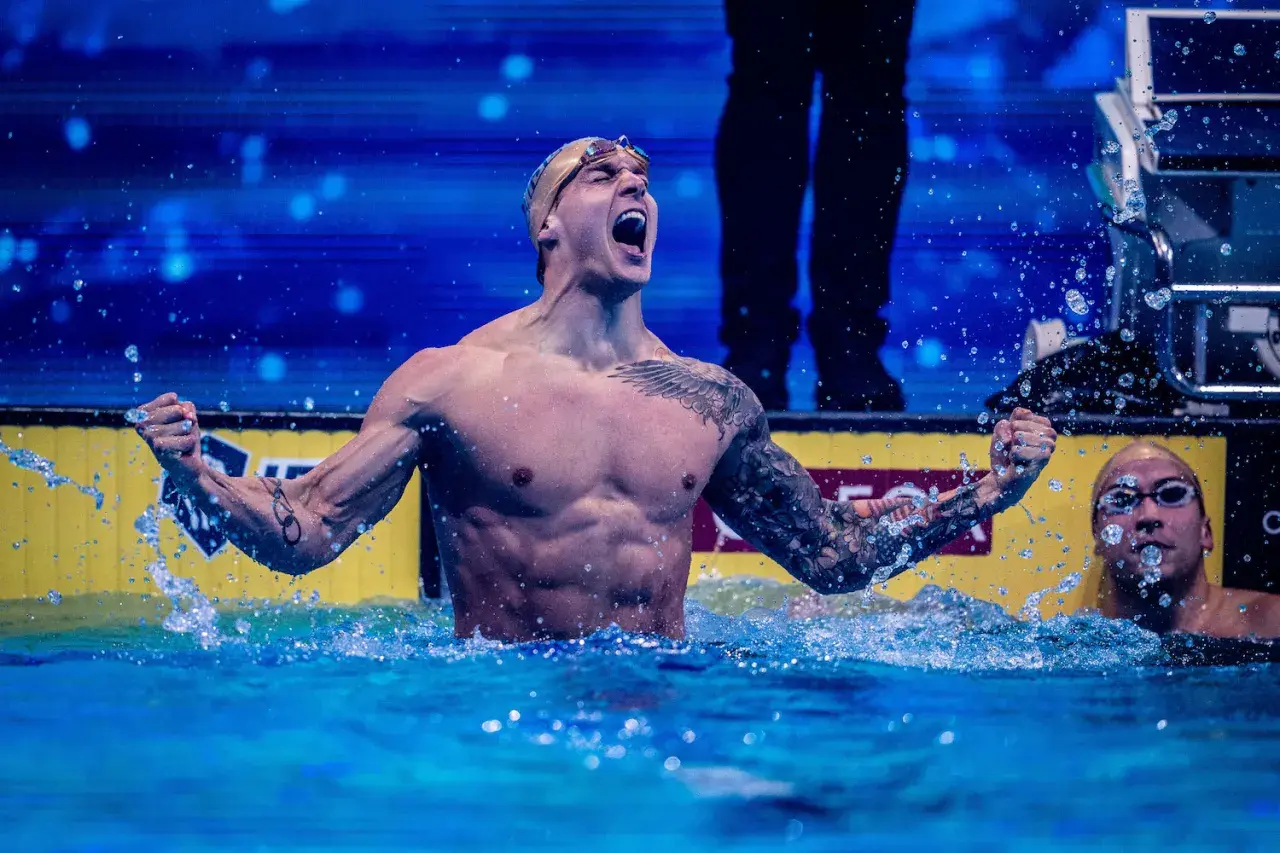
Swimmers often look broader through the upper body because the sport loads the back, shoulders, and shoulder blades in a very specific way. The visible shape comes from a mix of muscle development, posture, training volume, and genetics, and it tells you more about how the body adapts to repeated pulling than about some mysterious body type that appears overnight.
The main reasons are muscle, posture, and body type
- Swimming builds the lats, deltoids, traps, and chest, which changes the outline of the upper body.
- The shoulders can look wider without the bones changing much; the visual effect is mostly soft tissue and posture.
- Freestyle, butterfly, and backstroke create the strongest upper-body adaptations because they demand repeated pull and recovery patterns.
- Genetics and growth still matter a lot, especially in swimmers who started training during puberty.
- Broad shoulders can help with power and water feel, but pain, stiffness, or rounded posture are warning signs, not trophies.

Why swimmers often look broader across the shoulders
When I look at a swimmer’s frame, the first thing I notice is usually not the collarbones. It is the combination of a wider upper-back line, fuller deltoids, and a more open shoulder position that makes the whole top half of the body look broader.
The biggest visual driver is the latissimus dorsi, or lats: the large back muscles that help pull the arm through the water. Add the deltoids, upper traps, pecs, and triceps, and the silhouette changes fast. U.S. Masters Swimming makes the same basic point: swimming builds muscles that many other sports do not challenge in the same way, while bone structure itself does not suddenly expand because of training.
| What contributes to the look | What it changes | Why it matters |
|---|---|---|
| Lats | Wider back line | Create the V-taper that people associate with swimmers |
| Deltoids and traps | Rounder shoulder cap | Make the shoulders look fuller from the front and side |
| Low body fat | Sharper muscle outline | Exposes the upper-body shape more clearly |
| Posture | Open chest and set shoulder blades | Can make the upper body appear broader even before muscle size changes much |
| Genetics | Clavicle length and torso proportions | Defines the starting frame, which training then builds on |
That is why two swimmers can look very different even if they log similar pool time. One may have naturally wider clavicles and a long torso, while another simply carries more visible muscle and lower body fat. Next, it helps to separate the permanent parts of the frame from the parts swimming really changes.
What swimming changes and what it does not
Swimming changes the upper body in a way that is real, but often misunderstood. It tends to increase muscle size, muscular endurance, and shoulder-blade control far more than it changes the actual width of the skeleton.| Body feature | Typical effect from swimming | Practical takeaway |
|---|---|---|
| Muscle size | Often increases in the lats, delts, traps, pecs, and triceps | This is the main reason swimmers look broader |
| Scapular control | Improves with repeated stroke practice | Better control usually means better force transfer in the water |
| Posture | Can improve or drift into a forward-shoulder pattern | Dryland work decides which direction wins |
| Bone width | Changes very little after growth | Training cannot meaningfully widen the clavicles |
| Overall look during adolescence | Training and natural growth overlap | It is easy to credit swimming for changes that puberty would have produced anyway |
That last point matters more than people think. If a child starts serious training during a growth spurt, the shoulders can appear to widen quickly, but the real story is usually growth plus training plus selection. In other words, swimming shapes the body, but it does not rewrite anatomy from scratch. Once you understand that distinction, the next question is which parts of training make the shape more obvious.
How stroke choice and training volume shape the look
Not every swimmer develops the same upper-body profile. Stroke choice, weekly volume, and how much work is done with paddles, pull buoys, or resisted sets all change the result.
| Stroke or training pattern | Shoulder demand | Typical effect on shape |
|---|---|---|
| Freestyle | High, because of constant alternating pulls and body rotation | Often builds the clearest lat and deltoid development |
| Butterfly | Very high, with repeated explosive pulling and recovery | Can produce a very powerful upper frame quickly |
| Backstroke | Moderate to high, especially for scapular control and rear shoulder work | Usually supports balanced upper-back development |
| Breaststroke | Lower shoulder load than the front-crawl and fly in most swimmers | Often shows less dramatic shoulder width |
| Heavy pull sets and paddles | High force through the shoulder girdle | Can accelerate muscle growth, but also raise overload risk if overused |
The more total pull work a swimmer does, the more the upper body tends to adapt. That is especially true when a training week leans hard on paddles, resisted work, or sprint sets that demand a lot of power from the shoulders and lats. The useful detail here is not that “more is always better”; it is that the body responds to the pattern it sees most often. And that leads directly to the trade-off no one wants to ignore.
Broad shoulders are useful until they start costing range of motion
Broad shoulders are not just a cosmetic side effect. In the water, a strong upper back and shoulder girdle help with catch stability, stroke power, and the ability to hold position when fatigue sets in. A swimmer who can keep the shoulder blade organised under load usually gets a cleaner line through the water.
But there is a point where the same adaptations become a problem. If the front of the shoulders tightens, the chest shortens, and the upper back stays rounded outside the pool, the athlete may lose overhead range and start compensating. That is when I stop thinking about size and start thinking about mechanics.
- Persistent pain in the front or top of the shoulder often points to overload rather than healthy adaptation.
- Reduced external rotation can make recovery and entry feel restricted.
- Clicking, catching, or weakness under load is a warning that the shoulder is not tracking cleanly.
- Rounded shoulders on land may mean the chest and lats are dominating while the smaller stabilisers are falling behind.
For swimmers, the most common mistake is assuming that a bigger-looking shoulder is automatically a stronger one. Sometimes it is. Sometimes it is just tighter. That is why the best fix is not to chase more bulk, but to train the shoulder complex as a system.
How I would train swimmer shoulders without building a sloppy frame
If the goal is a powerful swimmer’s body, I would treat the shoulders as part of a larger system: shoulder blades, rotator cuff, upper back, thoracic spine, and trunk. The body works as a chain, not as a separate set of muscles.
A simple starting point is 2 to 3 short dryland sessions a week, each lasting about 15 to 25 minutes. That is usually enough to keep the shoulders durable without piling more fatigue onto an already demanding swim schedule.
| Priority | What it does | Useful exercises |
|---|---|---|
| Upper-back strength | Supports better posture and shoulder control | Chest-supported rows, cable rows, face pulls |
| Rotator cuff endurance | Helps keep the ball-and-socket joint centred | Band external rotations, side-lying external rotation |
| Scapular control | Keeps the shoulder blade moving well under load | Push-up plus, wall slides, Y-T-W raises |
| Thoracic mobility | Prevents the upper back from locking into a rounded shape | Foam roller extensions, open-book rotations |
| Lat and pec length | Offsets the tightness that heavy pulling can create | Doorway pec stretch, overhead lat stretch |
For loading, I usually keep it simple: 2 to 4 sets of 8 to 12 controlled reps for strength work, with slower reps and clean technique rather than ego lifting. If a swimmer is already doing a lot of pool volume, I would rather see excellent form, good range, and no pain than another heavy pressing session that only makes the front of the shoulder tighter.
The goal is not to build a bodybuilder’s frame. It is to give the stroke enough strength to stay efficient while the shoulder stays free enough to recover. That balance is what makes the swimmer look powerful rather than beaten up.
The strongest swimmer shoulders are the ones that still move well
The short answer is that swimmers often have broad shoulders because swimming builds the muscles around the shoulder girdle, especially the lats and delts, and because repeated training shapes posture and body composition over time. Genetics and growth set the starting point, but the pool usually writes the visible finish.
What matters most, though, is not shoulder width on its own. A good swimmer’s upper body should look strong, but it should also move cleanly, rotate freely, and stay pain-free through long training blocks. If I had to choose, I would always take balanced mechanics over a bigger frame that only looks impressive on deck.
If the shoulders are broad and the stroke is efficient, that is a useful adaptation. If they are broad and painful, stiff, or constantly rounded forward, the body is telling you the training balance needs work.