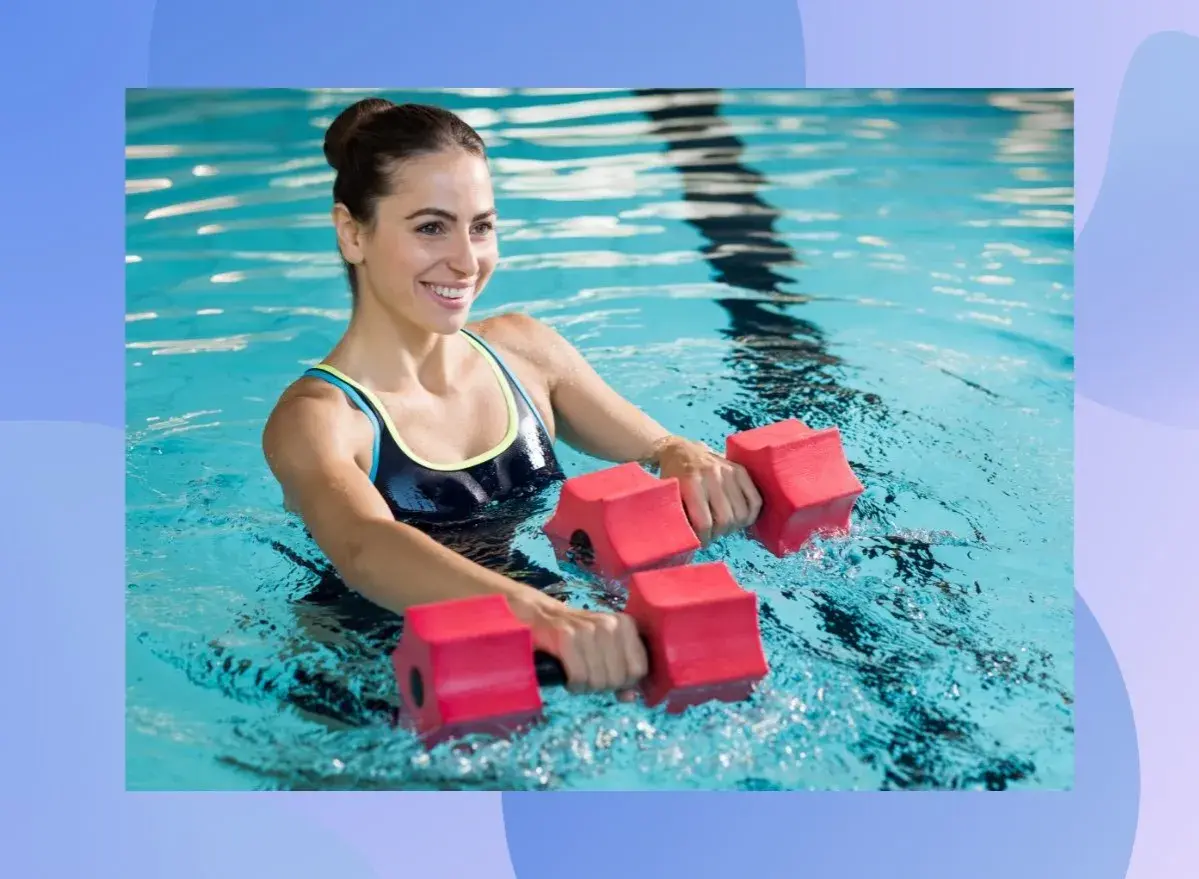
Pool-based core work can be one of the smartest ways to train the midsection without beating up the joints. Pool exercises for abs are most useful when they challenge control, breathing, and body position at the same time, not when they just make you tired. In this guide, I focus on the moves that actually transfer to better swimming, better posture, and a more stable brace in everyday training.
What matters most before you start
- Water adds resistance from every direction, so the abs work hardest when you stay controlled, not when you rush.
- The best pool moves for the midsection are treading water, flutter kicks, pikes, standing twists, and dolphin kicks.
- A 12 to 15 minute circuit is enough for most people if the reps stay clean.
- Kickboards, noodles, pull buoys, and ankle bands can increase difficulty, but form still matters more than equipment.
- Pool training builds core endurance and stability, but visible abs still depend on overall body composition and full-body training.
Why the pool is a strong place to train your core
The pool gives you a combination that is hard to copy on land: buoyancy reduces impact, while drag forces every kick, twist, and hold to work against resistance. That means you can train the trunk without the pounding that often makes floor-based core work uncomfortable for the lower back, hips, or knees. For swimmers, it also pays off in a practical way, because a stronger core usually means a cleaner body line and less energy wasted in the water.
| Factor | What it changes | Why it helps the abs |
|---|---|---|
| Buoyancy | Reduces impact on joints and spine | Makes it easier to keep training consistently |
| Drag | Adds resistance in every direction | Forces the trunk to stabilize continuously |
| Depth | Changes leverage and balance demands | Deep water usually increases core challenge |
| Breathing | Requires steady rhythm under load | Improves bracing and control under fatigue |
I like this style of training because it rewards precision. If the midsection is doing its job, the movement feels smooth and organized rather than frantic. That makes the exercise list itself much more important than the amount of water you splash around.

The exercises that do the real work
I would not build a pool session around random movement. The best choices are the ones that make the abdomen stabilize the torso, resist rotation, or compress the hips toward the ribs under control. In other words, you want exercises that force the trunk to stay honest.
| Exercise | Main focus | Why it matters | Best for |
|---|---|---|---|
| Treading water | Deep core endurance, obliques | Builds constant stabilization and breathing control | All levels |
| Flutter kicks | Lower abs, hip flexors | Trains sustained tension while the legs stay long | Swimmers, intermediate trainees |
| Pikes or knee tucks | Rectus abdominis, deep core | Rewards slow compression instead of speed | Lower-ab focus |
| Standing twists | Obliques, anti-rotation | Teaches the torso to rotate under control | Beginners |
| Dolphin kicks | Abs, glutes, lower back | Uses a wave-like body line that carries over to swimming | Swim-specific conditioning |
| High-knee jog | Core endurance, cardio | Raises heart rate while forcing the trunk to stay tall | Conditioning days |
| Pool plank with noodle | Transverse abdominis, posture | Challenges the deep brace without ground impact | Beginners, rehab-style work |
| Pull-buoy swim without kicking | Trunk stability | Teaches the hips to stay high while the upper body works | Swimmers |
If I had to narrow it down to a simple starting trio, I would choose treading water, flutter kicks, and pikes. That combination gives you endurance, compression, and enough instability to expose weak bracing fast. It is also easy to scale up or down without changing the whole workout.
How to turn them into a 15-minute workout
For most people, a short circuit works better than a long, messy session. I prefer two rounds for beginners and three rounds for more experienced swimmers, because the pool already adds load and extra volume can turn into sloppy movement if you are not careful.
| Level | Work interval | Rest | Rounds | Goal |
|---|---|---|---|---|
| Beginner | 20 seconds | 40 seconds | 2 | Learn positions and breathing |
| Intermediate | 30 seconds | 20 to 30 seconds | 2 to 3 | Build steady core endurance |
| Advanced | 40 seconds | 15 to 20 seconds | 3 | Conditioning without losing form |
- Warm up for 3 minutes with easy water walking, relaxed treading, or light kicking.
- Move through five exercises: treading water, flutter kicks, standing twists, pikes, and dolphin kicks.
- Keep each effort controlled and stop the set if the body line starts to collapse.
- Rest briefly, then repeat the circuit for the number of rounds that matches your level.
- Finish with 1 minute of easy swimming or floating recovery.
The main rule is simple: finish with tension still in the abs, not with your form falling apart. If you are chasing quality, 15 minutes is enough.
How to make the workout harder without losing form
Progression in the water is usually about leverage and control, not just speed. I like to change one variable at a time so I can tell whether the core is actually working or whether the session has just become more chaotic.
- Move deeper in the pool for treading water and knee-tuck work.
- Use a kickboard to lengthen the lever during flutter kicks or dolphin kicks.
- Add a pool noodle to plank-style holds so the body has to fight instability.
- Try a pull buoy or ankle band to remove the kick and force the trunk to keep the hips from dropping.
- Shorten the rest before you add more exercises.
- Use a slower lowering phase on pikes and tuck movements; three controlled seconds down is more useful than a rushed descent.
This is the point where the session starts to feel athletic instead of merely busy. If the movement gets sloppy before the burn shows up, the progression is too aggressive.
Common mistakes that waste the work
The pool can hide bad mechanics for a few seconds, which is why I pay close attention to form. The most common mistake is turning a core drill into a cardio drill and losing the trunk position that makes the exercise valuable in the first place.
| Mistake | What it causes | Better cue |
|---|---|---|
| Holding your breath | Higher tension, poorer bracing, faster fatigue | Exhale steadily and keep the rib cage stacked over the pelvis |
| Kicking too fast | Cardio takes over and the abs stop doing the main job | Keep the kicks compact and controlled |
| Arching the lower back | Load shifts away from the abs and into the spine | Keep the pelvis neutral or slightly tucked |
| Using the arms to save every rep | Less work for the midsection | Let the water challenge balance instead of forcing every movement |
| Chasing long sessions | Technique breaks down before the core gets real work | Stop when the body line starts to fade |
When I see these errors, the fix is usually not more effort. It is better timing, a calmer breath, and a shorter set with cleaner reps. That simple correction usually changes the quality of the workout immediately.
What the pool can and cannot give you
Water training is excellent for core endurance, better body position, and lower-impact conditioning, but it is not a magic shortcut to visible abs. That still depends on overall body composition, nutrition, and some form of full-body strength work outside the pool. The pool is the tool that makes the trunk work more intelligently, not the thing that replaces everything else.
For joint-sensitive athletes, the Arthritis Foundation notes that warm-water exercise is often most comfortable around 83 to 90 degrees Fahrenheit, which can be a useful range if you want steady work without too much stiffness. I also treat fatigue as a hard stop: when breathing gets messy or the hips start sinking, the set is done. At that point, the drill is no longer training the core well.
If you want stronger swimming mechanics and a midsection that can hold position under pressure, this is the formula I trust: a few good water drills, short rest, and enough control to keep each rep useful. That is where the real payoff comes from.
