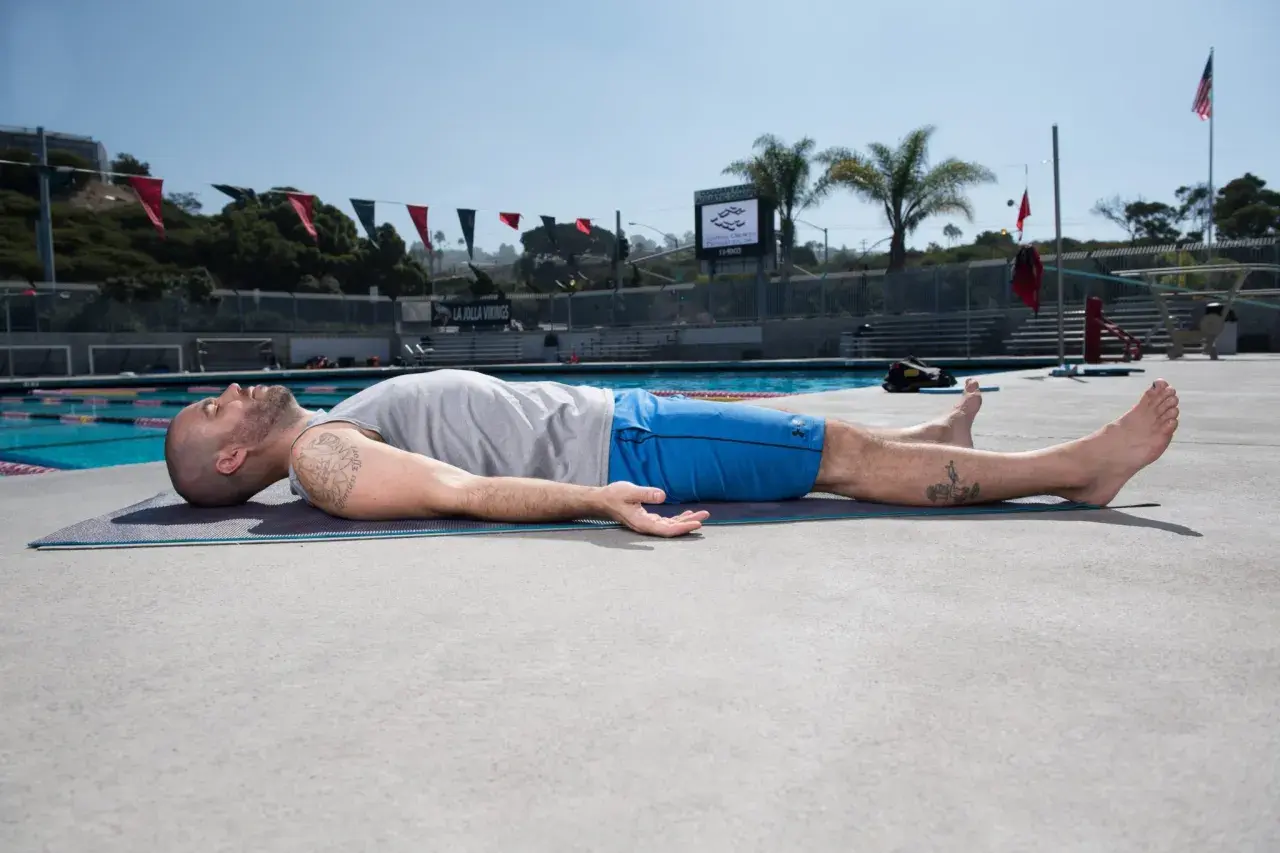
Swimming asks the same joints to work hundreds of times in one session, so recovery and movement quality matter as much as yardage. A well-built yoga for swimmers routine can improve shoulder control, upper-back rotation, breathing mechanics, and the kind of mobility that actually carries over to the pool. In this article, I focus on what helps most, what to avoid, and how to fit yoga into swim training without blunting speed or strength.
What matters most for swimmers who use yoga well
- Shoulder mobility only helps when stability is still there. Loose shoulders without control usually create more problems than they solve.
- Thoracic rotation and ribcage position matter more than deep hamstring stretches. They affect streamline, breathing, and body line.
- Short, consistent sessions beat occasional long ones. Ten to twenty minutes is often enough.
- Recovery-focused yoga works best after hard sets or on easy days. Save intense holds for times when you are not about to race.
- Pain is a stop sign. A stretch that pinches the front of the shoulder or irritates the neck is not the right drill.
Why yoga helps swimmers train better
I usually think of yoga as support work for swimming, not a separate fitness goal. The best sessions improve the movement patterns that a swimmer uses every day: overhead reach, trunk rotation, controlled breathing, hip extension, and posture under fatigue. That matters because swim strokes reward efficient motion, not just raw flexibility.
The real value is not simply “being looser.” I want swimmers to move through a wider range with control. That distinction is easy to miss. Flexibility is passive range; mobility is usable range. A swimmer who can lift the arm overhead but cannot keep the shoulder blade organized is not more efficient. In the water, that usually shows up as a sloppy catch, early fatigue, or a nagging pinch at the front of the shoulder.
Breathing is another overlooked piece. Good yoga work teaches a swimmer to exhale fully, keep the ribs from flaring, and stay calm when the body opens up. That kind of breathing control can carry over to freestyle rhythm, turn-to-push-off transitions, and recovery between hard repetitions. When the body is less tense, the stroke often looks cleaner too.
In practice, I see the biggest carryover when yoga supports strength and technique work rather than trying to replace them. That leads directly to the body areas that deserve the most attention.
The mobility limits that show up most often in the pool
Before choosing poses, I look at four zones that usually decide whether a swimmer feels smooth or stiff: shoulders, thoracic spine, hips, and ankles. Each one affects a different part of the stroke.
| Area | What it affects in swimming | What yoga should target | What to watch out for |
|---|---|---|---|
| Shoulders | Recovery phase, catch position, backstroke line, butterfly recovery | Chest opening, scapular control, gentle external rotation | Forcing end range when the shoulder is already unstable |
| Thoracic spine | Body roll, breathing, streamline, overhead reach | Rotation and extension through the upper back | Letting the lower back compensate for a stiff upper back |
| Hips | Kick efficiency, turns, dolphin kick, body line | Hip flexor release, glute activation, controlled openers | Chasing flexibility without keeping the pelvis stable |
| Ankles | Kick shape, streamline, push-off position | Gentle calf and soleus mobility, ankle pointing | Overstretching if the foot already cramps easily |
If I had to rank those areas for most swimmers, shoulders and thoracic spine come first, then hips. Ankles matter too, but they are usually not the main bottleneck unless kick efficiency or push-offs are clearly limited. That is why the best yoga work for swimmers is selective, not random. The next step is choosing poses that solve those problems without creating new ones.

The poses I would start with first
I do not think swimmers need an elaborate flow to get value from yoga. A small set of reliable positions is usually better, especially if you are already doing hard pool work and dryland strength. These are the poses I would keep in rotation first.
| Pose | Best for | Typical dose | Why it helps |
|---|---|---|---|
| Cat-cow | Warm-up and spine awareness | 6 to 8 slow reps | Builds segment-by-segment control through the spine instead of dumping motion into the lower back |
| Thread the needle | Thoracic rotation and shoulder release | 20 to 30 seconds per side | Opens the upper back, which helps body roll and relaxed recovery |
| Low lunge with cactus arms | Hip flexors and chest opening | 3 to 5 breaths per side | Useful after kick-heavy sessions or long sprint sets |
| Puppy pose | Lats, shoulders, and ribcage | 20 to 40 seconds | Targets the overhead line without demanding deep back bending |
| Bridge pose | Glutes and front-body opening | 4 to 6 breaths | Counteracts long hours of sitting and helps restore hip extension |
| Legs-up-the-wall | Recovery and down-regulation | 2 to 5 minutes | Simple, low-cost recovery work that helps you settle after a hard practice |
If a swimmer only has eight minutes, I would keep cat-cow, thread the needle, low lunge, and legs-up-the-wall. That combination covers the upper back, shoulders, hips, and recovery without wasting time. If you have a little more room, puppy pose and bridge add useful work for the lats, chest, and glutes. I would rather see that kind of focused menu than a long, trendy flow that looks good on paper but does not fix anything in the water.
The key is to treat each position as a training stimulus, not just a stretch. Move slowly, breathe on purpose, and stop before form breaks down. That makes the work useful enough to fit into a real swim week.
How to fit yoga into a swim week
The biggest scheduling mistake is using the same style of yoga every time. A short dynamic session before the pool can be helpful, but a long static stretch session right before a hard main set is usually a bad trade. I use a simple rule: dynamic before intensity, restorative after intensity.
| Timing | Goal | Good choices | What to avoid |
|---|---|---|---|
| 5 to 8 minutes before swimming | Wake up the spine, shoulders, and hips | Cat-cow, thoracic rotations, gentle lunges, shoulder circles | Long holds, deep end-range chest openers, anything that makes you feel floppy |
| 10 to 20 minutes after swimming | Downshift and restore range | Thread the needle, puppy pose, bridge, legs-up-the-wall | Fast vinyasa work that adds more fatigue |
| 20 to 30 minutes on an easy day | Build mobility and breathing control | A slower flow with hip openers, spinal rotation, and longer holds | Turning the session into a sweat test |
For most swimmers, two or three short sessions per week are enough to create a noticeable difference if they are done consistently. I also like pairing yoga with the most demanding part of the training week, because recovery work is most useful when the body actually needs it. If you do a heavy sprint session on Tuesday, a 15-minute reset afterward is often more valuable than a random full-body stretch on Friday when you already feel fine.
One more practical point: if you are racing soon, keep the work lighter than usual. The goal is to arrive loose and responsive, not to discover new ranges the day before a meet.
Common mistakes that make the practice less useful
I see the same problems again and again when swimmers start doing yoga without a plan. Most of them come from trying to force more range instead of building better control.
- Chasing depth instead of quality. A deeper stretch is not automatically better if the shoulder blade, ribcage, or pelvis is collapsing.
- Ignoring pain signals. Mild effort is fine; sharp pain, pinching, numbness, or a sense of catching is not.
- Overstretching already loose shoulders. Many swimmers need stability more than more range, especially if they have a history of shoulder irritation.
- Doing aggressive holds before speed work. Long static stretching can leave you feeling too open and less powerful for the main set.
- Using yoga instead of strength training. Yoga can support the shoulder and trunk, but it does not replace pulling strength, rotator cuff work, or core stability.
- Practicing without breathing control. If you hold your breath through every pose, you are missing one of the most useful parts of the session.
If a swimmer has repeated shoulder pain, night pain, or a drop in stroke power, I would not push deeper into stretching and hope for the best. That is the point where assessment from a coach, physical therapist, or sports medicine clinician makes more sense than another mobility video. The work should support performance, not hide a problem.
A simple way to keep the practice useful all season
If I were building this into a normal swim schedule, I would keep it simple and repeatable: one short mobility session before two practices, one recovery-focused session after the hardest water workout, and one slightly longer reset on an easy day or off day. That is enough for most swimmers to improve body awareness, reduce stiffness, and keep the stroke cleaner under fatigue.
- Before swim: 5 to 8 minutes of movement-based work.
- After hard swim days: 10 to 20 minutes of slower, restorative positions.
- On easy days: 20 to 30 minutes with controlled holds and breathing.
The goal is not to become hyper-flexible. The goal is to keep the shoulders organized, the ribs and hips working together, and the body calm enough to recover between hard sets. Used that way, yoga becomes a practical part of swim training rather than a generic add-on, and that is what makes it worth keeping in the plan.
