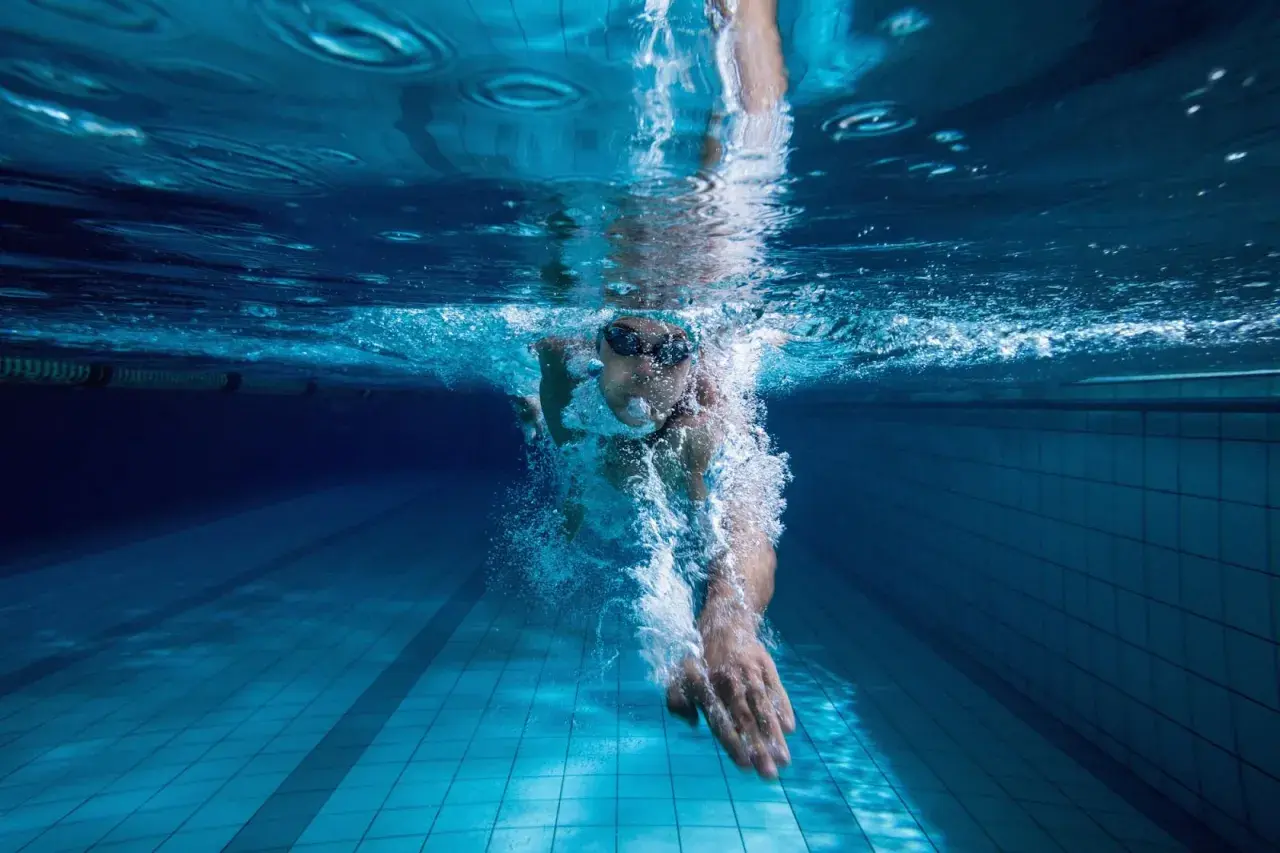
Building swim stamina is less about endless laps and more about the right mix of aerobic volume, controlled pace, and technique that still holds together when fatigue starts to bite. In this guide, I break down endurance swim workouts, the session structure that makes them effective, and the weekly rhythm I would actually use with a real swimmer. I’ll also cover how UK pool lengths change the feel of a set, because 25m and 50m training are not the same problem.
The fastest route to better swim stamina
- Three quality swims a week usually beat one huge session with no structure.
- Most stamina gains come from a mix of aerobic repeats, threshold work, and clean technique under fatigue.
- If your stroke count climbs sharply late in a set, your efficiency is dropping and the workout has gone off track.
- In the UK, 25m pools are common for short-course training, while 50m pools demand steadier pacing and better rhythm.
- Equipment helps, but it should support the session rather than replace normal swimming.
What endurance training in the pool is really building
When swimmers say they want more endurance, they usually mean four things at once: they want to breathe under control, hold pace for longer, keep their stroke neat when tired, and finish the session without feeling wrecked. A good stamina-focused swim should train all four, but not in the same way.
- Aerobic base gives you the ability to keep moving without flooding the body with fatigue too early.
- Stroke economy helps you travel farther per stroke, which matters more than raw effort when the set gets long.
- Pacing discipline teaches you not to go out too hard in the first third and pay for it later.
- Breathing control makes the session feel calmer and keeps form from falling apart under stress.
I find that many swimmers make the mistake of treating endurance like a single skill. It is not. It is a blend of fitness, rhythm, and efficiency, and the best workouts train that blend without turning every repeat into a survival test. Once you understand that, the next step is deciding what actually belongs in the session.
The session ingredients that matter more than raw distance
I like a simple structure: warm-up, a technically clean pre-set, the main set, and a short cooldown. When one of those pieces is missing, the workout usually becomes either too chaotic or too flat. If you want the session to build stamina instead of just collecting metres, each part needs a job.
Warm-up should usually be 400-800m, depending on the swimmer, and it should do more than just loosen the shoulders. I want a bit of easy swimming, a few drills, and a few build efforts so the body shifts from relaxed to ready. A build is a repeat that gets gradually faster, not a sprint from the first stroke.
The main set is where the real adaptation happens. For most swimmers, that means a total of roughly 1,200-2,500m of purposeful work, with enough rest to preserve form but not so much that the heart rate drops completely. For aerobic sessions, 10-30 seconds of rest is often enough. For threshold work, 20-45 seconds is more realistic.
The cooldown should be easy enough that the breathing settles and the shoulders stop feeling abrasive. I usually keep it at 200-400m, and if the swimmer is new to this kind of work, I would rather cut distance from the main set than skip the cooldown entirely.
One useful habit: count strokes on one length at the start of the workout and again near the end. If the number rises a lot, you are not just getting tired; you are losing efficiency. That gives you a much better clue than distance alone, and it leads naturally into how I would build a real week around those sessions.
A weekly structure I would use for most swimmers
For stamina building, I usually think in weeks rather than isolated workouts. One excellent session can leave you feeling good, but it does not create much adaptation on its own. Repetition does. For most recreational swimmers, three swims a week is the sweet spot: enough frequency to improve, not so much volume that quality collapses.
| Swimmer type | Sessions per week | Typical volume per session | Main emphasis |
|---|---|---|---|
| Returning or beginner | 2-3 | 1,200-2,000m | Technique, short aerobic repeats, one modest continuous swim |
| Intermediate | 3 | 2,000-3,000m | One aerobic session, one threshold session, one mixed-pace session |
| Advanced or triathlon-focused | 4 | 3,000-4,500m | Two aerobic or threshold sessions, one long set, one race-specific set |
I would rather see an intermediate swimmer do 3 x 2,400m with clear purpose than 1 x 6,000m once a week and call it training. The body adapts to repeatable stress, not random heroics. With the week shaped properly, the individual sessions become much easier to choose.

Four sessions worth repeating
The broken aerobic set
Set: 4 x 400m at steady aerobic effort with 20 seconds rest, then 8 x 50m drill-swim on short rest, then 200m easy.
This is the set I reach for when I want volume without turning the pool into a slog. The rest is short enough to keep the heart rate working, but the pace stays controlled enough that technique does not collapse. If you only ever swim this kind of session, you will miss some top-end work, but for base building it is hard to beat.
The threshold ladder
Set: 3 rounds of 400m, 300m, 200m, 100m at strong but repeatable pace, with 20-30 seconds rest between reps and 100m easy between rounds.
This is where pacing discipline gets tested. The reps get shorter, but they should not turn into reckless sprints. Threshold means the hardest pace you can repeat for a meaningful block without your stroke falling apart. If the first round feels heroic and the second round falls apart, the pace is too ambitious.
The pull-kick mix
Set: 6 x 200m alternating pull, kick, and swim, or 3 x 200m pull, 3 x 200m kick, 3 x 200m swim.
I like this for swimmers whose endurance is limited by one part of the body rather than the whole engine. Pull work can challenge the upper body, kick work can expose weaknesses in body position, and full swim ties it all back together. Used properly, equipment makes the set smarter. Used badly, it becomes a crutch.
Read Also: Pool Workouts for Weight Loss - Your Guide to Fat Burning
The negative split continuous swim
Set: 1 x 1,000m or 2 x 800m, with the second half slightly faster than the first half.
This is one of the most honest stamina tests you can do. It teaches you to settle early, stay patient, and finish with cleaner mechanics than you started. For open-water swimmers and triathletes, it is especially useful because it mirrors the mental discipline of long racing: do not panic early, do not drift late.
In a 25m pool, these sessions can feel a little friendlier because the turns give you more small recovery points and more speed off the wall. That does not make them easier in a training sense, though, so I still watch splits and stroke count instead of trusting feel alone. Once the sessions are in place, the next question is how hard they should feel.
How to pace the work without turning every session into a grind
I usually look at three things: pace, stroke quality, and effort. Heart rate can help, but in swimming it lags behind what you are actually doing, so I do not let it overrule what the splits and stroke pattern are telling me. A simple effort scale, or RPE, works well here; RPE means rate of perceived exertion, a 1-10 scale of how hard the work feels.
| Effort level | How it feels | Typical rest | Best use |
|---|---|---|---|
| Easy | Relaxed, conversational, loose shoulders | 10-20 seconds | Warm-up, cooldown, technique resets |
| Aerobic | Steady, controlled breathing, pace feels sustainable | 10-25 seconds | Long repeats, base building, density work |
| Threshold | Hard but repeatable, form still intact | 15-30 seconds | 100-400m repeats, stamina under pressure |
| Fast but controlled | Sharp, demanding, still technically tidy | 30-90 seconds | Short race-specific work and speed maintenance |
Common mistakes that quietly stall stamina gains
- Going hard every session turns endurance training into repeated fatigue, which is not the same thing as adaptation.
- Swimming too much with poor posture rehearses inefficient movement and makes tired shoulders feel inevitable.
- Resting too long between repeats reduces workout density, which weakens the stamina stimulus.
- Letting equipment do the work can mask weak body position, especially if fins or paddles dominate the session.
- Ignoring breathing rhythm often shows up as rushed strokes, lifted heads, and a messy finish to the set.
- Chasing distance before consistency usually leads to one big week and then a drop-off, which is a poor trade.
My bias is simple: I would rather cut 200m from a workout than let form disintegrate just to protect the number on the page. That is especially true in a sport where efficiency matters so much. The final layer is making the work fit the pools and schedules swimmers actually have in the UK.
The UK details that make planning easier
In the UK, I plan in metres and I assume many swimmers will train in 25m pools, even when their target event is long-course or open-water based. That matters because a 25m pool gives you more turns, more underwater work, and a slightly easier rhythm to settle into. A 50m pool forces you to hold form for longer between walls, which usually exposes pacing problems faster.
- 25m pool: useful for broken intervals, turn practice, and speed endurance.
- 50m pool: better for long-course specificity and steadier pacing.
- Open-water goal: add sighting practice and one continuous swim every 1-2 weeks if possible.
- Equipment: a snorkel, fins, or a pull buoy can help, but I would not use all of them in the same session unless there is a clear reason.
Swim England uses the short-course and long-course split for 25m and 50m pools, and that distinction matters more than many swimmers realise when they compare training pace to race pace. The wall count changes the feel of the session, so I always judge progress by the quality of the swimming, not just by how fast the clock looks. With that context in place, the smartest move is to focus on the few habits that make the whole plan work.
What I would prioritise before adding more metres
- Hold the same stroke count and body line for the full length of a main set.
- Swim three times a week before chasing bigger volume.
- Use one easy session, one threshold session, and one mixed-pace session as your baseline.
- Keep recovery honest so the next swim is useful, not just survivable.
- Only add metres once pace and technique stay stable under fatigue.
If I had to reduce the whole subject to one rule, it would be this: build stamina by swimming often enough to adapt, hard enough to matter, and clean enough to preserve form. That is where lasting endurance comes from, and it is what turns a pile of metres into real swimming fitness.