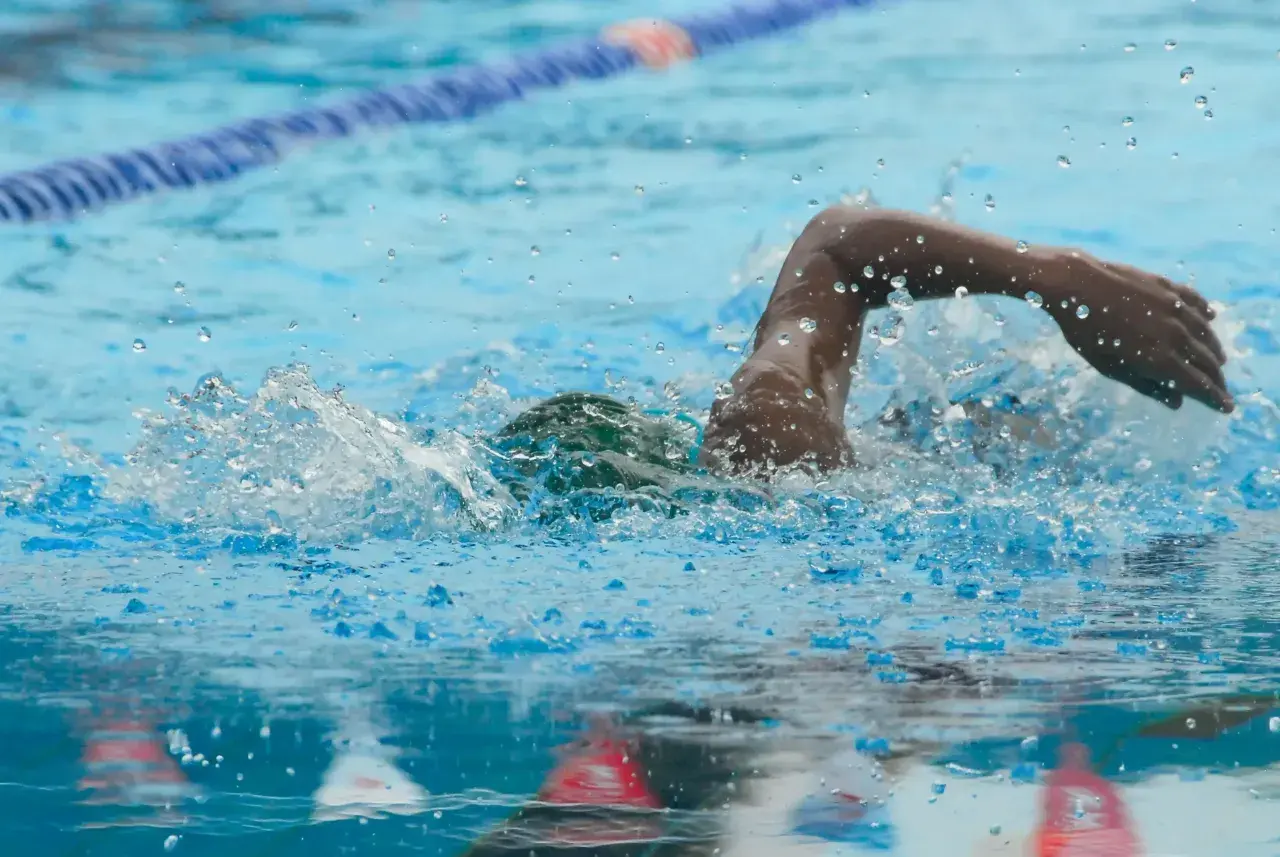
A good 1 hour swim workout should do more than fill the clock. It needs a clear warm-up, enough drill work to keep your stroke honest, a main set that raises fitness, and a cool-down that leaves you better than when you started. In this article, I break down a complete 60-minute pool session, show how to adjust it for different levels, and explain how to pace the work so it actually serves your training.
The hour should balance technique, effort and recovery
- Start with 10 to 12 minutes of easy swimming so breathing and body position settle before the hard work begins.
- Use drills with a purpose, not as filler, so the session improves stroke quality as well as fitness.
- Keep the main set long enough to build endurance or speed, but not so long that form falls apart.
- In UK pools, metres are the easiest way to plan the session, and a 25m pool makes it simple to track lengths.
- Match the rest to the goal: shorter rest for aerobic work, longer rest for faster repeats.
- A solid hour in the pool should feel productive, not chaotic.

What a productive hour in the pool should include
I like to think in blocks, not in random laps. The structure that works best for most swimmers is 10 to 12 minutes of warm-up, 8 to 10 minutes of drill work, 20 to 25 minutes of main work, a shorter speed or strength block, and a few minutes to cool down. That format gives you enough repetition to improve fitness while still protecting technique, which is the part that usually falls apart first when people simply try to swim for an hour.
There is a practical reason for that order. Early easy swimming raises core temperature, drills make you pay attention to body line and catch, and the main set does the heavy lifting for endurance or speed. When the session ends with controlled easy swimming, the next workout usually starts better too. From here, the question is not whether to train for an hour, but how to fill that hour in a way you can repeat.
A 60-minute session that fits most swimmers
The version below is the one I would hand to a busy swimmer who wants one session they can actually use. It works in metres, which makes it easy to follow in UK pools, and it scales well if you need to trim or extend the day.
| Block | Time | Example content | Why it matters |
|---|---|---|---|
| Warm-up | 10 minutes | 200 easy swim, then 4 x 50 as 25 drill and 25 swim with short rest | Raises temperature, settles breathing and prepares the shoulders |
| Technique set | 8 minutes | 4 x 50 with one clear cue each rep, such as catch-up, fingertip drag, single-arm work or light kick | Keeps the stroke organised before the main effort starts |
| Main set | 25 minutes | 8 x 100 at a steady aerobic pace on an interval that leaves 10 to 20 seconds rest | Builds fitness without turning the swim into a slog |
| Speed touch | 8 minutes | 6 x 50 strong with 20 to 30 seconds rest, or 8 x 25 fast with plenty of recovery | Keeps pace sharp and reminds the body how to move quickly |
| Cool-down | 5 to 7 minutes | 100 to 200 very easy swim, ideally mixed strokes | Brings the session down cleanly and helps the next workout feel better |
If you want one copy-and-go version, I would start with 400 easy swim, 4 x 50 drill and swim, 10 x 100 aerobic, 6 x 50 strong, and 200 easy to finish. That lands around 2,100 metres, although the exact time in the pool depends on rest, turn speed and how crowded the lane is. In a 25m pool, that is 84 lengths, so it is easy to track without overthinking it.
What matters most is not the exact number of metres but the balance between work and recovery. If the hour starts to feel rushed, cut a few repeats from the main set rather than deleting the warm-up or cool-down. That keeps the session useful instead of merely long, which is the next thing I want to refine by goal.
Three versions of the same hour, depending on your goal
Once the basic structure is in place, I usually change only one major variable at a time: endurance, speed or recovery. That keeps the workout coherent and makes progress easier to read.
| Goal | Main focus | Example main set | Typical total distance | Best when |
|---|---|---|---|---|
| Steady fitness | Controlled aerobic work with clean form | 6 to 10 x 100 at a repeatable pace with short rest | 1,800 to 2,400m | You want better general fitness or you are building back after time away |
| Speed and power | Short, fast repeats with longer recovery | 12 x 50 strong, then 8 x 25 fast and relaxed | 1,400 to 2,000m | You need sharper turnover and better quality under pressure |
| Technique and recovery | Easy swimming, drills and light pace changes | 8 x 50 drill and swim, then 6 x 50 smooth build | 1,200 to 1,700m | Your shoulders are tired, the week was hard, or you need a cleaner session |
For most swimmers, I like one hour each week to lean on endurance, one to lean on speed, and one to lean on technique. You do not need to do everything in every session. In fact, trying to do everything at once is how a lot of swimmers end up with mediocre workouts and tired shoulders. Once you know the goal, the pacing becomes much easier to set.
How to pace the work so the hour stays useful
Three terms matter here: send-off, pace clock and RPE. A send-off is the departure time for each repeat, the pace clock is simply the pool clock you leave on, and RPE means rate of perceived exertion on a 1 to 10 scale. Those three tools are enough to build a good swim session without turning the pool into a maths exercise.
For aerobic work, I usually aim for about 10 to 20 seconds of rest per repeat. That is enough to keep form tidy while still creating a training effect. For speed work, 30 to 60 seconds of recovery is often the better choice because quality matters more than density. If your 100m repeats are around 1:40 and you leave on 1:55, you get 15 seconds of rest, which is usually a sensible aerobic target. If that rest shrinks to a few seconds by the third or fourth repeat, the interval is too tight for that day.
My rule is simple: choose the effort first, then choose the interval. A threshold set should feel hard but repeatable, not like a series of survival swims. A speed set should feel fast but technically clean, not chaotic. If you finish a rep and the stroke already looks messy in the mirror or on the pool clock, the pace is too ambitious. That leads naturally to the mistakes I see most often.
The mistakes that waste a perfectly good swim hour
- Starting too hard. If the warm-up becomes a race, the main set usually pays for it later.
- Choosing intervals that are too tight. A set with no breathing room quickly becomes sloppy, especially in the second half.
- Letting drills turn into lazy swimming. A drill only works if you keep the cue specific, such as a cleaner catch or better balance.
- Chasing distance instead of purpose. More metres are not always better if the stroke quality is falling apart.
- Skipping the cool-down. Five easy minutes can make the next session feel noticeably better.
- Ignoring shoulder warning signs. A dull muscular burn is normal; sharp pain is not something to train through.
I also see swimmers add tools too early. Paddles, for example, can be useful later, but they are not the place to start if your stroke is still unstable. Once those traps are out of the way, the gear and pool setup matter more than most people expect.
The kit and pool details worth sorting out first
I would keep the equipment list short. Goggles are non-negotiable, a cap is usually worth having, and a pace clock or waterproof watch helps keep the session honest. After that, the useful extras depend on the session, not the other way round.
| Item | Best use | My take |
|---|---|---|
| Goggles | Every session | Choose a pair that seals well and does not leak halfway through the main set |
| Cap | Comfort and drag reduction | Useful, especially in busy leisure centres where hair and water mix badly |
| Pace clock or watch | Intervals and rest control | Essential if you want a repeatable workout rather than random laps |
| Pull buoy | Upper-body focus and body position | Helpful for selected sets, but not a substitute for good alignment |
| Kickboard | Kick sets and leg-focused work | Good in moderation; too much can overload the lower back or shoulders |
| Short fins | Body line and rhythm | Useful for technique and some speed work, but they should support the set, not define it |
If you train in a 25m pool, the maths is straightforward: 100m is four lengths, 200m is eight, and 400m is sixteen. That makes a session easier to follow when the lane is busy or the wall is crowded. I also like swimmers to bring water, because a one-hour pool session still counts as real training and dehydration creeps up faster than people expect.
Once the kit is right and the clock is visible, the last step is making the same hour better over time rather than just repeating it.
The simplest way to keep the same hour improving
The cleanest progress plan is to keep the structure steady and change only one thing each week. Week one is for learning the pace. Week two can add a repeat or slightly tighten the main set. Week three can trim a little rest, usually by 5 seconds on aerobic work. Week four should make the session look neater, not necessarily harder.
If you swim two or three times per week, I would also rotate the emphasis. One session can be endurance-led, one technique-led, and one faster, shorter set. That gives you a better mix than trying to make every swim solve every problem. In practice, that is how a one-hour pool session stops being a placeholder and starts becoming part of a real training plan.Keep the structure, respect the rest, and let the main set match the day’s goal. That is usually enough to turn a simple hour in the pool into a session that genuinely moves your swimming forward.
