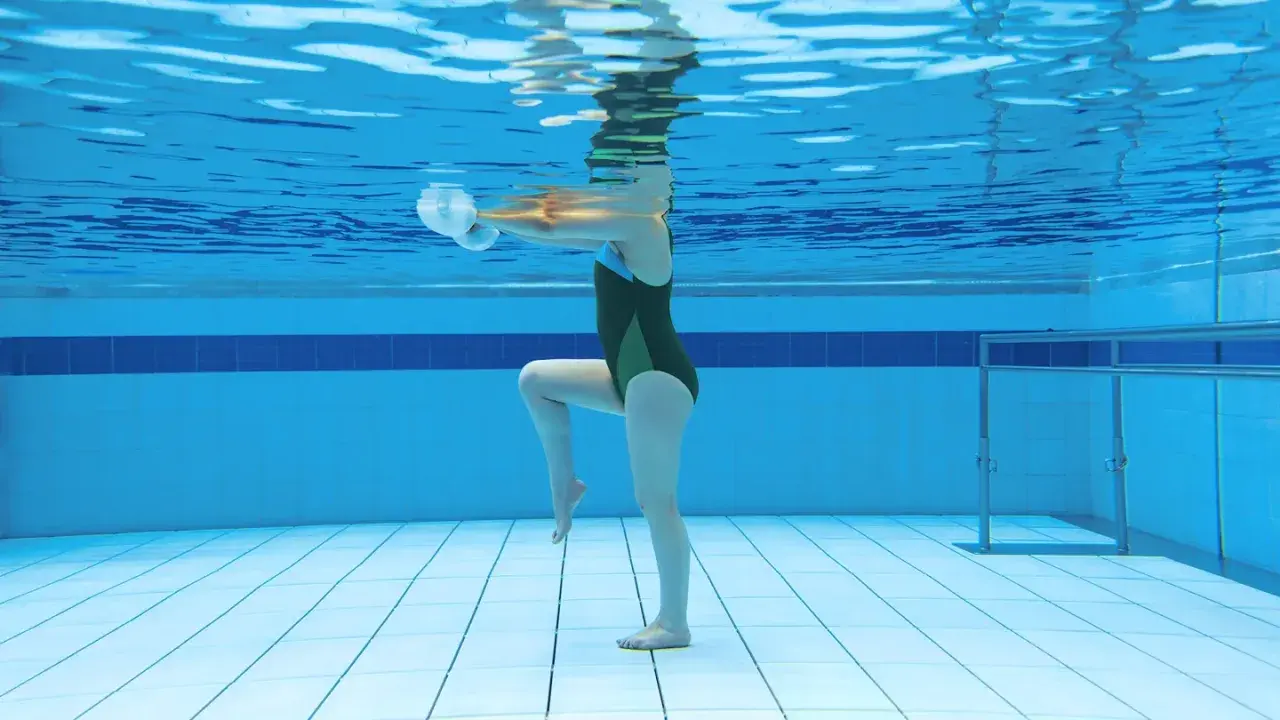
Pool running sits in a useful middle ground: it keeps the heart rate up, loads the legs and trunk, and removes the repeated impact that makes land running hard to recover from. The main running in water benefits are joint relief, steady aerobic conditioning, and enough resistance to challenge the hips, core, and arms at the same time. For swimmers, it is also a clean way to add fitness work between hard swim sets without piling on extra pavement stress.
The fastest way to judge whether pool running is worth it
- It is low-impact but not low-effort, so you can train hard without pounding your joints.
- Water adds resistance in every direction, which makes posture and cadence matter more than stride length.
- It is especially useful for injury layoffs, recovery days, hot-weather training, and cross-training blocks.
- Deep water gives the most unloading; shallow water is easier to learn but does not reduce impact as much.
- Heart rate can behave differently in water, so effort and breathing are often better guides than land-based pace.
What pool running actually does to your body
When I talk about aqua jogging or deep-water running, I am really talking about a running pattern performed in an aquatic environment where buoyancy changes the rules. Water supports part of your body weight, so the knees, ankles, hips, and spine get a break from repetitive impact. At the same time, the water’s resistance forces every arm swing and leg drive to work against drag, which keeps the session honest from a training point of view.
That combination is what makes pool running interesting. You get the feel of locomotion and the cardiovascular demand of a real workout, but without the same ground reaction forces you get on a treadmill or road. In practical terms, it is a strong option when you want to keep training quality high while lowering mechanical load. Once you understand that balance of unloading and resistance, the benefits become much easier to judge.
The benefits that matter most for runners and swimmers
The biggest win is simple: you can keep building or maintaining fitness when land running is too costly for your body. That is why I like it for runners with cranky knees or Achilles tendons, but also for swimmers who want a second conditioning tool that does not beat up the legs.
- Less joint stress - Buoyancy reduces impact, which makes pool sessions valuable during injury rehab, return-to-run phases, or higher-volume training weeks.
- Solid aerobic work - If you keep the effort honest, pool running can keep your cardio system working hard even when your feet never touch the deck.
- Useful strength endurance - Water resistance recruits the hips, glutes, calves, shoulders, and core in a way that steady land running does not.
- Better form awareness - The slower, more controlled movement makes sloppy mechanics obvious. That is a feature, not a flaw.
- Recovery without inactivity - It lets you stay moving on days when a run would be one stressor too many.
- Useful in hot or crowded training weeks - A pool gives you a controlled environment when outdoor running is uncomfortable or when you need to keep impact down.
I also like it for athletes who need a bridge between swimming and dry-land conditioning. It is not the same as land running, but it is far from a “light” workout if you program it with intention. Those advantages only pay off, though, if the mechanics are clean.
How to do it well in the pool
Form matters more in water than many people expect. If you try to imitate land running too literally, you usually end up pedaling, twisting, or moving so slowly that the workout never really gets going. I prefer a tall, stacked posture with a slight forward lean, quick cadence, and compact arm drive.
- Stay tall through the torso - Think long spine, ribs down, and a steady core rather than a loose, flailing upper body.
- Drive the knees with intent - The motion should look like running, not cycling.
- Keep the turnover quick - Water slows you down, so cadence is usually a better target than stride length.
- Use the arms actively - Strong, controlled arm action helps balance the body and adds training load.
- Choose the right depth - Chest-to-neck depth is the usual sweet spot for deep-water work; shallower water changes the loading and the feel.
- Wear a flotation belt in deep water - It helps you stay upright and lets you focus on effort instead of fighting to keep your head positioned correctly.
If the goal is fitness, I usually advise people to judge intensity by breathing and effort first. Heart rate can read differently in water than it does on land, so chasing a treadmill-style number can be misleading. With the mechanics set, the next question is whether deep water or shallow water fits the job better.
Deep water and shallow water are not the same workout
Both styles can work, but they are not interchangeable. Deep water is the more unloading option, which makes it better for reducing impact and protecting sore joints. Shallow water is easier for beginners because you can touch the bottom, but that also means the session feels more load-bearing and a little closer to land exercise.
| Feature | Deep water | Shallow water |
|---|---|---|
| Impact | Minimal, because you are essentially non-weight-bearing | Lower than land running, but still more contact and load |
| Best use | Rehab, recovery, protected cardio, injury-prone athletes | Entry-level sessions, technique practice, easier access |
| Equipment | Flotation belt is usually helpful | Often workable without flotation support |
| Training feel | More core control, more unloading, less familiar at first | More accessible, slightly more leg loading |
If you want the closest thing to running without pounding, deep water wins. If you want something more approachable or you are still building confidence in the pool, shallow water is a reasonable stepping stone. That choice matters because a lot of bad pool sessions are really just bad programming.
Common mistakes that reduce the training effect
The most common mistake is treating pool running like a casual warm-up and expecting land-level fitness gains from it. The second is trying to recreate your normal stride too literally. Water changes the mechanics, so overstriding and excessive forward reach usually just waste energy.
- Going too easy for too long - If the effort never rises above a comfortable jog, the cardio stimulus is limited.
- Using pace instead of effort - In water, speed is a poor measure of quality. Effort, posture, and breathing matter more.
- Letting the trunk collapse - A soft core turns the movement into noise instead of useful work.
- Overlooking cadence - Too much pause between steps makes the session feel clunky and less specific.
- Staying too shallow when you need unloading - If the goal is rehab or joint relief, depth is not a small detail.
- Doing no structured intervals - Most runners and swimmers get more from short controlled efforts than from endless unstructured jogging in place.
My rule is simple: if the session feels like you could have done it by accident, it was probably not hard enough. Once that is fixed, the next step is fitting pool running into a week in a way that actually supports swim training and fitness.
A simple week of pool running that actually fits into training
I like pool running most as a tool, not as a lifestyle. It works best when it fills a clear role in the week: recovery, aerobic maintenance, or a hard cardio day when land impact is off the table. If it is replacing your main run, the session should be structured. If it is supporting swim training, it should fit around the sessions that matter most in the pool.
- Recovery session - 20 to 30 minutes easy, with relaxed breathing and smooth posture.
- Steady aerobic session - 30 to 45 minutes at a controlled, conversational effort.
- Interval session - 10 minutes easy, then 6 to 10 repeats of 1 to 3 minutes hard with equal easy recovery, then a cool-down.
If pool running is carrying most of your aerobic work, the CDC’s 150-minute weekly target for moderate-intensity activity is a useful benchmark. I would not force every pool session to be moderate in the same way, but that number gives you a practical floor when you are building or maintaining general fitness. From there, the right mix depends on whether you are rehabbing, cross-training, or simply reducing impact during a busy training block.
Where I would be cautious before making it the main event
Pool running is excellent for preserving fitness, but it is not a complete substitute for land running if your event demands land impact, bone loading, or race-specific mechanics. That is the part people sometimes miss. You can protect your joints in water and still lose some of the durability that comes from running on firm ground.
I would also be careful with expectations in rehab. If pain is the reason you moved to the pool, the goal is consistent training with fewer symptoms, not proving toughness in deep water. If the motion aggravates the injury, or if balance and swimming comfort are not there yet, the safer move is to scale the depth, shorten the work, or get professional input before pushing harder. Used that way, pool running becomes a sharp training tool rather than a gimmick, and that is exactly where it earns its place in a swimmer’s or runner’s week.