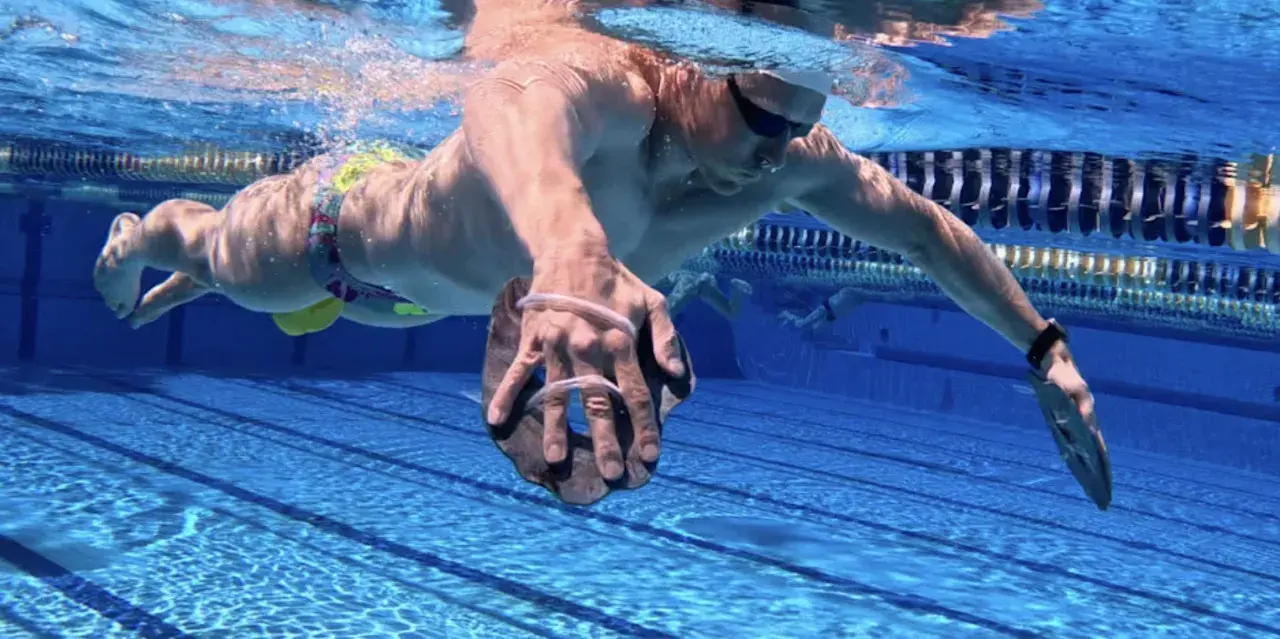
Hand paddles can be one of the most useful tools in the pool, but only when they are used to sharpen the stroke rather than chase brute force. A paddle drill is best treated as feedback: it magnifies what your hands, forearms, shoulders, and body line are already doing, so clean technique feels better and sloppy technique becomes obvious fast. In this guide I’ll show what it trains, how to use it safely, which paddle style fits which goal, and a simple session structure that works for fitness as well as form.
What matters most before you add paddles to a swim set
- Technique comes first. Paddles expose a good catch, but they also expose a weak one.
- Start small. Smaller or more flexible paddles are easier on the shoulders and easier to control.
- Use them for feedback. They should make your entry, catch, and pull feel clearer, not just harder.
- Keep the volume modest. Short, focused repeats are more useful than long sloppy sets.
- Stop at the first warning sign. Shoulder pain is a reason to reduce load, not push through.
What the drill is really training
The main job of hand-paddle work is not to make you feel strong for the sake of it. It trains the catch, the pull-through, and your ability to hold pressure on the water without collapsing your stroke. Because the paddle increases the surface area of your hand, you have to organise the stroke better through the front end of the pull, keep the elbow from dropping, and stay balanced through the torso.
That is why swimmers often notice two things at once: they feel more load in the lats, shoulders, and triceps, and they also become more aware of how the hand enters and how the forearm sets. That awareness matters for fitness too. Better water connection usually means you waste less energy per length, which is useful whether you are building aerobic base, improving pace control, or trying to hold form late in a main set.
I also like paddles as a pacing tool. They slow some swimmers down just enough to make them swim with intention instead of rushing the turnover. If you can keep pressure on the water at a controlled rhythm, you are usually working the stroke more intelligently, not just harder. That leads naturally into the next question: how do you use them without turning the session into a shoulder test?How to swim it without turning it into shoulder work
The safest way to use hand paddles is to treat them as a short technical load, not a default for every pull set. I would always warm up without them first, because you want the shoulders, core, and breathing rhythm settled before you add resistance.- Begin with normal swimming. Get 200-400m of easy freestyle in first, then decide whether the stroke feels stable enough for paddles.
- Keep the first set short. Four to six 50s is usually enough to get feedback without overloading the shoulder.
- Use a calmer stroke rate. If the turnover gets frantic, the hand starts fighting the water instead of holding it.
- Pair with a pull buoy when needed. A buoy can help keep the hips up so the upper body is not fighting a sinking body line at the same time.
- Leave something in reserve. If your form collapses before the end of the repeat, the set is too long or the paddle is too large.
One practical rule I use is to keep all equipment-based swimming, including paddles, to no more than about half of weekly volume. So if you swim 8,000m in a week, roughly 4,000m with gear is a sensible ceiling for many recreational and club swimmers. That is not a universal law, but it is a useful guardrail. From there, the real decision becomes which paddle style actually matches your goal.

Which paddle style matches your goal
Not every paddle is trying to do the same job. Some are built to make the stroke more efficient, while others are there to add resistance and build strength. If you choose the wrong one, the session can become too hard too soon.| Goal | Best paddle style | Why it works | When to avoid it |
|---|---|---|---|
| Technique feedback | Small technique paddles or strapless styles | They punish poor entry and dropped elbow quickly, so you feel errors early. | When your shoulder is already irritated or your stroke is very unstable. |
| Strength endurance | Medium paddles with a secure finger strap | They add enough load to challenge the pull without demanding huge force. | When you start forcing the water or losing body position. |
| Power and race prep | Larger paddles for short repeats | They increase resistance, which is useful for controlled sprint work. | On long sets or if you have not built tolerance gradually. |
| Shoulder-friendly learning | Flexible or perforated paddles | They create less drag and give a softer introduction to hand-paddle work. | When you want maximum resistance from a well-trained stroke. |
My preference is simple: if you are still building a clean catch, use the smallest paddle that gives you useful feedback. If you already hold the water well, you can progress size more carefully. The point is not to prove strength. The point is to get a cleaner pull that transfers back to normal swimming.
The drills that make the biggest difference
These are the drill patterns I find most useful because they keep the focus on mechanics rather than ego. They work especially well in front crawl, but the same ideas can be adapted to other strokes where appropriate.
Sculling for water feel
Sculling teaches you to sense pressure on the palm and forearm. With paddles on, the feeling becomes louder, which helps swimmers understand how to hold the water in the first part of the catch. I like short reps here because the goal is control, not fatigue.
Catch-up freestyle for timing
Swim freestyle but wait until one hand reaches the front before the other starts the next pull. The paddle makes crossover and messy entry harder to hide, so you notice whether your hands are entering shoulder-width apart and whether your rhythm stays calm.
Single-arm freestyle for balance
Swimming one arm at a time isolates the pull and shows whether one side is doing more work than the other. This is useful when you want to improve alignment, rotation, and the path of the underwater pull. Switch sides every 25m or 50m so the body stays honest.
Fingertip drag for a smoother recovery
Dragging the fingertips along the surface during recovery encourages a relaxed, high-elbow return. The paddle adds enough extra awareness that awkward recovery mechanics become obvious very quickly. This is a fine drill for swimmers who rush the arm over the water and lose rhythm.
I would rather see six clean 50m repeats with one of these patterns than a long set where the last half turns into survival mode. That is where most of the value sits: in the quality of the movement, not the distance covered while the stroke falls apart.
Common mistakes I would not ignore
Most problems with paddles come from using too much resistance too early, or from treating them like a strength toy instead of a technical tool. If you want the drill to help your swim rather than punish it, these are the mistakes to watch for.
| Mistake | Why it matters | Better choice |
|---|---|---|
| Starting with oversized paddles | They can overload the shoulder before the stroke has adapted. | Begin with small or medium paddles and build gradually. |
| Using them in the warm-up | Cold shoulders do not tolerate extra drag well. | Warm up first, then add resistance after the stroke feels settled. |
| Letting the wrist straps do the work | You can hide a poor catch instead of fixing it. | Choose a setup that gives honest feedback and forces better hand pressure. |
| Chasing speed instead of shape | The stroke gets noisy, rushed, and inefficient. | Keep the turnover calm and the entry clean. |
| Ignoring shoulder discomfort | Pain often gets worse when resistance is repeated. | Reduce size, shorten the set, or drop paddles completely. |
The simplest test is this: if the set makes you feel more aware of your stroke, it is probably useful. If it makes you feel like you are muscling your way through the water, the load is too high or the technique is not ready for it.
A simple pool session that makes the drill pay off
If I were building a practical session around hand paddles in a 25m pool, I would keep it focused and repeatable rather than complicated.
- 200m easy freestyle and mixed stroke warm-up, no paddles
- 4 x 50m scull or catch-up drill with small paddles, 15-20 seconds rest
- 4 x 100m pull with paddles and a pull buoy, smooth pace, 20-30 seconds rest
- 4 x 50m freestyle without paddles, trying to keep the same water feel
- 200m easy cool-down
For a more strength-focused day, I would shorten the repeats and increase the quality, not the size of the paddles. For example, 8 x 25m hard but controlled pull can be more useful than a long grind that turns the shoulders into the limiting factor. The transfer back to normal swimming is usually better when the session ends with a clean stroke pattern rather than with exhaustion.
What good paddle work leaves behind
The best sign that you used paddles well is not that your arms are tired. It is that your next few lengths without them feel more organised. The entry is cleaner, the catch holds better, and the body line stays calmer under effort. That is the real value of this tool for swim training and fitness: it helps you notice what efficient pulling actually feels like, then carry that feeling back into ordinary swimming.If you keep the load modest, choose the right paddle size, and stop before form slips, this kind of work can improve strength, stroke awareness, and pacing without turning the session into a shoulder problem. That is the balance I would aim for every time: enough resistance to teach, not so much that it rewrites the stroke in the wrong direction.