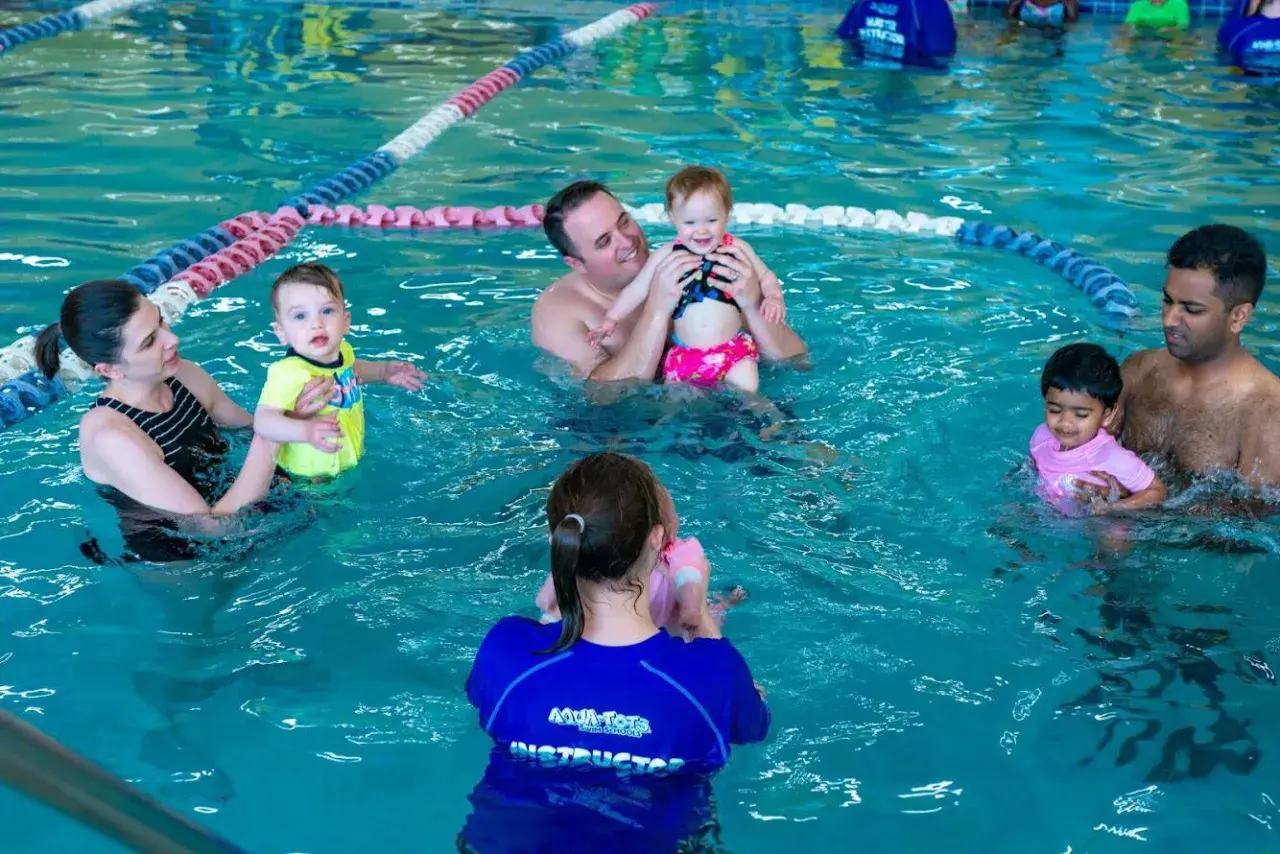
The main things to know before choosing a class
- Goal first: early lessons should build water comfort, safe entries and exits, breath control, and basic floating before anything looks like “real” swimming.
- Instructor quality matters most: look for current CPR/First Aid, recognized swim-teaching credentials, and a class that stays small enough for real feedback.
- Format should match age: parent-child classes fit the youngest swimmers, small groups work for many preschoolers, and private lessons help anxious or fast-moving learners.
- Progress should be visible: a good program shows gradual gains over multiple sessions, not big promises after one class.
- Cost varies by format: in many U.S. markets, group lessons are far cheaper than private sessions, but private instruction can be worth it when attention is the bottleneck.
What these early lessons are really meant to build
The right toddler program is not trying to produce a tiny competitive swimmer. It is teaching a child to enter the water calmly, tolerate splashes, blow bubbles, float with support, and respond to a teacher’s cues. I also like programs that treat water competence as the real objective: the child should become safer around water, not merely look cute in a class photo.
That matters because the risk side is real. USA Swimming notes that drowning is the second leading cause of unintentional injury death for children under 14, with the highest rates among ages 1 to 4, and it cites research showing formal lessons are associated with a much lower drowning risk. In plain English, early instruction is not a luxury add-on; it is a meaningful safety layer.
For the youngest children, progress is usually tiny and still worthwhile. A toddler who enters the pool without panic, reaches for the wall, or rolls to the back with help is already building a foundation. Some parent-child programs begin before walking age, because the early goal is comfort and routine, not independent swimming.
The point is simple: if a program skips comfort and tries to rush stroke mechanics, the child often pays for it later in fear or resistance. Once the goal is clear, the next question is who is teaching and how the class is managed.

What to look for in the instructor and the pool
I pay close attention to the adult in the water before I look at the website copy. A strong instructor should have training in a recognized learn-to-swim method, current CPR and First Aid, and enough experience with babies or preschoolers to keep the class calm when a child gets hesitant.
HealthyChildren.org recommends experienced, qualified instructors and lifeguards with current CPR and First Aid, and I agree with that standard completely. I also want parents to be able to watch from a designated area, because seeing the lesson tells you far more than any marketing page can.
- Small ratios: for very young beginners without a caregiver in the water, a ratio of 1:4 or fewer is the benchmark I want to see; once it creeps toward 1:6, attention starts to thin out.
- Visible supervision: parents should be able to watch the lesson from a designated area, and the staff should be comfortable explaining what they are doing and why.
- Clear feedback: instructors should tell you what your child practiced, what improved, and what comes next instead of just saying “good job” and moving on.
- Safe environment: the deck should feel organized, the water should be clean, and the schedule should not be so chaotic that children spend most of the time waiting.
- Age-appropriate pace: songs, repetition, and short skill blocks usually work better than long drills for toddlers.
For under-4s, I want the lesson to feel age-appropriate in the broadest sense: emotionally safe, physically supported, and still respectful of water. That is where many programs either earn trust or lose it, and it leads directly to the question of format.
How to choose between parent-child, group, and private formats
The format matters as much as the curriculum. In the U.S., many toddler lessons are either parent-child, small group, or private, and each has a different job.
| Lesson format | Best for | Strengths | Trade-offs | Typical price signal |
|---|---|---|---|---|
| Parent-child | Babies and toddlers who need reassurance and routine | Parent stays close, child relaxes faster, and skills transfer well between class and home | Slower independence and more parent involvement | Usually the lowest cost, often billed per month or package |
| Small group | Many preschoolers and confident toddlers | Social learning, predictable routine, better affordability | Less one-on-one correction and some waiting time | In many markets, roughly $25-$40 per class |
| Private or semi-private | Anxious children, fast catch-up, or kids who need more individualized coaching | Most targeted feedback and faster adjustment | Highest cost and less peer motivation | Commonly $50-$200 per session depending on city and length |
My own rule is straightforward: if your child is nervous, private can be worth the money; if your child loves the water but needs structure, a small group is usually the sweet spot; if your child is very young, parent-child classes often make the first months easier. The trick is to match the format to the child, not to the marketing on the sign.
That choice only works if the class teaches the right skills in the right order, which is the next thing I would check.
What toddlers should learn first and what comes later
For toddlers, I care less about polished strokes and more about a sequence that makes sense. Early milestones are usually comfort, buoyancy, breath control, and the ability to move to a wall or adult on command. HealthyChildren.org recommends that, as children grow, broader water competency should eventually include getting to the surface, propelling themselves at least 25 yards, and getting out of the water, but toddlers should reach those benchmarks gradually, not all at once.| Age band | What matters most | Good signs |
|---|---|---|
| 6 months to 3 years | Comfort, trust, and basic body position | Easy separation and reunion routines, assisted back floats, kicking, blowing bubbles, reaching for the wall |
| 3 to 4 years | Simple propulsion and safer responses | Short independent swims with support nearby, submersion tolerance, turning to breathe, climbing out safely |
| 4 to 5 years | More independence and repetition | Better front and back movement, longer attention span, more consistent face-in-water work |
| 5+ beginners | Efficiency and endurance basics | More deliberate breathing, streamlining, and movement over longer distances |
I like this staged approach because it keeps expectations honest. A toddler class is successful when a child leaves a little more comfortable, a little more coordinated, and not overwhelmed.
That makes the final question practical rather than emotional: what should you check before paying for the first month?
The checklist I use before I enroll a child
Before I enroll, I do a quick reality check. If a program cannot answer these questions clearly, I move on.
- Who will teach the class, and can I meet that instructor before the first lesson?
- What training and certifications do the instructor and lifeguards have?
- How large is the class, and what is the ratio for young beginners?
- How much of the lesson is active water time versus waiting on the deck?
- How do you measure progress, and when do children move up?
- What is expected of parents in and out of the water?
- What happens if my child cries, refuses, or misses a week?
- Is the pool warm, clean, and easy to access without a chaotic deck or slippery bottlenecks?
I also watch for one subtle sign: whether the instructor can keep the class moving without rushing the child. The best toddler programs feel structured, not frantic. They repeat the same safety habits long enough to make them stick, and they leave room for a child’s mood on any given day.
If I had to reduce the whole decision to one sentence, it would be this: choose the class that teaches small water-safety wins well, in a calm environment, with an instructor who understands that trust comes before technique.
