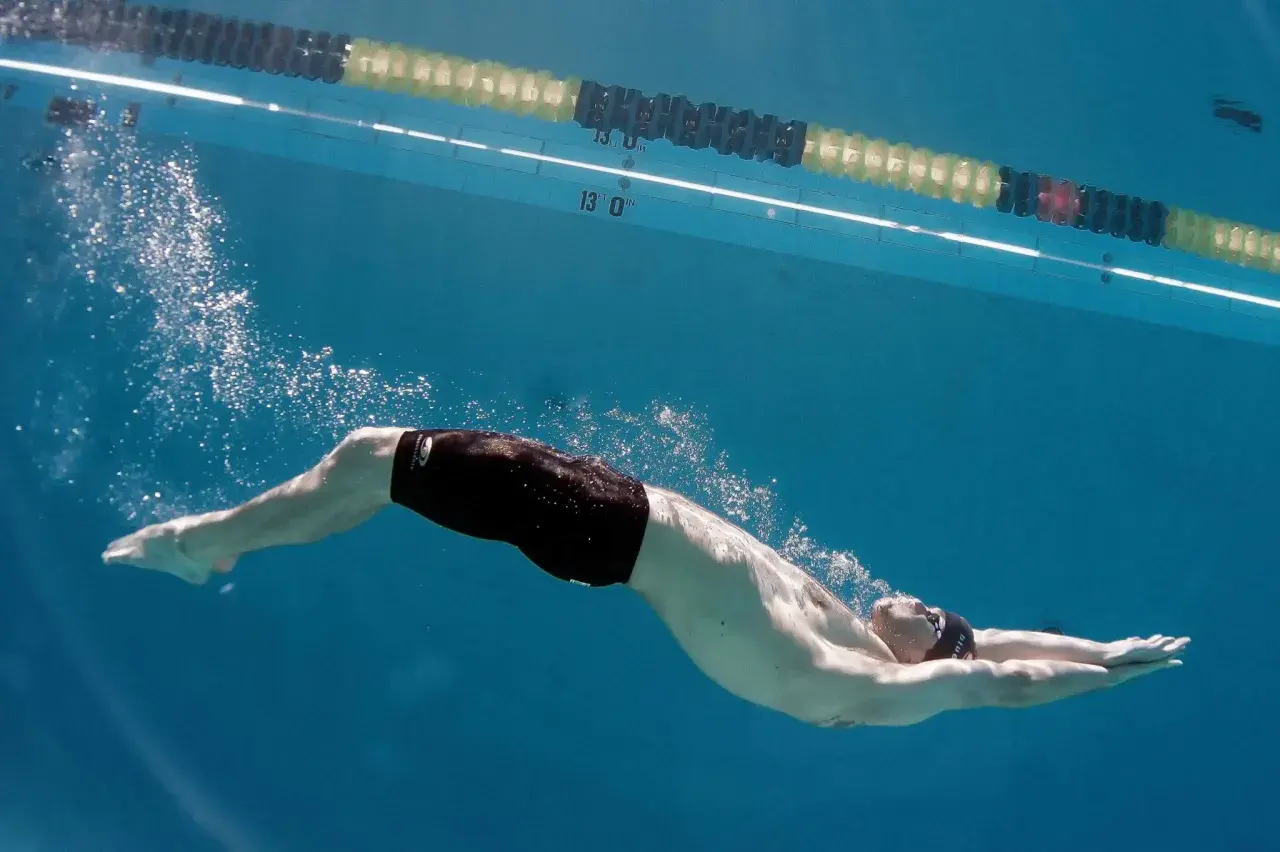
Strong legs matter in swimming, but the best leg workouts for swimmers do more than build sore quads. The real target is a kick that keeps the hips high, drives clean push-offs, and still works when fatigue sets in late in the race. In this article I break down what to train, which exercises actually carry over to the pool, how often to lift, and what usually gets in the way of progress.
The main things this plan needs to improve
- Kick quality by improving hip drive, ankle mobility, and leg alignment.
- Starts and turns by building force for stronger push-offs from the wall.
- Late-race durability so the kick does not collapse when breathing gets hard.
- Single-leg control to reduce side-to-side imbalances that show up in the pool.
- Training efficiency with two focused lower-body sessions per week for most swimmers.
Why lower-body strength changes swimming performance
Swimming is not won by the legs alone, but the legs do more than many people give them credit for. They help set body position, keep the hips from sinking, add speed off starts and turns, and support the last 10 to 15 meters when technique tends to fall apart. In my experience, swimmers often notice the biggest payoff in the water not from looking stronger in the mirror, but from feeling less drag and cleaner acceleration in streamline.
Ankle mobility matters here more than most gym-only athletes expect. If the ankles are stiff, the foot becomes a worse lever and the kick gets blunt. U.S. Masters Swimming has long emphasized that point in its lower-body dryland work: improve the range of motion, build force where it counts, and the kick gets more useful without becoming sloppy. That is the right lens to keep in mind. Once you accept that, the next step is knowing which muscles actually deserve the workload.
The muscles and movement patterns that matter most
I do not think of swimmer leg training as one big block called “leg day.” I think of it as a set of movement patterns that support the way the body behaves in water. Some muscles create force, others stabilize the hips and knees, and a few are there mainly to help the feet stay pointed and the legs stay aligned.
| Area | Why it matters in the water | What weakness usually looks like | Useful exercises |
|---|---|---|---|
| Glutes | Drive hip extension, help hold a higher body line, and support strong wall push-offs. | Hips sink, turn drive feels soft, and the kick looks disconnected. | Hip thrusts, bridge marches, split squats. |
| Hamstrings | Support hip extension and help control the leg through each kick cycle. | The back side of the leg never feels fully involved and sprint speed fades early. | Single-leg RDLs, leg curls, staggered hinges. |
| Quads | Help with knee drive and forceful extension off the wall. | Push-offs feel weak and the kick loses snap. | Split squats, step-ups, squat jumps. |
| Adductors | Keep the legs tracking cleanly and matter especially for breaststroke. | The knees drift apart and the kick loses shape. | Lateral lunges, side lunges, controlled adductor work. |
| Calves and ankles | Help keep the feet pointed and make the foot a better lever. | Floppy feet, weak finish, and less useful propulsion. | Standing calf raises, seated calf raises, ankle mobility drills. |
That is why I push swimmers toward both bilateral and single-leg work. A barbell squat may build useful general strength, but if one leg always takes over, the pool will eventually expose it. The goal is not to train every muscle equally; it is to train the muscles that keep the kick efficient under fatigue. That leads straight into the exercises I would actually put on the list.

The exercises that transfer best to the pool
When I build a lower-body plan for a swimmer, I care less about novelty and more about transfer. The following exercises show up often because they cover the biggest needs: force production, single-leg control, ankle position, and explosive finish. They are also easy to scale up or down depending on age, training age, and the amount of swim work already in the week.
| Exercise | Why it helps swimmers | Suggested dose | Key cue |
|---|---|---|---|
| Split squat | Builds unilateral strength for turns, starts, and side-to-side balance. | 3 sets of 6 to 8 reps per side. | Keep the front knee stacked and the torso tall. |
| Single-leg Romanian deadlift | Trains the glutes and hamstrings while forcing hip control. | 3 sets of 6 to 8 reps per side. | Push the hips back and keep the pelvis square. |
| Lateral lunge | Targets the adductors and groin, which matters more than most swimmers think. | 2 to 3 sets of 6 reps per side. | Sit into the stepping hip without collapsing the knee. |
| Hip thrust or bridge march | Builds glute power and helps keep the pelvis stable in streamline. | 3 sets of 8 to 12 reps. | Finish with the ribs down, not an over-arched back. |
| Standing or seated calf raise | Improves foot position and calf endurance for long sets and repeated push-offs. | 3 sets of 12 to 20 reps. | Use a full stretch and a brief pause at the top. |
| Split jump or squat jump | Turns strength into speed for late-race kick and explosive wall work. | 3 sets of 3 to 5 crisp reps. | Land softly and stop the set before it turns sloppy. |
If you only had time for four movements, I would keep the split squat, single-leg RDL, lateral lunge, and calf raise. U.S. Masters Swimming’s lower-body routines lean on ankle mobility, staggered hinges, lateral work, bridge variations, and small jumps for a reason: that mix maps well to the kick and the push-off. The mistake is not usually exercise selection. It is piling on too much volume, too much fatigue, or too much load before the swimmer can own the movement.
For the best carryover, I like a simple rule: earn the right to go faster. First get clean positions and full control, then add speed.
How I would program this into a swim week
The current ACSM guidance still supports resistance training at least two nonconsecutive days per week, and that fits swimmers well. Two focused lower-body sessions are usually enough if the pool work is already demanding. I prefer one day that is more strength-biased and one day that is more power- and stability-biased.
| Session | Main goal | Example structure |
|---|---|---|
| Day A | Build force | Split squat 3 x 6, single-leg RDL 3 x 6, calf raise 3 x 12, bridge march 2 x 10. |
| Day B | Turn force into speed | Lateral lunge 3 x 6, hip thrust 3 x 8, split jump 3 x 4, calf raise 2 x 15, ankle mobility 5 minutes. |
That template works because it separates the heavy work from the explosive work without making the week feel like a second full-time sport. If you are already experienced with lifting, heavier main lifts can sit around 80% of 1RM for a few clean sets. If power is the priority, lighter loads and fast intent matter more than grinding. For most swimmers, 30 to 45 minutes is enough. Once the session starts to damage your next swim practice, the dryland work has crossed the line.
I also like to place the hardest lower-body day away from the most important kick set or race-pace day. You want the gym to support the water, not compete with it. That brings up the errors I see most often, because a plan can look good on paper and still miss the point in practice.
The mistakes that quietly kill the payoff
Most poor results from lower-body training are not caused by bad exercises. They come from bad sequencing, poor dose, or trying to get a conditioning effect from a strength session. These are the patterns I would clean up first:
- Training only the quads. Swimmers need glutes, hamstrings, adductors, calves, and ankle control, not just knee-dominant work.
- Skipping single-leg work. If one side always takes over, the imbalance will show up in starts, turns, and kick symmetry.
- Turning jumps into slow grinding reps. Plyometrics only help when the reps stay quick and controlled.
- Doing the hardest leg session right before a key pool set. That usually leaves the swimmer flat in the water instead of sharper.
- Ignoring ankle mobility. Tight ankles can ruin a kick even when the legs are otherwise strong.
- Chasing soreness instead of performance. Feeling wrecked is not the same as getting faster.
My practical fix is simple: keep the session short, keep the form strict, and stop before the quality drops. If a swimmer cannot hold position, control the landing, or keep the same speed on both sides, the workout is already too noisy. Once those mistakes are under control, the right emphasis becomes much easier to choose for each swimmer type.
What changes for sprinters, distance swimmers, and breaststroke specialists
Not every swimmer should train the same lower-body way. The event and stroke change what matters most, and that is where a lot of generic advice falls apart. I would adjust the emphasis like this:
| Swimmer type | Main emphasis | What to dial back |
|---|---|---|
| Sprint freestyle and butterfly | Power, jumps, stronger hip extension, shorter and sharper sets. | Long fatigue circuits that make the legs heavy for too long. |
| Distance swimmers | Repeatable strength, calf endurance, and body-position control. | Excessive plyometric volume that does not add much return. |
| Breaststroke specialists | Adductors, lateral strength, hip control, and clean leg tracking. | Programs that only move straight ahead in the sagittal plane. |
| Masters swimmers or athletes returning from a break | Bodyweight work, machines if needed, mobility, and gradual progression. | Maximal loading and aggressive jump work too early. |
Breaststroke is the clearest example of why context matters. The legs do not just need power. They need the right kind of power, delivered through the hips and inner thighs without losing timing. A distance swimmer, on the other hand, may care more about holding body line and keeping the kick efficient across long repeats. That is why the same exercise can be useful for one swimmer and excessive for another.
How to keep the gains showing up in the pool
If I had to reduce the whole topic to a few habits, I would keep it brutally simple. Build lower-body strength twice a week, stay away from failure, and keep the movements clean enough that they look athletic instead of exhausting. Then give the ankles a few minutes of attention on most swim days, because that tiny habit pays off more than people expect.
- Progress only one variable at a time: load, reps, range of motion, or jump speed.
- Recheck whether the kick feels cleaner after 4 to 6 weeks, not whether the legs just feel tired.
- Keep the mobility work short enough that you will actually repeat it.
- Drop plyometric volume first if pool quality starts to dip.
The best leg workouts for swimmers are the ones that make the water feel easier, not the gym feel harder. If your kick gets crisper, your walls get more violent, and your legs hold position without extra strain, the plan is doing its job. That is the standard I would use all season long.