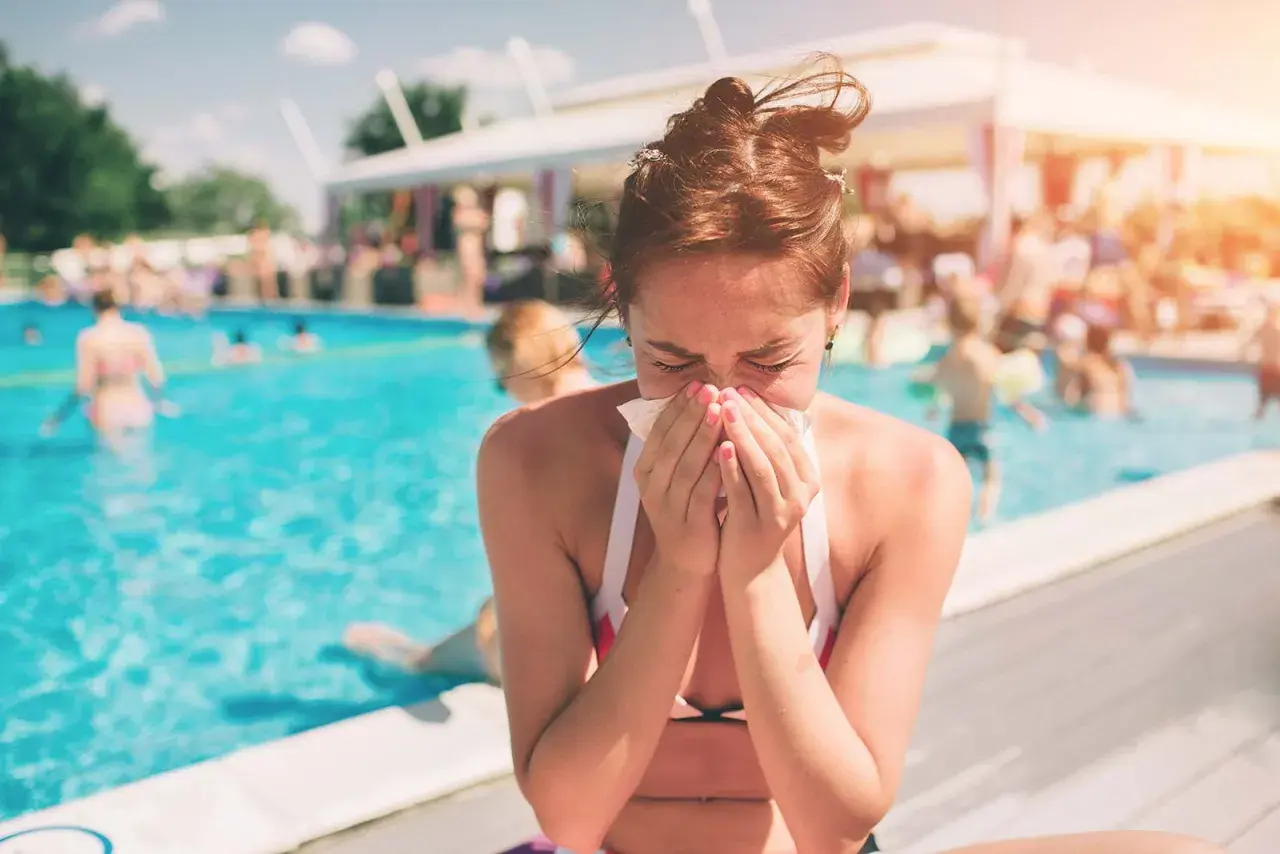
Swimming should leave you tired, not congested. When the nose burns, pressure builds in the face, or mucus turns thick after a session, the problem is often swimming-related sinus irritation rather than a major infection, and swimmer's sinusitis is usually the loose label people use for that pattern. In this article I cover what is happening, how to tell irritation from true sinusitis, what to do in the first 72 hours, and when it is sensible to call a GP or NHS 111.
What matters most before you head back to the pool
- Post-swim sinus symptoms are often caused by irritation, trapped water, or poorly ventilated indoor pools rather than a bacterial infection.
- Mild cases usually settle with rest, fluids, pain relief, and a saline nasal rinse.
- A strong pool smell can be a clue that the air around the water is part of the problem.
- If symptoms last more than a week, keep returning, or get worse, a pharmacist, GP, or NHS 111 should be involved.
- Repeated flare-ups can point to allergies, chronic rhinitis, or sinus disease that needs a proper look.
What is really going on when your sinuses react to swimming
Your sinuses are small air spaces behind the cheeks and forehead that connect to the nose. When the lining swells, mucus does not drain properly, and the result is blockage, pressure, a dull headache, or a reduced sense of smell. In my view, the first mistake people make is assuming every post-swim blockage is an infection; most of the time, it starts as inflammation or irritation, not something dramatic.
Swimming can trigger that swelling in a few different ways. Cold water, forceful breathing during hard sets, and water forced into the nose during dives or flip turns can all irritate the lining. If you already have a cold, hay fever, or a generally sensitive nose, the effect is usually stronger because the tissue is already primed to swell.
The practical takeaway is simple: if symptoms appear soon after the pool and calm down quickly, I think irritation first. If they build over days and linger, I start thinking more broadly about sinusitis itself. That distinction matters, because it changes what you should do next.
Why indoor pools and hard sessions trigger it
Indoor pools are the usual trouble spot. CDC notes that chloramines can irritate the respiratory tract, including the nose, especially where ventilation is poor. Those chloramines form when chlorine reacts with sweat, dirt, and other body waste in the water, so a strong "chlorine" smell is often a warning sign, not proof that the pool is clean.
I pay close attention to the environment around the pool, not just the water. If the air is warm, stale, and eye-stinging, the irritation tends to spread beyond the eyes and into the nose and throat as well. That is one reason some swimmers feel fine in one venue and miserable in another even when their training load is identical.
Hard sessions can add another layer. Deep breathing increases air flow across already irritated nasal tissue, and underwater work can push water higher into the nasal passages. The result is a pattern that feels like sinus pressure, but is sometimes just a mechanical and chemical irritant response wearing the same clothes as sinusitis.
How to tell irritation from true sinusitis
The pattern matters more than the label. I use the clues below to separate a short-lived pool reaction from something that deserves more attention.
| Pattern | What it usually feels like | What it suggests | What usually helps |
|---|---|---|---|
| Chloramine irritation | Burning nose, sneezing, watery discharge, stinging eyes, symptoms starting during or right after the session | Airway irritation from the pool environment, especially indoors | Fresh air, showering off, saline rinse, better-ventilated pool |
| Water trapped in the nose | One-sided pressure, dripping after turns or dives, brief fullness that eases within hours | Mechanical irritation rather than infection | Gentle saline rinse, avoiding aggressive underwater work while symptoms settle |
| Viral sinusitis | Blocked nose, facial pressure, thick mucus, reduced smell, often after a cold | Inflammation linked to a virus, not the pool itself | Rest, fluids, pain relief, saline cleaning |
| Allergy or chronic rhinitis flare | Itching, sneezing, clear runny nose, recurrent symptoms in certain places or seasons | Underlying sensitivity that swimming exposes | Antihistamines or steroid nasal spray if advised, plus trigger control |
| Possible bacterial sinusitis | Symptoms that worsen after 7 to 10 days, fever, bad-smelling discharge, marked one-sided pain | A case that should be assessed rather than guessed | Pharmacy or GP review, and sometimes prescription treatment |
What I would do in the first 72 hours
I would not try to "train through" a raw, swollen nose. Give the lining a break for a day or two, especially if the pool is clearly the trigger.
- Pause the aggravating session type. Skip hard intervals, repeated underwater work, and deep dives until breathing feels normal again.
- Drink more than usual. Hydration does not cure sinusitis, but dry mucosa feels worse and clears mucus less efficiently.
- Use pain relief if needed. Paracetamol or ibuprofen can help with pressure and headache if you normally tolerate them.
- Rinse the nose with salt water. A practical home method is 570 ml of cooled boiled water, 1 teaspoon of salt, and 1 teaspoon of bicarbonate of soda, used up to 3 times a day with a fresh mix each time.
- Keep an eye on the pattern. If the irritation fades within a day or two, the pool environment is likely the main culprit; if it keeps building, the picture is less benign.
If you use an over-the-counter decongestant spray, follow the pack instructions and do not keep it going indefinitely. I prefer saline first because it is simple, cheap, and less likely to create a second problem while you are trying to solve the first.
When NHS help is the right next step
The NHS advises urgent help if you are very unwell, painkillers are not helping, symptoms are getting worse, or you have a weakened immune system. You should also speak to a pharmacist or GP if symptoms do not improve after 7 days of pharmacy or GP treatment, or after 3 weeks of self-care, or if you keep getting the same problem again and again.
I would also treat one-sided facial symptoms, recurrent episodes, or a pattern that happens every time you swim as a reason to stop guessing. At that point, the question is no longer "How do I get through today’s session?" It is "Why does my nose keep reacting this way?"
Antibiotics are not the default answer here. Sinusitis is usually viral, which is why clinicians tend to start with symptom control, not prescriptions, unless the story points clearly toward bacterial infection or a complication.
How to stop it coming back without cutting your swim time
Prevention is mostly about reducing the load on the nose. I would start with pool conditions, then look at your own habits, then look at your underlying health.
- Shower before and after swimming. Rinsing before you enter the water helps reduce the body waste and sweat that create chloramines, and showering after helps wash irritants off your skin and face.
- Choose better-ventilated pools when you can. If the air above the water feels harsh, stale, or heavily chemical, your nose is probably not imagining it.
- Use a nose clip for drill sets if water entry is the trigger. It is not a cure, but it can reduce forced water exposure during dives and turns.
- Treat allergies properly. If hay fever or non-allergic rhinitis is part of the story, managing that background inflammation makes pool exposure much easier to tolerate.
- Track the pattern. I like a simple note of pool, session type, whether the pool was indoors or outdoors, how fast symptoms appeared, and whether the problem was one-sided or both sides.
- Respect the warning sign of recurring flares. If the same nose problem comes back week after week, the likely issue is no longer just "bad luck at the pool"; it may be chronic rhinitis, polyps, or another structural factor.
What I look for most is consistency: if the symptoms only happen in one venue and settle fast, the environment is probably the real enemy. If they keep following you around, the nose itself needs a closer look. That is the point where a quick fix stops being enough, and a proper assessment starts paying off.
