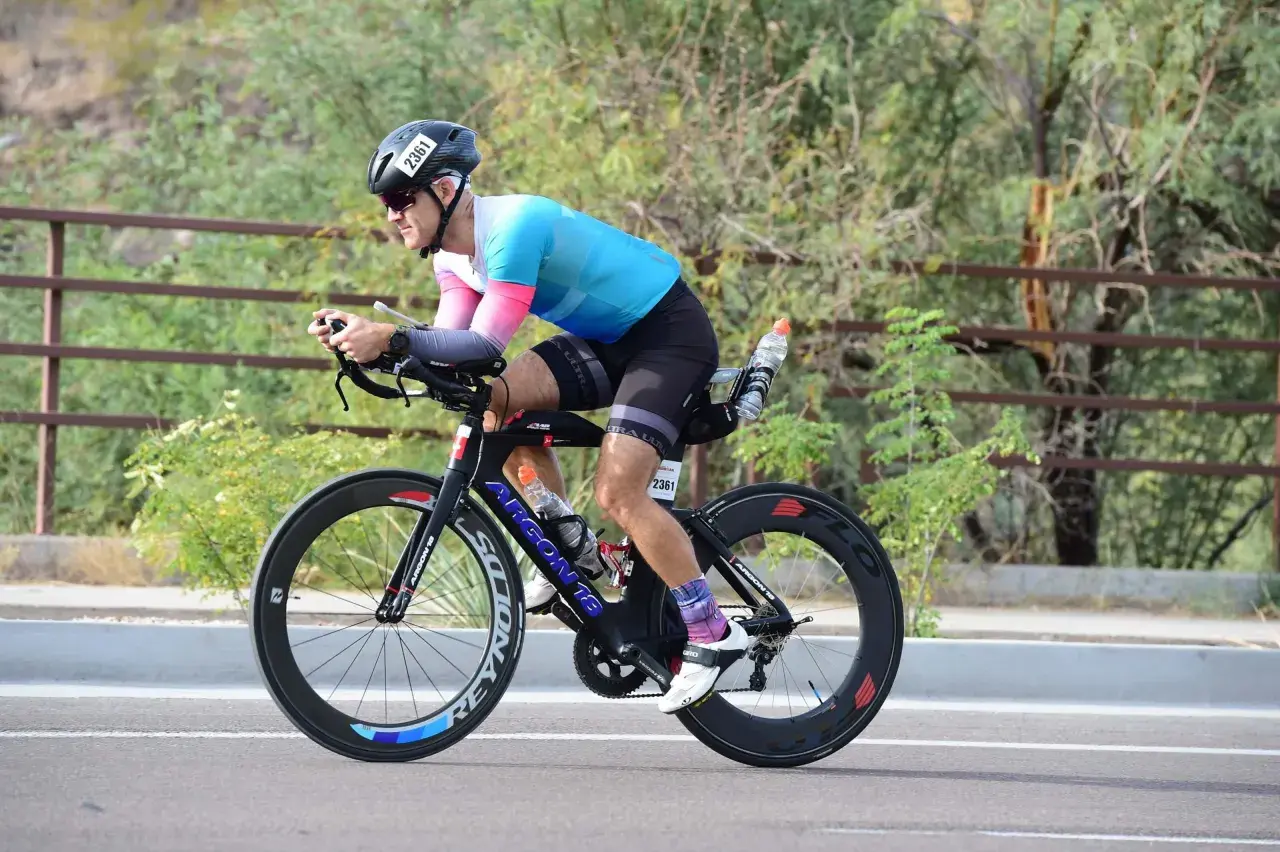
What matters most before you build the bike block
- Train for the run off the bike. The ride has to leave you able to run well, not just post a good bike split.
- Use a mix of endurance, quality and brick rides. One type alone rarely gives a complete bike leg.
- Keep cadence controlled. For most non-draft racing, smooth pedalling around 90 rpm is a practical target.
- Get the fit right early. Comfort, alignment and position matter more than a marginal gear upgrade.
- Practise race-specific nutrition. Long rides and bricks are where pacing and fuelling mistakes show up first.
- Measure the right things. Look at repeatability, not just one good session.
How the bike leg changes across race distances
The first mistake I see is treating every triathlon as if the bike should be ridden the same way. A sprint race rewards sharper work close to threshold, while long-course racing rewards restraint, position and the ability to repeat steady power for a long time. The shorter the event, the more you can lean into intensity; the longer it gets, the more the bike leg becomes a test of patience.
| Race distance | What the bike should achieve | Best training emphasis | Common mistake |
|---|---|---|---|
| Sprint | Arrive at the run with speed still available | Short threshold work, fast transitions, controlled hard efforts | Riding the first half like a time trial and blowing the run |
| Olympic | Hold strong pace without spikes | Tempo, threshold blocks and aero comfort | Chasing every surge and ignoring rhythm |
| Middle distance | Keep output steady while protecting the legs | Long aerobic rides with race-pace sections | Underestimating how much fuelling matters |
| Iron-distance | Stay smooth, efficient and durable for hours | Low-to-moderate intensity, long steady riding, position work | Training the ride to feel heroic instead of sustainable |
In practice, I want the bike to do two jobs at once: create enough fatigue to make the race honest, and stay controlled enough that the run still has shape. Once that idea is clear, the weekly structure becomes much easier to build.
How to structure the week without overcooking the run
When I build a bike week, I usually anchor it with one longer aerobic ride, one quality session and one ride that connects directly to the run. That is enough for most age-group athletes to improve without turning every session into a test. If you train in the UK, the indoor trainer is not a compromise; on wet roads, in traffic or after dark, it is often the cleanest way to complete a truly useful interval session.
| Session type | Why it exists | Typical range | How often |
|---|---|---|---|
| Endurance ride | Build durability and aerobic control | 60-180 minutes | 1 time per week |
| Quality intervals | Raise sustainable power or pace | 45-90 minutes total | 1 time per week |
| Brick ride | Connect the bike to the run and practise race rhythm | 45-150 minutes on the bike, then a short run | Every 1-2 weeks |
| Recovery spin | Keep the legs moving without adding stress | 30-60 minutes | As needed |
I prefer clear separation between hard and easy work. If every ride is moderately hard, nothing is really effective and nothing is properly recoverable. Two quality sessions plus a steady ride is usually more productive than scattering fatigue across the week. If you also keep a little strength work in the background, do it to support posture and resilience, not to replace bike volume. That balance only works if cadence and effort stay under control, which is where pacing matters next.
Cadence and pacing are the real performance levers
Cadence is not a vanity metric. It changes muscular load, heart rate drift and how fresh your legs feel when you start the run. USA Triathlon’s coaching material puts many non-draft athletes around 90-95 rpm as a sensible working range, with draft-legal racing usually a little higher. I treat that as a practical starting point, not a rule carved in stone.
| Situation | Practical cadence range | What I want to see |
|---|---|---|
| Non-draft racing | 90-95 rpm | Smooth, repeatable pedalling with manageable torque |
| Draft-legal racing | 95-110 rpm | Quick response to surges without grinding |
| Climbs and headwinds | Let it float, but avoid spikes | Steady effort first, speed second |
| Heavy legs in training | Do not force cadence alone | Lower the load and restore control |
Power meters make this easier because they show what you are actually doing, not what the road feels like in the moment. If you do not use one, use breathing and posture as your guardrails: the upper body stays quiet, the breathing stays under control, and the ride never turns into a series of random sprints. The real skill is to arrive at the run with just enough tension in the legs, not too much. Efficient pacing is easier when the bike actually fits you, so the next section is about position and setup.

Bike fit and position pay back every minute you train
A good fit is not about making the bike look fast. It is about keeping your knee tracking clean, reducing the little compensations that waste energy, and letting you stay in position long enough for the fit to matter. USA Triathlon’s guidance on bike fit makes the same basic point: a proper setup supports your body, your riding style and your goals better than an aggressive position that only feels fast for ten minutes.
- Saddle height and reach should let you pedal without rocking the hips or locking the shoulders.
- Pad stack and bar position should let you stay aero without collapsing your chest.
- Clip-on aero bars can help a road bike behave more like a tri bike if the position remains stable.
- Tyres and pressure should suit the road surface rather than old habits about running everything rock hard.
- Indoor trainer setup should be stable enough that you can work on position, not just survive the session.
I would rather see an athlete on a modest bike that fits well than on an expensive frame that creates neck tension, numb hands or a back that tightens halfway through the ride. In UK conditions, the smart trainer often becomes the most reliable place to do that position work because it removes traffic, junctions and weather from the equation. Once the body and bike are aligned, brick sessions become a learning tool rather than a punishment.
Brick sessions that actually transfer to race day
A brick is simply a bike followed immediately by a run, but the real value is not the awkward feeling in the first few minutes of the run. The value is that you learn how your legs respond, how your fuelling behaves and how quickly you can settle after the bike. USA Triathlon’s guidance is clear here: bricks are useful for practising race-day nutrition and the move from cycling to running, not just for creating fatigue.- Sprint brick. Ride 45-75 minutes with a controlled hard middle section, then run 10-15 minutes at steady race effort. This is about transition speed and leg turnover, not volume.
- Olympic brick. Ride 75-120 minutes with a few race-pace blocks, then run 15-25 minutes. The aim is to learn what controlled pressure feels like when the legs are already loaded.
- Middle-distance brick. Ride 2-3 hours, then run 20-30 minutes. Keep the ride disciplined and use the run to practise settling rather than chasing pace.
I keep bricks specific and rarely turn them into a second workout hidden inside the first. If the run becomes too long, the session stops teaching bike-to-run transfer and starts teaching exhaustion. Use the same bottles, gels and timing you plan to race with, because that is where the real race-day data lives. Even a smart plan fails if a few predictable errors keep creeping in, and those are worth naming plainly.
Common mistakes that waste months
The biggest mistake I see is training for average speed instead of for what you can still do after the bike. Athletes often look at a file, see a good ride average, and miss the fact that the run off that ride was poor. That is not a bike problem alone; it is a pacing problem, a fuelling problem and sometimes a fit problem all at once.
| Mistake | What it usually causes | Better approach |
|---|---|---|
| Riding every session too hard | Flat legs, poor recovery and a weak run | Separate easy, steady and hard rides properly |
| Ignoring bike fit until late | Hot spots, aches and lost stability | Sort position early, then make small changes only |
| Practising only in ideal conditions | No plan for wind, rain or indoor work | Use a mix of outdoor rides and structured trainer sessions |
| Never rehearsing fuelling | Late-race fade and stomach trouble | Practise drink and gel timing on long rides and bricks |
| Copying pro volume | Too much fatigue for too little adaptation | Build the ride around your own run and recovery capacity |
There is a simple rule I keep coming back to: if a ride leaves you unable to run well, it was probably too ambitious for its place in the week. The solution is rarely more effort; it is usually better sequencing, better fit or better restraint. If you can spot those patterns early, the final check becomes much simpler and far more objective.
The four-week check that tells you the plan is working
After about four weeks, I want to see evidence that the bike block is changing something useful. Not every improvement shows up as pure speed. Sometimes the clearest signs are smaller: less stiffness when you dismount, a steadier cadence on climbs, or a run that starts awkwardly but settles faster than before.
- You can hold your target position for longer without fidgeting or neck strain.
- The same route at the same effort feels a little easier, or is a little faster.
- Brick runs stop feeling like damage control and start feeling manageable.
- Your fuelling stays consistent for the full ride instead of dropping off late.
- You finish key sessions able to train again the next day instead of needing a long reset.
If those signs are moving the right way, keep the plan stable and let the adaptation settle. If they are not, change one variable at a time: fit first, pacing second, volume third. That is the most reliable way I know to make the bike leg support the rest of the race rather than steal from it.
