A triathlon pool is less about luxury and more about repeatability: clear lane space, a visible pace clock, and enough calm to hold form under fatigue. In the UK, that usually means making the most of 25m and 50m pools rather than waiting for a specialist facility. In this guide, I break down what to look for, how to structure sessions, and how to make pool work carry over to race day.
What matters most when you train for triathlon in the pool
- A good training pool gives you consistent access, clean lanes, and a pace clock you can actually read.
- 25m pools suit intervals and technique work; 50m pools are better for longer race rhythm and fewer wall push-offs.
- Pool sessions should build three things at once: efficiency, pacing control, and comfort under fatigue.
- Open-water skills still matter, so I use the pool for sighting, drafting, and start-control drills as well.
- In the UK, a reliable lane slot usually beats a fancy facility you can only use once in a while.

What a triathlon pool actually needs to offer
When I look at a pool for triathlon work, I do not start with branding or architecture. I start with whether the water lets me train well: lane discipline, stable conditions, and enough space to swim without stopping every few lengths. Swim England notes that competition pools in England are typically 25m or 50m long, and that simple difference changes how the session feels and what it teaches.
A 25m pool is usually better for short repeats, drills, and sessions where you want regular feedback from the wall and pace clock. A 50m pool is more demanding in a useful way: you get fewer free resets, longer uninterrupted stretches, and a rhythm that is closer to open water. If I had to choose only one format for triathlon preparation, I would still pick the pool I can use consistently, but I would understand exactly what that choice gives me.| Pool type | Best use | What it teaches well | What it hides |
|---|---|---|---|
| 25m pool | Intervals, drills, confidence building | Stroke rhythm, turn efficiency, repeat pace | How you feel when you swim for longer without a wall |
| 50m pool | Race rhythm, endurance sets, steady efforts | Pacing discipline, uninterrupted form, mental steadiness | Small pacing errors can feel harder to diagnose because you get fewer resets |
In practical terms, a good pool for this sport should give you predictable swimming, not just available swimming. That is the standard I use before I think about anything more advanced.
How I use pool time to build triathlon fitness
Pool swimming for triathlon is not just about doing more metres. The real gains come from doing the right kinds of metres in the right order. I usually think in four layers: breathing, body position, pace control, and fatigue resistance. If one of those is missing, the swim may feel hard without actually making you much better.That is especially important because race swims are often shorter than people expect. British Triathlon describes a sprint-distance swim as 400m in a pool or 750m in open water. A 400m pool swim sounds short until you realise it is 16 lengths in a 25m pool or 8 lengths in a 50m pool, and every small mistake in pacing shows up very quickly.
- Breathing rhythm - I want breathing to feel automatic, not rushed. If your breath pattern falls apart, your whole stroke usually follows.
- Stroke economy - Good triathlon swimming is efficient swimming. You should feel that each stroke moves you forward, not just keeps you afloat.
- Pace control - I care less about one fast length than about holding a useful pace for repeat after repeat.
- Fatigue resistance - The pool should teach you how to stay calm and technically clean when your shoulders start to load up.
I also like to match session length to the race you are preparing for. As a working range, I often keep focused sessions around 1,200-1,800m for sprint racers, 1,800-2,500m for Olympic-distance athletes, and 2,500-3,500m for longer-course triathletes. That is not a hard rule, but it is a sensible place to start if the goal is improvement rather than just accumulation.
Once that base is clear, the next step is turning it into sessions that actually move your swim forward.
Pool sessions that actually move the needle
If I want a pool session to matter, I make sure it has a purpose. That can be technique, threshold work, endurance, or race-specific rhythm. A random lap count rarely does as much as a structured set, even if it feels satisfying in the moment.
| Goal | Example main set | Why it works |
|---|---|---|
| Confidence and form | 8 x 50m easy with 15 seconds rest, then 4 x 25m build | Keeps the session relaxed while sharpening body position and catch quality |
| Sprint and Olympic pace | 10 x 100m at controlled hard effort with 10-20 seconds rest | Teaches you to hold pace without blowing up on the first few repeats |
| Endurance | 3 x 400m steady with 30 seconds rest | Builds durability and makes race-pace feel less intimidating |
| Open-water rhythm | 6 x 200m with a sighting cue every 6-8 strokes | Links pool fitness to the skills you will actually use outside the lane |
When I write sessions like this, I keep the warm-up and cool-down simple: 200-400m to settle in, then the main set, then 100-200m easy to finish. That sounds basic because it is basic. The point is not to impress anyone; the point is to leave the pool with a clearer stroke and enough energy to train again soon.
One small thing matters more than most athletes think: counting lengths accurately. In a 25m pool, 400m is 16 lengths, 800m is 32 lengths, and 1,500m is 60 lengths. If you get sloppy with counting, the session becomes guesswork very quickly.
How to make pool work feel more like open water
Open water changes the problem. You lose the wall, the lines matter less, and your breathing has to stay calm when the field tightens up around you. That is why I do not let the pool become a pure comfort zone. I use it to rehearse the parts of open water that can still be trained indoors.
- Practise sighting by lifting the eyes briefly every 6-10 strokes, then returning the head quickly to neutral.
- Use bilateral breathing when it helps balance your stroke, but do not force it if it makes the rhythm worse.
- Swim some crowded lanes on purpose so you learn to hold line and pace without panic.
- Start a few reps fast and then settle, because the first part of a race is often messy.
- Trim your dependence on wall speed so your pace does not look better in the pool than it really is.
- Use simple training aids with a job, such as a snorkel for head position or a pull buoy for body line, not as a crutch.
I also like sessions that use lane ropes and marker buoys to break the straight-line comfort of the pool. That does not turn the lane into a lake, but it does remove some of the false calm that makes athletes overconfident indoors. If open water is not available near you for a while, this is the next best way to train the brain as well as the body.
The best sign that this is working is that your pool pace becomes more controlled, not just faster. That matters when you start choosing where to train in the UK.
What to look for in a UK pool or lane slot
In the UK, the quality of your training is often decided by access, not architecture. A decent 25m lane at the right time is far more useful than a brilliant pool you can never book. Swim England’s pool standards make the 25m and 50m formats the main reference points, so that is where I start. After that, I look at the details that affect repeatability.
| Question to ask | Why it matters |
|---|---|
| Is there a visible pace clock? | You need it for intervals, pacing, and honest feedback |
| Can I book the same lane slot every week? | Consistency builds habit and makes progress easier to measure |
| Are lanes kept sensible for slower and faster swimmers? | Good lane discipline reduces stop-start swimming and frustration |
| Is the water temperature stable enough for longer sets? | Too cold kills quality; too warm can ruin hard work too quickly |
| Are basic tools allowed, such as pull buoys, kickboards, or a front-mounted snorkel? | They make it easier to target specific technique problems |
| Is there a 50m option at least sometimes? | It gives you a better match for continuous race rhythm |
My rule here is simple: choose the pool you will actually use. If the off-peak session in a 25m pool is realistic three times a week, that beats a more glamorous option that only fits your schedule once. In triathlon, frequency beats perfection more often than people want to admit.
That also leads neatly into the mistakes I see most often, because they usually appear when the setup is not used well.
The mistakes that slow triathletes down in the water
The biggest problem is that many athletes treat pool time like a fitness test and ignore the skills that make speed sustainable. I see the same pattern again and again: too much effort, not enough structure, and far too little honesty about what the swim is actually teaching.
- Swimming hard all the time - this builds fatigue faster than it builds efficiency.
- Ignoring stroke count and pace - without numbers, improvement is easy to imagine and hard to prove.
- Relying on wall push-offs - turns can hide weak body position and poor pacing.
- Skipping technique once tired - that is exactly when technique matters most.
- Never practising open-water skills - pool confidence does not automatically transfer to race day.
- Using too many gadgets without a plan - gear should support a specific fix, not decorate the session.
If I want one simple correction priority, I start with breathing and body position before I chase more speed. A snorkel, pull buoy, or paddles can help, but only if they make the stroke cleaner. If they let you hide the problem, they are slowing you down.
The last thing worth deciding is whether a more specialised pool setup is actually worth paying for.
When a specialist pool makes sense and when it doesn’t
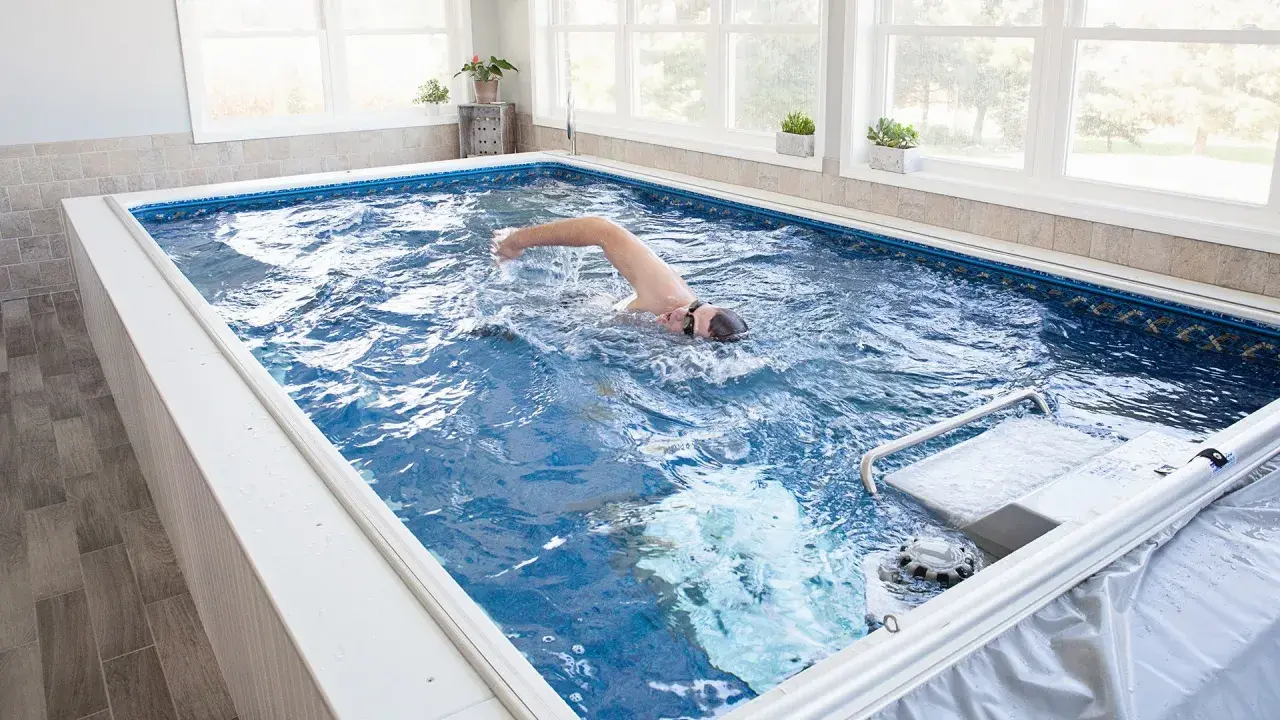
There are cases where a specialist setup is useful. A current pool or swim spa can be excellent for stroke work, continuous aerobic swimming, and rehab because it gives you constant feedback without interruption. That can be a real advantage if you are short on time, coming back from injury, or trying to isolate a technical change without the noise of a crowded public lane.
But I would not pretend that a specialist setup solves everything. It cannot replace lane traffic, crowded starts, turn timing, or the small pacing mistakes that show up in a normal pool. It also does not remove the need for open-water practice if your race uses open water. For most age-group triathletes, the smartest approach is still a dependable regular pool, used often, with a few carefully chosen race-specific sessions layered on top.That is the setup I trust: enough consistency to build fitness, enough variety to keep the swim honest, and enough realism to make race day feel familiar rather than chaotic.