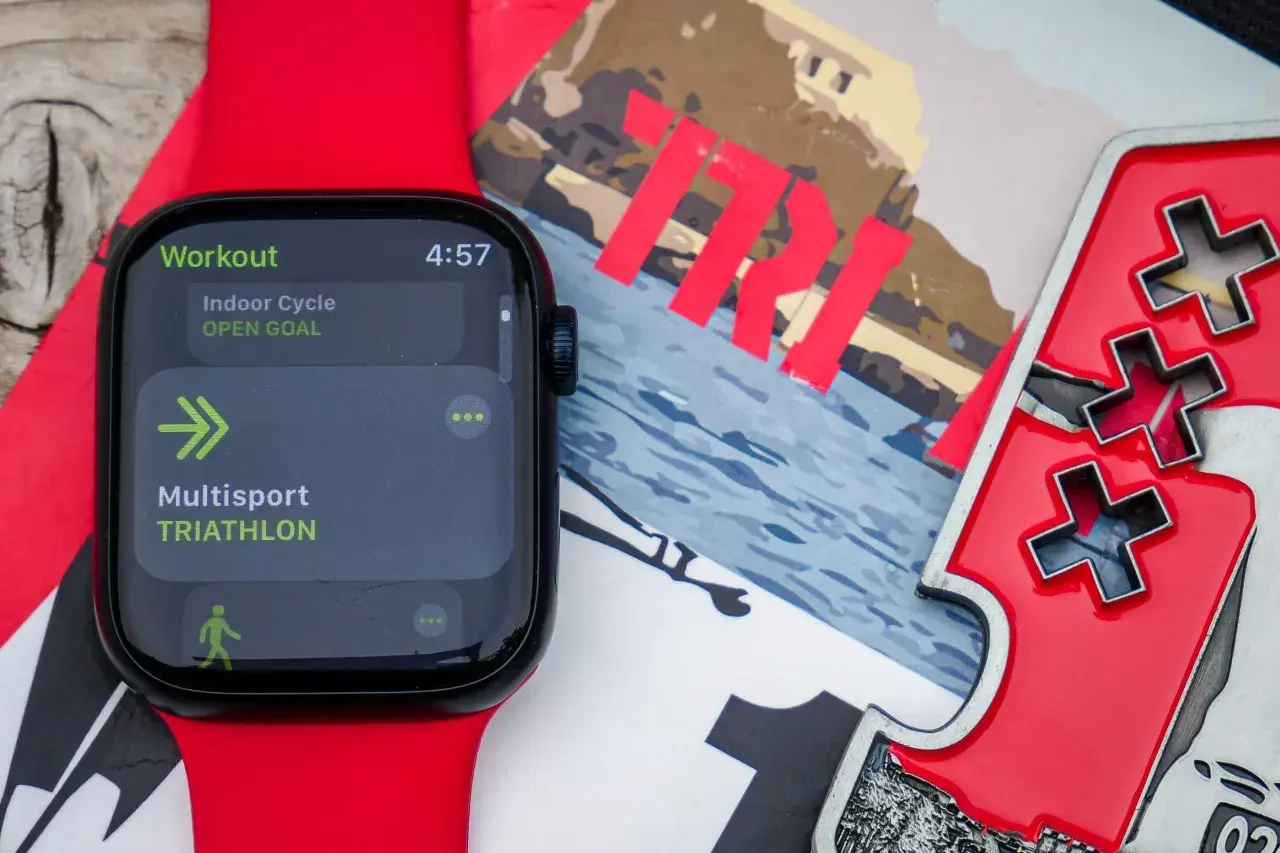
The Apple Watch Series 2 for triathlon sits in an awkward middle ground in 2026: it can still handle the basics of swim, bike, and run, but it belongs to an older software era that changed how Apple Watch handles endurance sports. I would use it if I already owned one and wanted a low-cost training companion, but I would not treat it like a modern multisport watch. The difference matters most when race day starts, because triathlon rewards clean transitions, reliable battery life, and software that does not get in the way.
The Series 2 can cover triathlon basics, but only if you accept its limits
- It has built-in GPS and 50-meter water resistance, so swim, bike, and run tracking are all realistic.
- Its watchOS support ends at watchOS 6.3, so it cannot use the modern automatic multisport triathlon workflow.
- Its battery was rated up to 18 hours when new, which is enough for many sprint and Olympic races but less reassuring on an aging used unit.
- It is best as a training watch, backup race watch, or budget option, not the cleanest primary choice for long-course racing.
- If you want automatic transitions and more margin on battery, a newer Apple Watch is the smarter tool.
What the Series 2 still does well in triathlon training
The Series 2 still earns its keep in one simple area: it can record each discipline in a way that is useful for training. Built-in GPS lets it measure outdoor runs and rides without carrying a phone, and its 50-meter water resistance means pool sessions and open-water work are part of the package, not an afterthought. Apple’s original spec sheet also noted pool and open-water swim workouts, lap counting, stroke detection, pace, and distance tracking, which is exactly why this watch was such a big step up from the first Apple Watch.
That combination is enough for an athlete who wants clean basics rather than a flood of advanced metrics. If your pool work, open-water sessions, and brick workouts are more about consistency than data overload, the watch still makes sense. The catch is that it behaves more like three solid single-sport tools than one polished triathlon system, and that difference shows up as soon as you start thinking about transitions.That is where the age of the software starts to matter.
Where it falls short when the race starts
The biggest limitation is not the sensor set, it is the software ceiling. Modern Apple Watch workouts can combine swimming, cycling, and running into one multisport session, and the watch can recognize when you switch legs automatically. The Series 2 cannot use that workflow because its watchOS support stops at watchOS 6.3, well before Apple added native triathlon-style multisport features.
In plain English, that means more manual handling on race day. You are more likely to start and stop separate workouts, miss a transition, or lose a little data cleanliness if you rush. I would also be cautious with battery expectations. Apple rated the Series 2 at up to 18 hours when new, but a used watch in 2026 may have lost enough capacity that a long race becomes a practical risk, not just a theoretical one.
There is also the reality of age. App compatibility is narrower, the experience feels less fluid, and I would not assume factory water resistance is still perfect on a device that has already lived a full hardware life. That does not make the watch useless; it just means I would stop thinking of it as a race-day computer and start thinking of it as a dependable old tool that needs a disciplined setup.

How I would set it up for race day
When I coach athletes through older gear, I always aim to reduce decisions on race morning. With the Series 2, that matters more than squeezing out one extra feature. I would charge it fully the night before, wear a snug sport band, and keep the setup stripped down to the data that actually matters.
- Use a swim-friendly band and test it in the water before race day.
- Start with a full battery and avoid unnecessary notifications.
- Record the swim, bike, and run as separate workouts if you are not using a compatible multisport app.
- Practice the button presses for ending one leg and starting the next so transition does not become a guessing game.
- Check the watch after open-water swims, because older hardware is less forgiving when a touch screen gets wet or a button press is rushed.
How it holds up across sprint, Olympic and long-course races
This is the part where a lot of people overestimate old hardware. The Series 2 can be fine in one race format and frustrating in another, even if the sport itself is the same.
| Race distance | How the Series 2 fits | My take |
|---|---|---|
| Sprint triathlon | Usually workable | The watch is often good enough if the battery is healthy and you have rehearsed transitions. |
| Olympic triathlon | Still possible | Data tracking is fine, but manual handling starts to matter more, especially if the battery is not in great shape. |
| 70.3 / half Ironman | Borderline as a primary watch | The distance itself is not the only issue; age, battery wear, and the lack of native multisport support all work against it. |
| Ironman | Not my recommendation | Even if the math looks close on paper, I would not trust a legacy watch as my main source of race-day data over such a long day. |
If you are racing sprint or Olympic distance and you already own the watch, I think it is fair to use it. Once you move into half-Ironman territory, the margin gets thin, and by full Ironman I would rather have a newer watch with more battery headroom and cleaner multisport behavior. That is also why newer models feel so much easier to live with.
When a newer Apple Watch is the better triathlon tool
The reason newer Apple Watches feel more triathlon-friendly is simple: the current Workout app supports multisport sessions that combine running, cycling, and swimming, with automatic recognition of the leg changes. That is the workflow triathletes actually want on race day because it removes one more moment where you can make a mistake under pressure.
Newer hardware also buys you more margin. For example, the Ultra 2 is rated for 36 hours of normal use and 100-meter water resistance, which is a much safer starting point for long-course racing. A current Apple Watch also gives you better app support and a much less awkward software experience than the Series 2 can offer in 2026.
If I were choosing between keeping an old Series 2 and moving up, I would keep the old watch only if budget is the main constraint or if I mainly want a swim-and-run training device. If the goal is confident race-day tracking, especially for longer events, newer hardware is the cleaner choice. The technology has moved far enough that the gap is not subtle anymore.
The habits that matter more than the watch itself
I have seen athletes blame the device for problems that were really setup problems. With a triathlon watch, the habits around it matter just as much as the hardware.
- Train transitions until they feel automatic.
- Wear the watch snugly enough that heart-rate data is stable and the sensor stays put in the swim.
- Test open-water GPS in conditions similar to your race, not just in a calm pool or on a straight road.
- Use the watch for pacing and timing, but do not depend on it for every decision if you are racing a long event.
- Bring the mindset that the watch is there to support the plan, not replace it.
That last point matters more than people admit. A triathlon is still won by pacing, nutrition, and composure, and a watch only helps when those things are already under control. With that in mind, the final question is whether this old model still deserves a place on your wrist in 2026.
My practical verdict on using it in 2026
If you already own the Series 2, I would not throw it away. It still has enough strengths to be useful for swim training, brick sessions, and shorter races, especially if you value simple tracking over modern triathlon analytics. For a beginner, it can be a perfectly reasonable entry point into structured endurance training.
My honest line is this: the Series 2 is good at recording triathlon basics, but it is no longer the watch I would pick to manage a serious race day. If the event is sprint or Olympic distance and the battery is healthy, use it with realistic expectations. If the race is longer, or if you want the clean automatic multisport experience that modern Apple Watch users get, upgrade the hardware and stop fighting the age of the platform.
That is the cleanest way to think about it: keep the Series 2 for what it still does well, and do not ask it to behave like a current triathlon watch.