What matters most before you book a lesson
- Choose a format that matches your confidence level, not your pride.
- Private lessons are usually best for fear, strong nerves, or a very slow start.
- Group lessons make sense if you can already put your face in the water and float with some control.
- A good teacher focuses on breathing, buoyancy, and body position before full stroke drills.
- In the UK, group sessions are usually the cheaper route, while 1:1 tuition gives faster feedback.
- Ask how progress is measured, because a clear plan matters more than a long timetable.
Why adult lessons work differently from school swimming
Adults do not learn water skills the same way children do, and trying to force a child-style lesson onto a nervous grown-up usually slows everything down. Adults tend to need a reason for each drill, a sense of control, and a pace that respects embarrassment, fear, or old bad experiences. That is exactly why the Swim England Adult Swimming Framework uses progressive stages and adult-specific goals rather than copying the school pool model.
From my perspective, the biggest difference is not physical strength. It is attention. Adults often overthink the movement, hold their breath when they panic, and tense up through the shoulders and neck. Good teaching has to calm that down before it can build technique, which is why the early lessons should feel almost simple: breathe out, let the water support you, find a stable position, repeat.
If you already have some confidence, adult coaching can also become a technique tune-up rather than a rescue mission. That makes the lesson structure flexible, but it also means the first question is not “How fast can I learn?” It is “What kind of support do I need to start well?” That leads directly to the lesson format.
Choose the lesson format that matches your confidence level
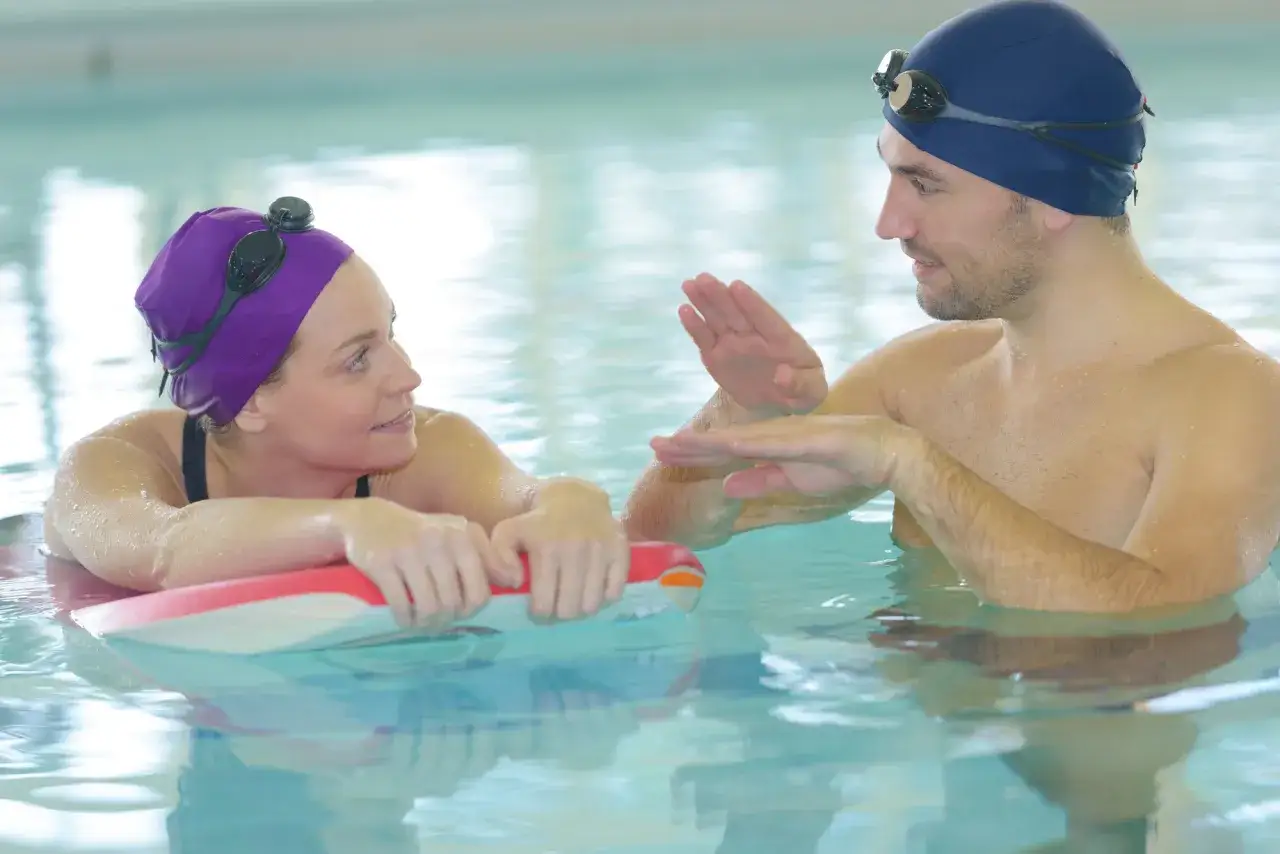
For most adults, the lesson format matters more than the pool brand or the marketing copy. I usually narrow it down to four options: group lessons, private 1:1 tuition, semi-private sessions, and short intensive courses. Each one can work, but each one solves a different problem.
| Lesson format | Best for | Typical UK price range | Main trade-off |
|---|---|---|---|
| Group adult lessons | Steady learners who want structure and lower cost | About £12 to £20 per session, often sold in blocks | Less individual attention and a slower pace when the group is mixed |
| Private 1:1 lessons | Nervous beginners, strong fears, or anyone who wants fast correction | About £35 to £80 per hour, sometimes higher in larger cities | Costs rise quickly if you need a long run of sessions |
| Semi-private lessons | Couples, friends, or two adults who want more feedback than a group offers | Usually between group and private pricing | Your pace depends on the slower learner in the pair |
| Intensive crash courses | People who want a quick confidence boost or have a fixed deadline | Often a short block priced in the tens of pounds per day or session | Progress can feel rapid, but retention depends on follow-up practice |
My rule of thumb is simple. If you feel embarrassed before you even get in the water, start with private lessons or a very small adult-only class. If you can already float, blow bubbles, and stay calm in shallow water, a group course is usually enough and often better value. The right format should reduce pressure, not add it, and that is the real test before you think about the instructor.
What a good instructor looks like
A strong adult swimming instructor does more than demonstrate a stroke. They explain why a drill matters, slow the lesson down when your breathing gets messy, and give you one correction at a time instead of ten. In the UK, I would want to see recognised teaching qualifications, such as Swim England or STA credentials, plus real experience teaching non-swimmers and anxious adults.
There are a few signs I always look for:
- They start with water confidence rather than stroke perfection.
- They can adapt the session if you are nervous, stiff, or easily fatigued.
- They use clear milestones such as floating, breathing, kicking, and short supported swims.
- They do not rush you into deep water before you can recover calmly at the wall.
- They keep the tone calm and direct, which matters more than being loud or theatrical.
A poor instructor often talks too much about arm shape and not enough about body position, or they teach adults exactly as if they were children. That usually leaves the learner more tense, not more capable. Once the teaching is credible, the next thing to understand is what a sensible programme should actually cover in the first few weeks.
What the first few weeks should cover
Good adult lessons should feel progressive, not random. The early phase is about safety, breathing, and balance, because those three things decide whether you can stay calm long enough to learn any stroke at all. A typical beginner path looks something like this.
- Orientation and entry - getting comfortable stepping in, holding the wall, and moving around the pool without panic.
- Breathing control - exhaling into the water, lifting to inhale, and avoiding the breath-hold that makes many adults tense up.
- Buoyancy and floating - learning that the water supports you more than you expect, especially once you stop fighting it.
- Supported kicking and balance - using simple drills to find a stable body line before trying full strokes.
- Short swims with rests - covering short distances, stopping, resetting, and repeating instead of forcing long continuous lengths too early.
- Deep-water progress - only when you can recover calmly and feel safe enough to practise in a less familiar part of the pool.
The exact pace depends on how often you go. A weekly 30- to 45-minute lesson is steady but slow. Two sessions a week, or a short intensive block, will usually speed up the first stages, but only if you keep practising the same skills rather than constantly chasing the next one. That is why progress feels uneven at first: you are building control, not just fitness.
What adult lessons cost and how UK timetables work
In the UK, pricing is usually shaped by pool time, class size, location, and whether the lesson is part of a course or a rolling booking. In planning terms, I think of group lessons as a budget-friendly route and private tuition as a faster but more expensive investment. That split is useful because it helps you compare offers without getting distracted by branding.
- Group adult lessons usually sit around the low teens per session and are often sold in 6- to 13-week blocks.
- Private lessons often land somewhere between £35 and £80 per hour, with London and premium venues tending higher.
- Crash courses can be good value if they give you several short sessions in a single week, but they are tiring.
- Concessions sometimes exist through leisure centres, especially for certain eligibility groups, so it is worth asking before you book.
Timetables matter just as much as price. Adult lessons are often scheduled in evenings or weekends, and that suits working learners, but it can also mean busier changing rooms and less flexible pool space. If you need a quiet environment, ask about adult-only sessions, smaller classes, or off-peak slots. A slightly less convenient time is often worth it if it helps you stay relaxed and consistent.
When I compare options, I ask one practical question: “What will make me show up every week?” If the answer is a small class, that is the better value. If the answer is a calm one-to-one session because you are anxious, that is the better value. Cost only matters in context, and the right context is the one that keeps you learning.
The mistakes that slow progress most
Most adult beginners do not fail because they lack talent. They slow down because they choose the wrong pace, the wrong environment, or the wrong expectation. I see the same mistakes again and again, and they are all fixable.
- Choosing a class that is too advanced because it feels less embarrassing than starting at the beginning.
- Skipping breathing practice and trying to “just swim,” which usually leads to panic and stiff movement.
- Rushing into full strokes before floating and body position feel stable.
- Using flotation aids forever instead of treating them as a temporary bridge.
- Comparing yourself to children or fit lane swimmers, which is both unfair and unhelpful.
- Practising too infrequently, then expecting one lesson a week to do all the memory work for you.
There is one mistake I would rank above the rest: treating swimming like a test you pass or fail in public. It is not that. It is a skill built through repetition, and repetition is only useful when the environment feels safe enough for your body to relax. That brings me to the simplest way to turn lessons into real progress.
A realistic path from nervous beginner to steady swimmer
If I were starting from zero, I would keep the plan boring on purpose. For the first two or three sessions, I would focus on getting in and out of the pool calmly, breathing out underwater, and floating with support. I would not worry about speed, distance, or “looking like a swimmer.”
- Before lesson 1: choose the format honestly, buy comfortable goggles, and tell the instructor if water makes you anxious.
- After 2 lessons: check whether you feel calmer in the water, even if your technique still looks rough.
- After 4 to 6 lessons: you should be able to repeat a few basic skills without constant reassurance.
- After 6 to 8 weeks: many adults can manage short swims, recover to the wall, and start linking breathing with movement.
- Later on: if your main goal is fitness or holidays, move toward longer repeats; if your goal is confidence, keep refining comfort and control.
The practical test is simple: can you get into the pool, stay calm, and repeat the basics well enough to improve next time? If the answer is yes, the programme is working. If the answer is no, change the format before you blame yourself. The right adult swimming journey is usually not dramatic, but it is cumulative, and that is what makes it worth doing.