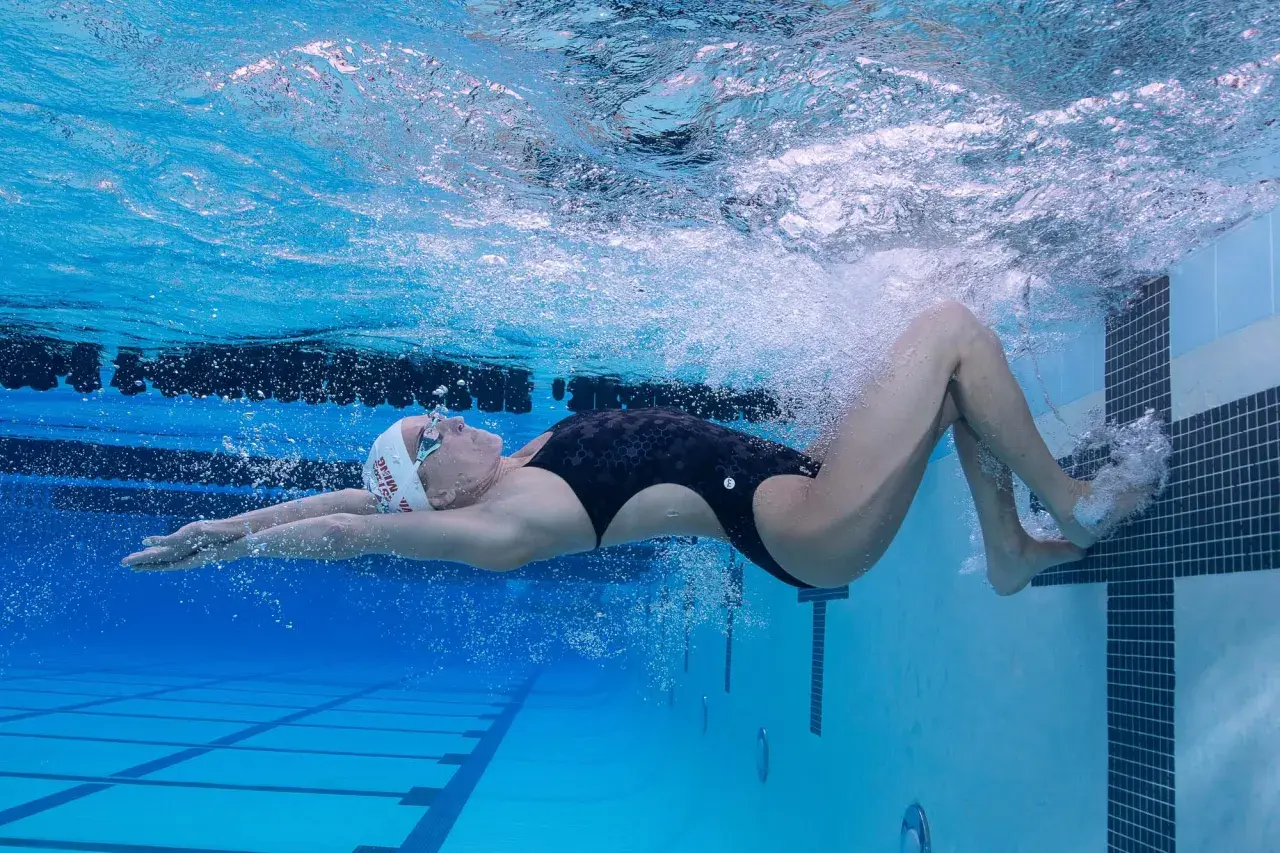
The essentials before you start practising
- Keep your speed alive into the wall instead of gliding and stalling early.
- Make the tuck compact so the rotation stays tight and controlled.
- Land your feet squarely and push off in a straight streamline.
- Use a light exhale through the nose if water tends to get in during the flip.
- For racing, know the rules - current competition formats allow only limited underwater distance after the turn.
Why a good flip turn matters more than most swimmers think
I treat the turn as a speed transfer, not a party trick. You arrive at the wall with forward momentum, compress that motion into a tight rotation, and then send it back out through the push-off. In a 25-metre pool, that matters a lot because you repeat the skill every length; even in a 50-metre pool, a sloppy turn still costs more than most swimmers realise.
It also matters because the turn is part of the stroke, not a pause between strokes. For freestyle, that means you want the approach, rotation, and breakout to feel connected. For backstroke, the same core idea applies, but the body position changes because you enter the wall on your back and return to the surface on your back after the turn. Under current race rules, swimmers may stay submerged for up to 15 metres after a start or turn, which makes a clean streamline and breakout even more important.
Once that purpose is clear, the mechanics become much easier to practise with intent.

The turn itself, broken down step by step
When I teach the movement, I keep it simple and repeatable. The swimmer only needs to remember five parts at first:
- Commit to the wall. Take your last stroke with purpose. Do not coast in early. A good turn starts with a strong approach, usually about one arm’s length from the wall.
- Tuck the chin and fold quickly. Bring your arms in, narrow the body shape, and pull the chest down so the rotation stays compact. A small shape turns faster than a loose one.
- Flip through the core. Think of drawing the knees in while the body continues forward. Keep the movement smooth rather than violent. A gentle exhale through the nose helps if water tends to sneak in.
- Find the wall with your feet. Land both feet squarely on the wall, usually just below the surface, so you can push without twisting.
- Push off in one line. Lock into streamline immediately, squeeze the ears, and hold the line before you take the first stroke or dolphin kick.
The details that make it fast instead of just workable
I coach flip turns with a handful of checkpoints. If those are right, the turn usually looks good even before the swimmer thinks it does. If one of them goes wrong, the problem is usually obvious on video.
| Cue | What it improves | What it fixes |
|---|---|---|
| Keep the last stroke active | Preserves speed into the wall | Gliding too early and arriving flat |
| Chin to chest | Makes the rotation compact | Lifting the head and opening the body |
| Hands stay narrow | Reduces drag during the fold | Sweeping the arms wide for balance |
| Feet land square | Gives a cleaner push-off | Turning sideways and twisting at the wall |
| Streamline first, breakout later | Keeps the push-off efficient | Popping up before the glide is finished |
The biggest gain usually comes after the feet hit the wall. A strong streamline and a calm breakout matter more than a dramatic somersault. In other words, I care less about how hard the swimmer spins and more about whether the push-off line stays clean for long enough to keep the speed they just created.
Common mistakes that cost speed
Most poor turns are not caused by weakness. They are caused by timing errors. These are the faults I see most often:
- Slowing down before the wall. The swimmer becomes careful too early and loses the speed that should carry into the flip. The fix is simple: keep the stroke rhythm honest until the last moment.
- Looking up at the wall. This lifts the head, opens the body, and makes the tuck messier. Keep the chin down and let the body fold instead of peeking forward.
- Taking a wide hand sweep. It feels balanced, but it usually creates drag and makes the rotation sloppy. Hands should stay close to the body.
- Flipping sideways. If the body rolls off-axis, the feet land crooked and the push-off goes nowhere useful. The goal is a straight, forward somersault.
- Planting the feet too deep or too shallow. Too deep and the push-off feels heavy; too shallow and the feet may slip or break the line. A good target is just below the surface, not halfway down the wall.
- Popping up too early. This wastes the best part of the turn: the glide and underwater propulsion. Hold the streamline longer than feels natural at first.
- Overthinking the breathing. Some swimmers hold their breath rigidly and feel panicked; others blow out too hard and lose control. A light, steady exhale through the nose is usually enough.
If you only fix one mistake first, fix the slowdown into the wall. Clean approaches make every other part easier.
Drills that build the movement without panic
I prefer drills that isolate one part of the turn at a time. That keeps the swimmer relaxed enough to learn the shape before trying to race it.
- Standing somersaults in chest-deep water - 6 to 8 reps. This removes the wall and lets you practise the tuck and rotation without pressure.
- Horizontal rolls - start from a gentle push and practise folding into a tight ball. This helps swimmers who can somersault on land but lose control in the water.
- One-stroke-in turns - take one stroke into the wall, flip, and push off. This sharpens distance judgement and teaches you not to glide too soon.
- Push-off streamline repeats - push off hard, hold the line, and add one or two underwater kicks only after the streamline feels stable.
- Stroke-count work - repeat the same number of strokes into the wall for four to six lengths. This makes your approach more repeatable and stops the turn from becoming guesswork.
If a drill stops looking tidy, I shorten it rather than forcing more reps. Four clean turns are more useful than ten sloppy ones.
How I’d build it into a normal session
A turn does not need a full workout to improve. Ten to fifteen focused minutes is usually enough if the swimmer stays fresh. My simplest session looks like this: 4 x 25 metres easy freestyle with the only goal of arriving at the wall on time, then 6 single turns with full control and generous rest, then 4 x 15 metres push-off-and-glide efforts, and finally 4 x 25 metres at normal pace while keeping the same entry distance on every length.
That structure works because it separates learning from fatigue. You get enough repetition to feel the movement, but not so much that the body starts improvising.
If I am coaching a swimmer who already has the basic movement, I will add a side-on phone video once a week. That usually reveals whether the approach is too close, the tuck is too loose, or the breakout is rising too early. A stopwatch helps too, but the video often tells the cleaner story.
The version I would trust under race pace
The turn that survives race pace is the one that feels ordinary. It does not depend on perfect conditions or a big burst of effort; it depends on repeatable habits. Keep the approach active, make the fold compact, plant the feet squarely, and leave the wall in one long line. If you can do that when you are tired, the turn stops being a weak point and starts becoming a genuine advantage.
That is the standard I would chase in a 25-metre pool, a 50-metre pool, or a busy club lane at the end of a hard set. The flip turn should feel like part of the stroke, not a break in it, and once it does, the rest of your swimming usually feels cleaner too.