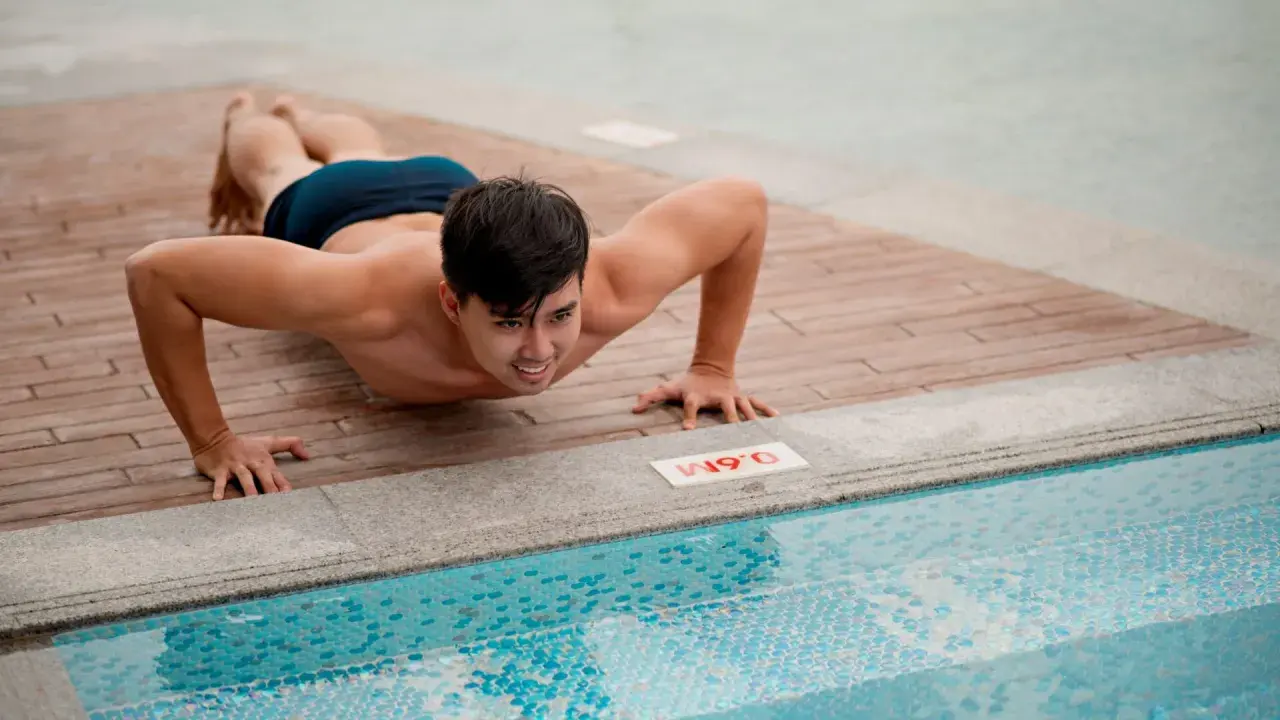
What matters most before you start
- Dryland should improve starts, turns, body position, and resilience, not just general fitness.
- The best transfer usually comes from a small set of movement patterns: squat, hinge, push, pull, rotate, and resist rotation.
- Most swimmers do better with 20 to 40 minute sessions than with long, exhausting gym blocks.
- If pool speed, shoulder comfort, or recovery drops, the dryland dose is probably too high.
- You do not need a full gym. A mat, a long band, a mini band, and one or two weights can cover most of the work.
What dryland should actually improve
Good off-pool training has a narrow job: it should help you hold a better line, produce force faster, and keep technique together when fatigue starts creeping in. That matters in the moments that decide races, especially starts, turns, streamlines, and the first few strokes after each wall. If I am looking at a swimmer's weekly plan, I want dryland to support those moments, not compete with them.
It also has a quieter job that many swimmers overlook. A well-built land programme can improve shoulder durability, hip control, and trunk stiffness, which is the ability to keep the torso stable while the arms and legs move around it. That is one reason swimmers often feel better in the water when the land work is organised well, even if the session itself does not look dramatic.
What it should not do is replace water feel, race-pace timing, or breathing rhythm. If the pool technique is messy, dryland will not magically clean it up. It can make the body stronger and more efficient, but it still needs the pool to turn that capacity into speed. Once that distinction is clear, the next step is choosing movements that carry over cleanly to swimming.

The movement patterns that transfer best to the pool
I get the best results when I think in movement patterns, not muscle groups. Swimmers do not need a bodybuilding split. They need a short list of patterns that reinforce posture, propulsion, and control under load. The table below is the framework I would start with.
| Movement pattern | Why it matters in swimming | Useful examples |
|---|---|---|
| Core bracing and anti-rotation | Keeps the body line from twisting and helps transfer force from the hips into the stroke. | Dead bug, Pallof press, side plank, bird dog |
| Squat and single-leg strength | Supports starts, push-offs, kick power, and the ability to stay balanced on one leg. | Goblet squat, split squat, step-up, rear-foot elevated split squat |
| Hip hinge and posterior chain work | Builds hip extension and back-side strength, which helps body tension and general power. | Romanian deadlift, kettlebell deadlift, hip thrust, glute bridge |
| Pulling and scapular control | Helps the shoulders stay organised through repeated arm cycles and balances pressing volume. | Band row, chest-supported row, face pull, pull-up variation |
| Mobility and landing mechanics | Keeps ankles, hips, thoracic spine, and shoulders moving well, which reduces stiffness and poor compensation. | Ankle rocks, thoracic rotations, squat-to-stand, pogo hops |
One useful rule: if an exercise looks impressive but does not help one of those patterns, I usually cut it. A narrow menu is easier to repeat, easier to progress, and easier to recover from. That does not mean boring training. It means purposeful training, which is what swimmers usually need more of. Once you know the patterns, the session itself becomes much easier to build.
A simple session structure you can repeat
A good session does not need to be complicated. I like a structure that can be finished in 30 to 40 minutes, or in 10 to 15 minutes if it is a pre-pool activation block. The goal is to leave the swimmer sharper, not flattened. If you are doing it right before a swim set, keep it crisp and stop well before failure.| Phase | Time | What to do | Purpose |
|---|---|---|---|
| Raise and mobilise | 5 to 6 minutes | Light jumps, arm circles, squat-to-stand, hip openers, thoracic rotations | Increase temperature and prepare the joints that matter most |
| Main strength block | 12 to 15 minutes | Goblet squat, split squat, row, push-up or land-based press | Build usable strength without turning the session into a grind |
| Trunk and power block | 6 to 8 minutes | Pallof press, dead bug, medicine ball slam or throw | Improve stiffness, transfer, and fast force production |
| Cool-down | 3 to 5 minutes | Calf, ankle, hip, and thoracic mobility | Reduce stiffness and make the next session easier to start |
I usually prefer pairing exercises, such as squat with row or split squat with Pallof press, so the session keeps moving without becoming chaotic. Reps should stay clean, usually in the range of 4 to 8 for strength and 3 to 5 for power, with 45 to 90 seconds of rest depending on the drill. If the movement quality drops, the set is already over. That leads naturally to the bigger question of where this work sits in the week.
How often to do it without overcooking the week
For most swimmers, two well-planned sessions a week beat five random ones. That is especially true in the UK club environment, where school, work, travel, and pool access can make the week feel fragmented. The right frequency depends on age, training history, and how hard the swimmer is already working in the water, but the table below is a practical starting point.
| Swimmer profile | Frequency | Best emphasis |
|---|---|---|
| Newer or younger swimmer | 1 to 2 sessions per week | Bodyweight control, mobility, landing mechanics, basic trunk work |
| Competitive age-group swimmer | 2 sessions per week | Movement quality, single-leg strength, shoulder-friendly pulling, light power |
| Advanced junior or senior swimmer | 2 to 3 sessions per week | Strength progression, more deliberate power work, maintenance of mobility |
| Masters swimmer | 2 sessions per week | Strength, posture, tissue tolerance, and recovery-friendly mobility |
My rule of thumb is simple: put harder lower-body work away from key kick sets or race-pace sessions, and keep pre-pool dryland focused on activation rather than fatigue. If shoulders are irritated, reduce pressing volume first and protect the scapular work before anything else. I would also keep the dryland load modest when the week is already heavy in the pool. The better the swim sessions, the more disciplined the land work needs to be. That makes the equipment question easier to answer.
Equipment that gives the best return
You do not need a crowded gym to build a useful routine. In fact, some of the best swimmer setups are deliberately small. If I were starting from scratch, I would rather have a few versatile tools that I can use consistently than a room full of machines that sit untouched.
- Long resistance band for rows, shoulder activation, pull-apart work, and low-load strength.
- Mini band for glute activation, lateral walks, and hip stability.
- Medicine ball for slams, chest passes, and rotational throws that build power.
- Dumbbells or a kettlebell for goblet squats, split squats, hinges, and carries.
- Pull-up bar or rings for vertical pulling if the swimmer has the strength and shoulder control for it.
- Mat and foam roller for mobility, floor work, and a more comfortable warm-up space.
For many swimmers, that is enough. The point is not to collect gear. The point is to make the training easy to repeat. A compact setup also works well for home training, travel weeks, and busy club schedules, which is exactly where consistency usually breaks down. Once the kit is sorted, the main threat becomes programming errors.
The mistakes that waste the whole session
- Chasing soreness instead of transfer. If every session leaves you wrecked, the pool will usually pay for it.
- Copying generic gym plans that ignore starts, turns, shoulder health, and bodyline.
- Doing too much pressing and not enough pulling, which can irritate shoulders over time.
- Turning strength work into conditioning with endless high-rep circuits and very short rests.
- Ignoring mobility in the ankles, hips, and thoracic spine, then wondering why positions feel stiff.
- Changing exercises every week before anything has time to improve.
- Progressing too fast by adding load, volume, and complexity at the same time.
The cleanest programmes usually look almost unexciting on paper. The swimmer repeats the basics, adds a little challenge at a time, and stays fresh enough to swim well. That is much more effective than constantly hunting for the newest drill. If time is tight, I would rather simplify the whole thing and keep the quality high.
If you only have 20 minutes, use this order
This is the version I would hand to a busy club swimmer who needs something realistic rather than idealised. It covers the essentials without draining the next pool session.
- 3 minutes of raise and mobilise work: jumping jacks, arm circles, squat-to-stand, and ankle rocks.
- 2 rounds of strength: goblet squat for 6 reps, band row for 8 reps, split squat for 6 reps per side.
- 2 rounds of trunk control: Pallof press for 8 reps per side, side plank for 20 to 30 seconds per side, dead bug for 6 reps per side.
- 3 to 5 medicine ball slams or chest passes with full, honest rest between efforts.
- 2 minutes of easy mobility for hips, calves, and thoracic spine.
If you repeat that structure for 6 to 8 weeks and improve just one variable at a time, such as control, load, or speed, you will get far more from it than from constantly inventing new sessions. Keep the work clean, keep the volume modest, and let the pool tell you whether the dose is right. That is the simplest way I know to make land-based training earn its place in a swimmer's week.