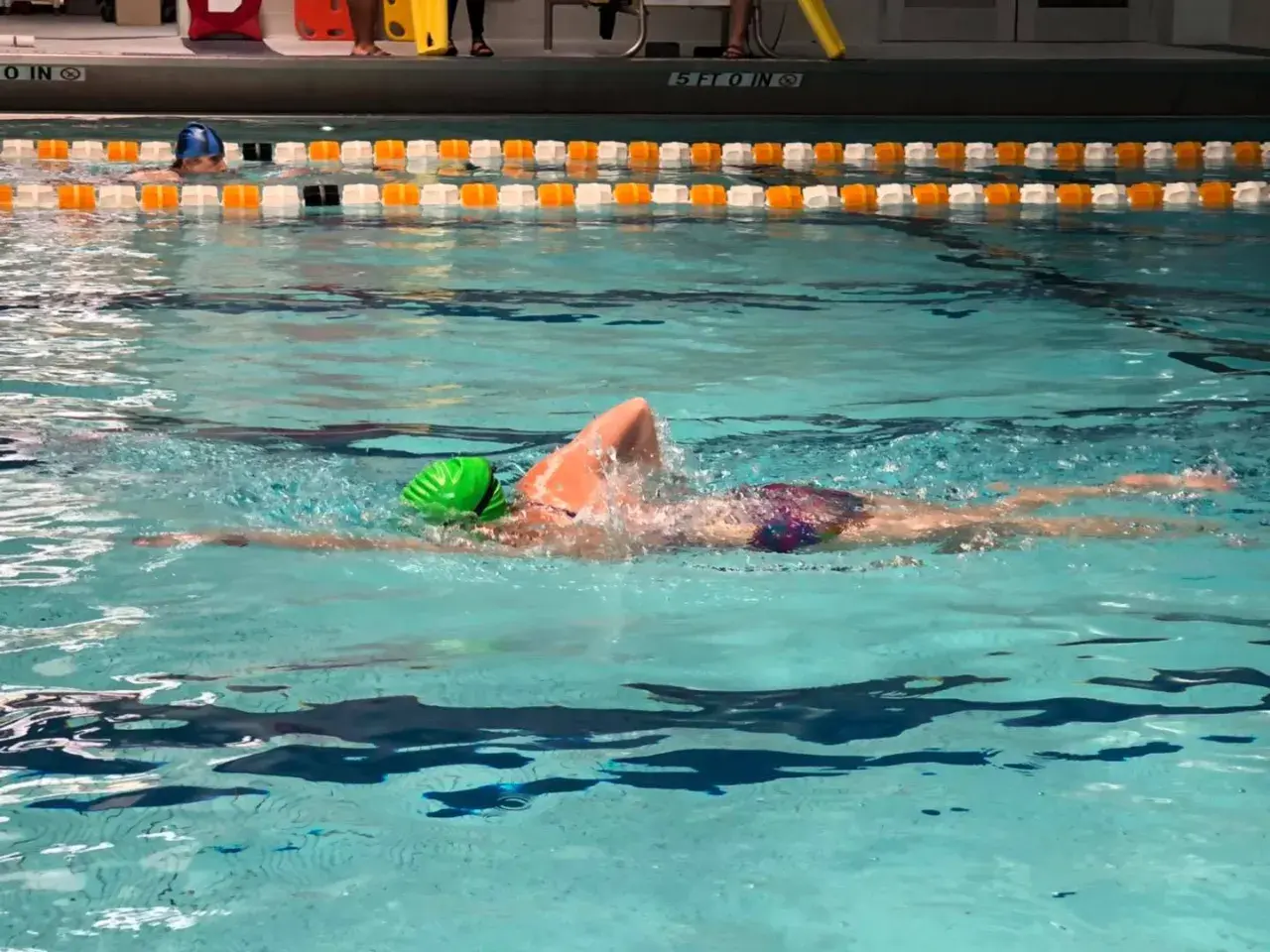
A front crawl swim is easier to improve when you stop treating it as one big motion and start fixing the pieces that create drag, breathing stress, and wasted effort. In practice, that means cleaner body position, a more useful catch, calmer breathing, and a kick that supports the stroke instead of fighting it. I’m focusing on the parts that matter most in the pool, not on theory that only looks good on paper.
The main things to get right before you chase speed
- Keep the body long and stable so the stroke moves you forward instead of sideways.
- Set the catch early and press back through the water instead of slipping through it.
- Exhale underwater so breathing does not break the rhythm of the stroke.
- Use the kick for balance first and speed second, especially in longer swims.
- Choose drills that isolate one fault and then return you to full stroke quickly.
Why front crawl is the freestyle stroke most swimmers default to
In pool swimming, freestyle technically allows any stroke, but front crawl is the version most people choose because it is the fastest and most economical when it is done well. That is why it shows up everywhere: lane swimming, triathlon training, open-water races, and the freestyle events themselves. For newer swimmers, the upside is simple: once the basics click, this stroke gives you a lot of speed for the effort spent.
The catch is that front crawl is also unforgiving. If the timing is messy, the body line drops, and the breathing gets rushed, the stroke starts to feel expensive very quickly. I like to frame it this way: it is a speed stroke only after it becomes a balance stroke first. Once you understand that, the rest of the technique makes more sense.
That is why I always start with body position before arms or kick. If the body is fighting the water, the rest of the stroke has to work too hard.
The body line that keeps the stroke fast
Water punishes extra movement. The more your body snakes, sinks, or lifts, the more energy you spend on holding position instead of travelling forward. A strong front crawl body line is long, narrow, and calm: head neutral, eyes slightly down, hips near the surface, and a small roll through the shoulders rather than a side-to-side wobble.
Swimming.org coaching notes put a lot of emphasis on a flat, streamlined line with a relaxed head, and that matches what I see most often in successful swimmers. The goal is not to become rigid; it is to stay long enough that every arm pull actually counts.
| Good cue | What it changes | What usually goes wrong |
|---|---|---|
| Eyes down and neck long | The head stays quiet and drag drops | Lifting the face breaks the line |
| Hips close to the surface | The kick stays useful instead of sinking | Dropping the hips makes the kick feel heavy |
| Shoulders rotate, head stays still | The recovery becomes easier | Over-rotating throws balance off |
If your stroke already feels busy, this is the first place I would simplify. Get the line right, and the arms have a much easier job. From there, the next step is teaching the hands to find water instead of just splashing through it.
Arm action that actually grabs water
Good front crawl arm work is less about a big sweep and more about a controlled hold on the water. The hand enters cleanly in line with the shoulder, reaches forward without crossing the centre line, and then the forearm and hand angle into the catch so you can press back against solid water. That early catch is what gives the stroke its power.
Most swimmers who feel weak in freestyle are not really weak; they are sliding through the catch. Their hand drops, the elbow collapses, and the pull becomes a press downward rather than a drive backward. I would rather see a shorter stroke with a firm catch than a long, glamorous stroke that slips away.
| Phase | What to feel | Common error |
|---|---|---|
| Entry | Clean and quiet, in line with the shoulder | Crossing over and weaving the body |
| Catch | Forearm and hand set the water early | Reaching forward for too long and then dropping the elbow |
| Pull and push | Pressure moves back toward the thigh | Pushing down or out to the side |
| Recovery | Loose, relaxed, and ready to re-enter | Throwing the arm wide and tense |
If you get the entry and catch right, the stroke starts to feel less slippery and more controlled. That sets up the part most swimmers underestimate, because even a good pull can fall apart when the breathing rhythm is wrong.
Breathing without breaking the rhythm
Breathing is usually where front crawl gets messy first. The easy fix is not to rush for air; it is to keep exhaling underwater so the breath is ready when your mouth clears the surface. That stops the panic pause that makes swimmers lift the head, sink the hips, and lose the stroke.
In practice, I want the breath to happen with the body roll, not against it. Turn just enough for one goggle to stay in the water, breathe to the side, and let the head return before the recovering arm starts its next cycle. A regular pattern, often every 2, 3, or 5 strokes depending on the set, is more useful than grabbing air whenever you feel short of breath.
- Exhale continuously underwater so you are never emptying your lungs at the top.
- Keep the head low and let the shoulder roll create space for the breath.
- Use bilateral breathing when it helps balance, open-water sighting, or stroke symmetry, but do not force it into every swim.
- Match breathing to the set: slower patterns for easy distance, a more frequent breath pattern when pace rises or the water gets rough.
Kick, rotation, and pacing
The flutter kick is important, but it is not the main engine for most swimmers. Its first job is to keep the body balanced and the hips from dropping; its second job is to add a little propulsion without creating too much drag. That is why a small, controlled kick often beats a frantic one, especially in longer pool sets.
For many adults, the useful question is not whether to kick hard, but how much kick matches the goal of the swim. A sprint wants more leg drive. A steady aerobic set usually wants less. Open-water swimming often sits somewhere in the middle, because you need enough kick to stay aligned but not so much that you burn energy before the main work is done.
| Kick pattern | Best use | Main trade-off |
|---|---|---|
| 2-beat kick | Longer sets, triathlon prep, relaxed distance pace | Less explosive speed off the wall or in a sprint finish |
| 4-beat kick | General fitness swimming and mixed pacing | Needs decent timing to feel smooth |
| 6-beat kick | Short races and fast repeats | Costs more energy and raises fatigue quickly |
Rotation matters just as much as the legs. Let the shoulders roll with the stroke, but do not let the whole body twist out of line. If that balance holds, the stroke starts to feel lighter and the water stays under control. At that point, the best gains usually come from targeted drills rather than just swimming more metres.
Drills and kit that fix the stroke faster
I like drills that isolate one problem and then hand you back to full stroke quickly. They should sharpen the feel of the water, not turn a session into endless half-strokes. A short set of the right drill often does more than a long set of tired laps.
- Catch-up drill helps length and timing, but only if you keep moving and avoid pausing at full extension.
- Single-arm freestyle exposes breathing faults and tells you whether one side is doing all the work.
- Side-kick with one arm extended improves balance and rotation, which is useful if your hips sink when you breathe.
- Fingertip drag keeps the recovery relaxed and stops the arm from flying wide.
- Front snorkel removes breathing from the equation so you can focus on line and catch.
- Pull buoy is useful for feeling the upper body mechanics, but it should not become a permanent crutch.
- Short fins can make body position easier to feel, especially if your kick is weak or your ankles are stiff.
- Hand paddles belong later, once the catch is stable, because they can hide poor mechanics and stress the shoulders.
If I had to pick the smallest useful kit for most swimmers in the UK, I would start with decent goggles, a front snorkel, and a pair of short fins. That combination gives you enough feedback without cluttering the session. Once the drills and tools make sense, the last step is to stitch everything into a swim you can repeat week after week.
A lane session that pulls the stroke together
When I want to rebuild front crawl without overcomplicating it, I use a short session built around one technical focus and one pace focus. It is simple enough to repeat, but specific enough to show whether the stroke is actually improving.
- 200m easy swim, concentrating on head position and a long body line.
- 6 x 25m catch-up or single-arm drill, with 20 seconds rest, keeping the hand entry clean.
- 4 x 50m front crawl, breathing every 3 strokes on the first 25m and every 2 strokes on the second 25m.
- 4 x 25m slightly faster, but only if the stroke shape stays the same.
- 100m easy loosen-down, checking whether the hips still stay near the surface when you are tired.
That kind of session usually improves more than fitness alone because it teaches the body to keep technique when the effort rises. If the stroke feels calmer, the timing is cleaner, and you can hold pace without fighting the water, the basics are doing their job.