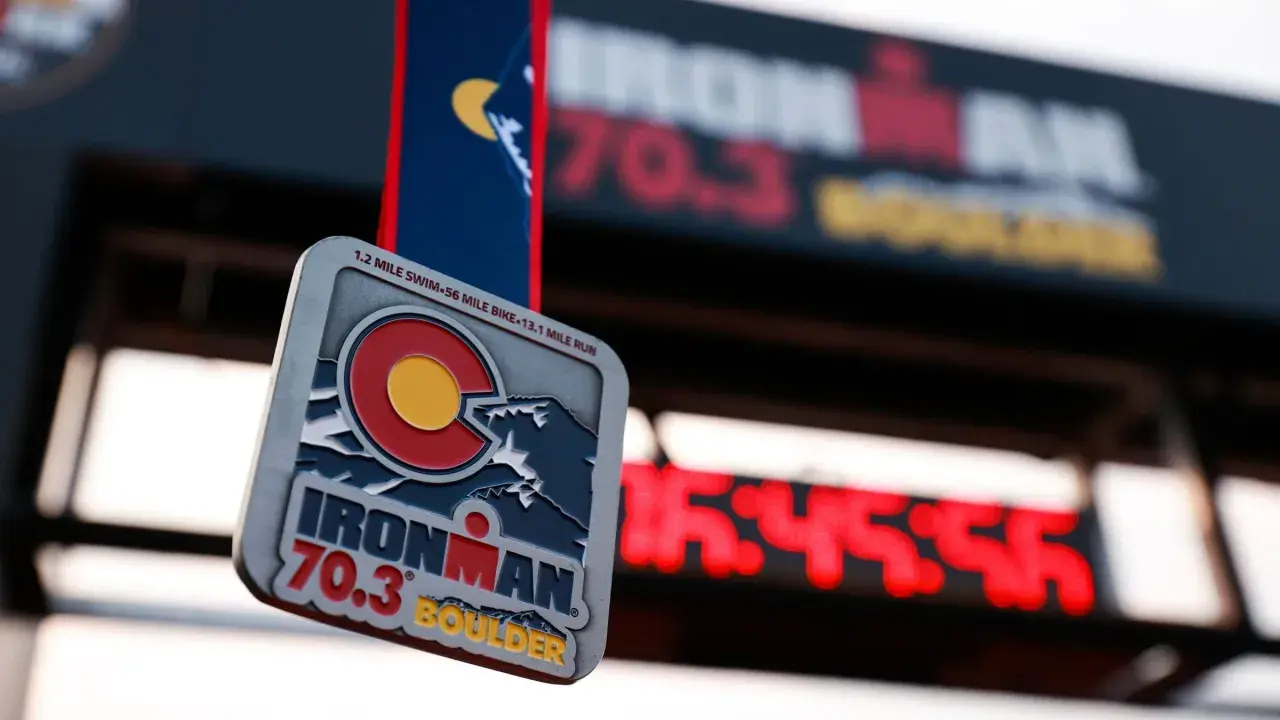
IRONMAN 70.3 Boulder is a race that rewards patience more than ego. The swim in Boulder Reservoir, the rolling bike, and the dirt-heavy run all look manageable on paper, but altitude and repeated surges make the day feel harder than the profile suggests. This article breaks down what the course really asks of you, how to approach the swim with smarter technique, and which race-week details matter most if you want to finish strong.
The Boulder course is a pacing test from the first stroke to the finish line
- The 2026 race is scheduled for June 13 in Boulder, Colorado.
- The event covers a 1.2-mile reservoir swim, a 56-mile two-loop bike, and a 13.1-mile two-loop run.
- Boulder sits at 5,430 feet above sea level, so effort feels sharper than it would at sea level.
- The bike features rollers and fast descents, while the run is mostly hard-packed dirt and gravel.
- The official 2026 race card shows an expected high of 79°F, a low of 61°F, and an average water temperature of 71°F.
- Race-day logistics matter: getting to the venue and moving around town are part of the challenge.
Why Boulder feels harder than the split sheet suggests
The first mistake I see athletes make is treating Boulder like a course they can “push through” with pure fitness. It is not built that way. The altitude is real, the terrain is honest, and the day rewards athletes who keep their effort under control when the course invites them to surge.
The official race page places Boulder at 5,430 feet above sea level, and that changes more than breathing. It changes how hard the bike feels after each climb, how quickly you can recover from a spike, and how long it takes before your run rhythm settles in. On top of that, the expected course profile is not flat in any meaningful sense: the bike is rolling, the run is repetitive enough to punish sloppy pacing, and the sun can make the second half of the day feel very different from the first.
If I had to reduce the race to one principle, it would be this: do not spend energy trying to prove fitness early. Once you accept that, the swim is easier to manage and the rest of the race becomes far more predictable.
How the reservoir swim should shape your plan
The swim starts with a one-loop, counterclockwise lap in Boulder Reservoir, with athletes entering from the east boat ramp and exiting at the west boat ramp. That is a simple layout, but simplicity is not the same as ease. Reservoir swims reward straight-line confidence, relaxed breathing, and a clean start more than raw pool speed.
For open-water swimmers, the key is not to turn the first 300 meters into a sprint. I would rather see a controlled first minute, quick exhalations, and a steady sighting rhythm than a frantic charge into the pack. In practical terms, that means holding your line, breathing early and often, and using landmarks instead of lifting your head every few strokes.
The water temperature listed on the 2026 race card is 71°F, which is usually comfortable enough that the bigger risk is overcooking the opening minutes, not getting cold. If you wear a wetsuit, make sure it is already broken in and does not rub your neck or shoulders. A small gear problem in open water can cost more time than people expect because it changes both body position and confidence. That is why the swim in Boulder is less about brute force and more about technical calm.
Once you exit cleanly, the race starts asking different questions, and the bike is where those questions get expensive.
What each leg really asks of you
| Leg | Distance | What it feels like | Biggest mistake | Better approach |
|---|---|---|---|---|
| Swim | 1.2 miles | Open-water effort with sighting, contact, and early heart-rate spikes | Starting too hard and fighting the pack for no gain | Settle early, breathe out fully, and hold a clean line |
| Bike | 56 miles | Two loops with rollers, fast descents, and repeated rhythm changes | Chasing speed on every rise and paying for it later | Ride by effort or power, cap surges, and stay smooth on descents |
| Run | 13.1 miles | Two loops on hard-packed dirt and gravel with enough rolling terrain to matter | Overstriding on uneven ground and letting cadence fall apart | Keep stride compact, stay patient, and fuel before you feel empty |
The bike is where many strong athletes give time back. The route heads into short rollers and fast sections, which makes it tempting to attack every climb and enjoy every descent as if it were free speed. It is not free. Every surge at altitude costs more than it does at sea level, and the cost shows up later, usually on the second loop or deep into the run.
The run is more forgiving on paper than the bike, but it has its own trap. Hard-packed dirt and gravel can feel fast at first, yet they punish runners who overstride or drift into sloppy posture. I like athletes to think in terms of rhythm, not pace obsession: short contact, quick cadence, relaxed shoulders. That is usually what keeps the final miles from unraveling.
The pattern across all three legs is consistent: Boulder punishes the athlete who spends energy in the wrong place. That makes preparation more important than any single heroic effort.
How I would prepare if I were coming from sea level
Altitude is the first thing I would plan around, especially if you live and train near sea level. You do not need to panic about it, but you do need to respect it. The first rule is simple: base your race strategy on effort, not on the pace you wish you could hold.
- Arrive early enough to settle in if your schedule allows it, because a few days of acclimation are worth more than pretending the altitude does not matter.
- Keep the first 20 to 30 minutes of the bike deliberately controlled, even if your legs feel good after the swim.
- Use open-water sessions in training to practice sighting, relaxed exhalation, and calm starts under stress.
- Include short hill surges in bike sessions so the repeated accelerations do not shock your legs on race day.
- Train at least a few runs on uneven or rolling surfaces so the dirt-and-gravel rhythm feels familiar.
From a swim perspective, I care most about athletes who can keep their breathing under control when the water gets crowded. That is a technique issue, not just a fitness issue. If you can exhale smoothly, stay long in the water, and avoid panic breathing in the first minute, you buy yourself far more energy than most athletes realize.
Fueling also needs to be rehearsed, not guessed. At altitude and in sun, small nutrition mistakes show up faster, so I prefer athletes to practice eating earlier rather than trying to “save” calories for later. Once that part is stable, the next job is logistics, because Boulder is one of those races where the city flow affects the athlete almost as much as the course itself.
Race-week logistics that are easy to underestimate
Boulder County says the bike course will be active between 7 a.m. and 2 p.m. on Saturday, June 13, 2026, and several key roads will be affected. If you are driving, supporting, or staying in town, that matters. The practical version is simple: give yourself more time than you think you need, and do not assume normal traffic patterns will hold.
For athletes and spectators, the shuttle system is not optional on race morning. That alone changes the tone of the day, because it means your arrival, warm-up, and pre-race routine need to be planned around transport rather than convenience. It is a small thing on paper, but it saves a lot of stress if you handle it early instead of improvising at the last minute.
The reservoir also closes to the public during race week, which means local movement around the venue becomes tighter than usual. If you are traveling with family or a support crew, I would map out arrival windows, meeting points, and post-race exits before race morning. The less mental bandwidth you spend on movement and parking, the more you preserve for execution.
That is the part many people overlook: Boulder does not just test fitness, it tests organization. Once those pieces are settled, you can focus on the only thing that really matters, which is how you choose to race the day.
The small adjustments that usually decide the day
- Swim with restraint. The first minute should feel controlled, not urgent.
- Cap your bike surges. Short climbs are not a license to go above threshold every time.
- Run with compact mechanics. The dirt and gravel reward stability more than stride length.
- Fuel earlier than feels necessary. Altitude and heat make late nutrition harder to rescue.
- Keep your pre-race routine simple. Boulder already gives you enough variables without adding chaos of your own.
If I were coaching someone for this race, I would keep repeating one idea: make the first hour boring. That is usually the difference between a solid Boulder day and a messy one. The athletes who do best here tend to look calm early, controlled on the bike, and stubbornly steady on the run, which is exactly what this course asks for.
For a strong result in Boulder, treat the swim as a technical test, the bike as a pacing test, and the run as a discipline test. That mix is what makes the race memorable, and it is also why the athletes who stay composed early usually finish with the better story at the end.
