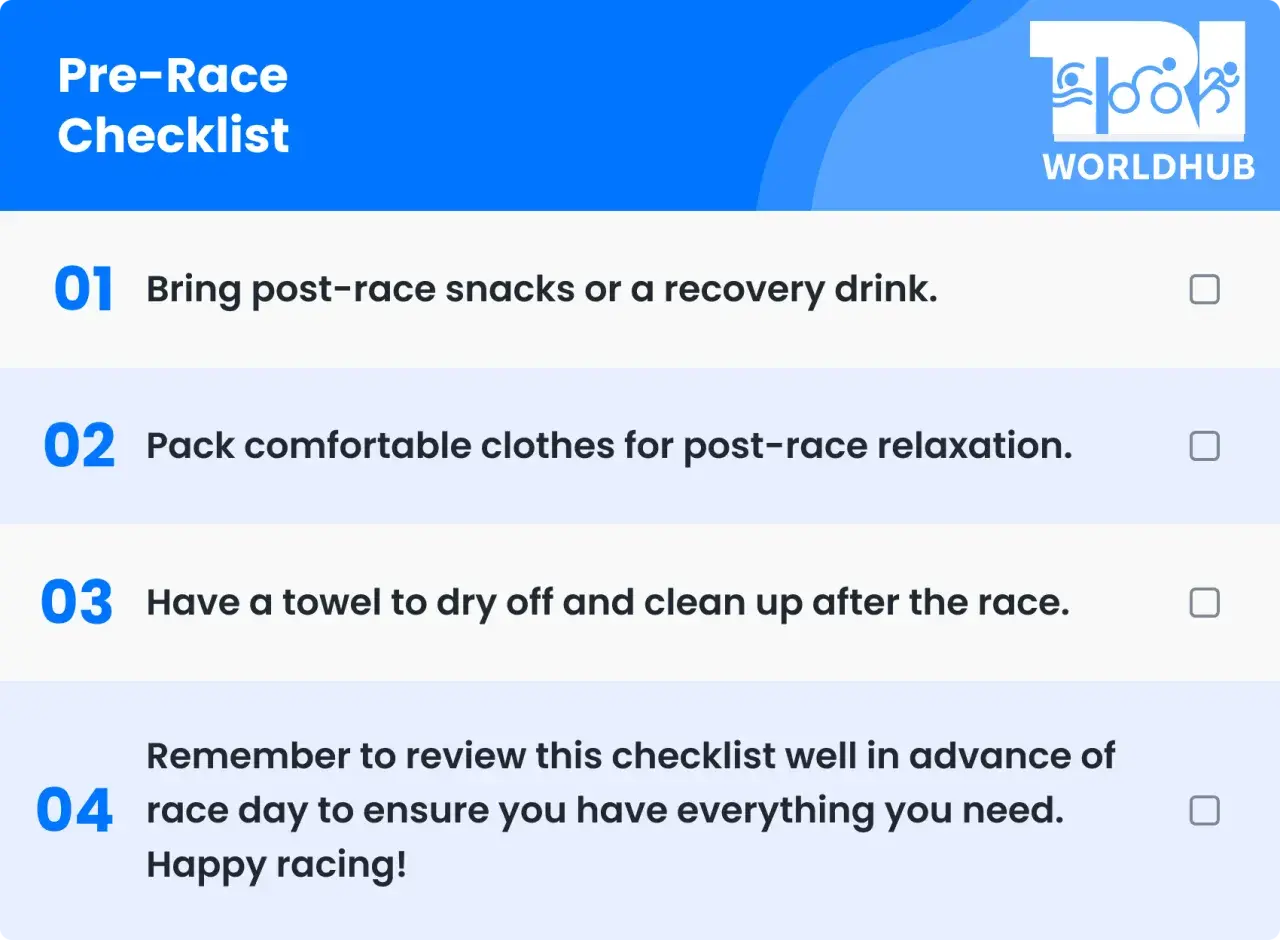
A triathlon race day goes smoother when every item has a place and every step has been rehearsed. A triathlon checklist is less about packing more gear and more about removing uncertainty: what you wear, what stays in transition, how you fuel, and how you move from swim to bike to run without wasting energy. In practice, the best version is simple, specific, and tested before race morning.
What matters most before the start horn
- Keep transition lean. The fewer loose items you bring, the fewer mistakes you can make under pressure.
- Train with the gear you will race in. Goggles, shoes, nutrition, and clothing should already be familiar.
- Separate swim, bike, run, and documents. That makes packing faster and forgotten items easier to spot.
- Plan for weather, not just distance. Heat, wind, rain, and cold can change the list more than the course does.
- Write down nutrition before race morning. Fuel is part of the race plan, not an emergency fix.
Start with the race guide, not the gear pile
The first thing I check is not the bike bag. It is the athlete guide, because the rules for check-in, body marking, chip pickup, transition access, and start procedures shape everything else. A sprint race, an Olympic-distance event, and a 70.3 do not use the same packing logic, and split transitions can change where you store your items.
Before I pack, I confirm five things: the swim start format, whether the race allows wetsuits, how transition is set up, what time check-in closes, and what the weather is likely to do. That one pass usually removes half the guesswork. Once the guide is clear, I can build a list that fits the event instead of hauling around extras.
The swim kit and open-water prep I would not skip
The swim leg usually has the fewest items, but it is where one bad choice can cost the most nerves. I keep two pairs of goggles in my bag, because leaks and fogging are common enough to justify the backup. For open water, I also want a suit or tri suit that has already been tested, plus anti-chafe balm on the neck, under the arms, and anywhere the wetsuit can rub.
| Area | Pack this | Why it matters |
|---|---|---|
| Swim | Goggles, spare goggles, cap, wetsuit or tri suit, anti-chafe balm, small towel | A small failure here can ruin the start before the race really begins. |
| Bike | Helmet, bike shoes, sunglasses, bottles, nutrition, bike computer, repair kit | The bike leg rewards clean setup and nothing forgotten at the mount line. |
| Run | Running shoes, socks if you wear them, race belt, hat or visor, gels, sunscreen | The run is where comfort choices start to feel expensive if you ignored them. |
| Documents and admin | Timing chip, bib, ID, registration confirmation, special instructions | These are the items that turn a smooth arrival into a scramble if they are missing. |
If I am racing in a tri suit, I treat it as part of the swim kit because it has to work in water, on the bike, and on the run. A tri suit is the all-day race kit you keep on from start to finish; it should dry quickly and fit well when wet. That matters more than most beginners expect, because comfort in the swim often decides how calm the rest of the morning feels.
For swimmers coming out of the pool, the biggest adjustment is not pace. It is control. Open water rewards sighting, relaxed exhalation, and a calm first 200 meters more than it rewards fitness alone. I like a few race-pace pickups with sighting practice during training, because that teaches my head and body to work together when the water is crowded. If the start is rough or the conditions are choppy, that rehearsal matters more than a brand-new pair of goggles ever will.
USA Triathlon’s beginner guidance keeps this leg simple for a reason: if the swim is clean, the rest of the day gets easier. That is why I treat the swim kit as comfort, safety, and confidence, not decoration. From there, the next question is how little I can carry on the bike and run without creating problems later.
How I set up transition to save time
Transition is where a lot of first-time athletes lose time for no good reason. My approach is simple: only bring what I need, lay it out in the order I will use it, and make the space easy to read at full heart rate. A bright towel helps me spot my rack quickly, and I keep the setup so lean that I can explain it in one breath.
USA Triathlon’s transition advice is still the best version of this idea: shoes, towel, helmet, sunglasses, socks, and race number are usually enough. I add only what I have actually trained with. That means helmet straps opened, bike shoes ready, sunglasses easy to grab, and the race belt threaded and ready so I am not fumbling with it after the swim.
- Put the bike in an easy gear for the first few pedal strokes.
- Place helmet and sunglasses where you can reach them without searching.
- Keep socks inside shoes if you wear them, so they are easy to pull on.
- Lay run shoes open with the tongue pulled up and the laces already adjusted.
- Use a landmark, not just rack color, to find your bike quickly.
I also rehearse the penalty that matters most: I do not touch the bike until the helmet is on and buckled. That single habit prevents one of the most common transition mistakes. Once transition is tidy, the final danger is improvising fuel, fluids, or weather protection on race day.
Fuel and fluids should be practiced, not guessed
Nutrition belongs on the checklist because it affects both pacing and mood. I usually think in two layers: the pre-race meal and the race fuel. The meal should be something I already know works, often taken two to three hours before the start, while the race fuel should match what I have practiced during training. If I am racing short course, I keep the plan simple. If I am racing longer, I get more precise about bottles, gels, and how much I expect to take on course.
The main rule is boring but important: do not test a new gel, drink mix, or supplement on race day. IRONMAN says it plainly, and the advice is still right for local age-group racing. New fuel can upset the stomach, new bottles can leak, and new habits can break under stress. I would rather use a slightly less exciting plan that my body already understands than gamble on something glossy and unfamiliar.
- Pack the same nutrition you trained with, not a last-minute upgrade.
- Label bottles if you use different mixes for the bike and run.
- Bring a small top-up snack for before the start if the schedule runs long.
- Add sunscreen, a hat or visor, and weather-specific layers if the forecast demands them.
- For heat, plan extra fluids and electrolytes; for cold, add arm warmers, a vest, or dry socks if the race allows it.
For sprint and Olympic races, I can usually keep the plan compact. For 70.3 and longer, I want the bike fuel written down in hours, bottles, and gels before I leave home. The point is not to over-engineer the day. It is to make sure your fueling plan is already decided before your heart rate spikes. That way the only thing left on race morning is execution.
The final 24 hours should feel almost automatic
The night before the race, I want my future self to have as few decisions as possible. That means charging devices, filling bottles, checking tire pressure, laying out swim, bike, and run clothes, and packing anything that is easy to forget when I am rushing in the morning. I also place my bib, timing chip, ID, and registration confirmation in the same pocket every time so I do not have to hunt for them.
On race morning, I try to arrive early enough to park, check in, use the bathroom, set up transition, and still breathe. For many local races, I like at least 90 minutes; for bigger events, closer to two hours is more realistic. That buffer keeps the whole day from turning into a sprint before the race even starts.
- Pack the car before bed so the morning is a handoff, not a scramble.
- Check the weather one last time and make the final clothing choice then.
- Bring your bike tools only if you know how to use them.
- Do a quick visual check of valves, brakes, shoes, and helmet fit.
- Keep a small bag for keys, phone, and non-race items so they do not end up in transition by accident.
The less I have to solve before the start horn, the better I race. Once the last-hour routine is set, the only thing left is removing the mistakes that sneak into even experienced athletes’ bags.
Strip out the mistakes before they reach the start line
The fastest way to improve a race-day list is to delete anything that creates friction. That usually means overpacking transition, bringing clothes or gadgets you have never trained with, or assuming the course will solve problems for you. A cluttered bag makes a calm athlete feel rushed, and a rushed athlete is more likely to forget the simple things.
- Do not debut new shoes, socks, goggles, or nutrition on race morning.
- Do not bring extra clutter into transition unless the athlete guide requires it.
- Do not rely on memory for bike location, start time, or check-in timing.
- Do not skip chafing protection if you know your skin reacts under pressure.
- Do not ignore course rules on headphones, glass containers, or helmet use.
Those are the mistakes I see most often, and they are all avoidable. Once you remove them, the final step is not packing more. It is turning the list into a repeatable system.
The best race-day list is the one you can reuse
My own race prep works because I separate the list into three parts: must-pack items, race-specific items, and nice-to-have extras. The must-pack list never changes much. The race-specific list is where I note things like split transition, weather layers, or special nutrition. The nice-to-have list stays short on purpose, because I would rather forget a luxury than bury the essentials.
After every race, I update the list while the details are still fresh. If I used something, it stays. If I forgot something, it gets added. If I packed something and never touched it, I ask whether it truly deserves a place next time. That is how I keep the plan lean without making it fragile.
My own triathlon checklist works because it is boring in the best possible way: the same core items, the same layout, the same race-morning sequence, with only the course-specific details changing. If you build it that way, you stop relying on memory and start arriving ready to race.
