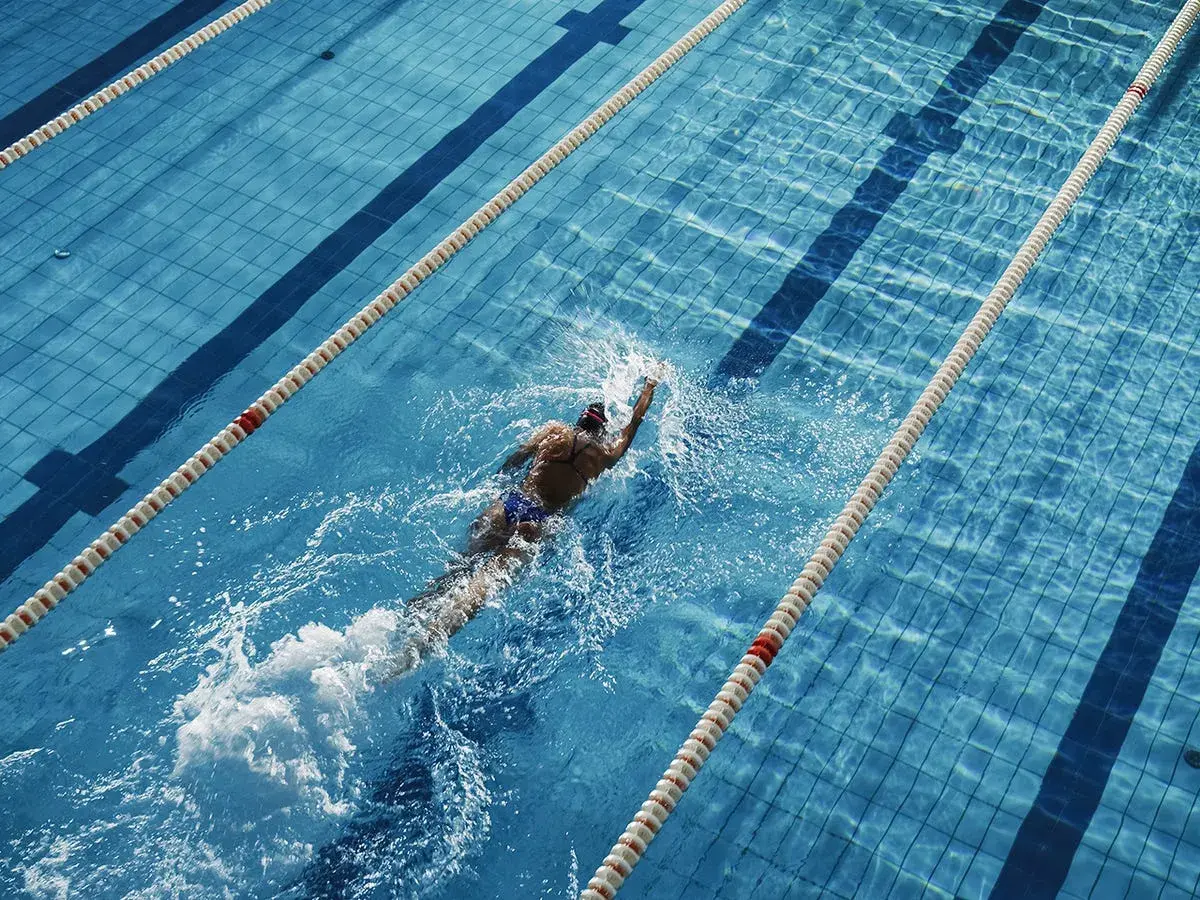
Pool training can be deceptively demanding. The honest answer to how many calories do you burn in the pool is that the number swings a lot with stroke, speed, body weight, and how much of the session you actually spend moving. In this guide, I break down realistic ranges, show you how to estimate your own burn, and explain which pool workouts give you the biggest return.
The short answer is a wide range, not a single number
- For a 155-pound adult, a casual 30-minute pool session often lands around 190 to 250 calories.
- Hard lap swimming can move that closer to 300 to 400 calories in 30 minutes.
- Butterfly, sprint sets, and other high-intensity water work can go higher still.
- Body weight, stroke choice, and rest time matter more than the water itself.
- The best estimate comes from active time, not the whole clock time on deck.

A realistic calorie range for pool workouts
Harvard Health's 30-minute chart gives a useful baseline: a 155-pound person burns about 216 calories with general swimming and about 360 calories with vigorous lap swimming. That gap is the whole story in miniature. Pool workouts can look similar from the side, but energy cost changes fast once you move from easy continuous swimming to real lane work.
I like using METs because they let me compare different pool workouts on the same scale. The table below uses MET-based estimates for 30 minutes of active time, which makes it easier to compare a relaxed swim, a lane workout, and harder training sets.
| Pool workout | Approx. MET | 125 lb | 155 lb | 185 lb | What it usually feels like |
|---|---|---|---|---|---|
| Water walking, moderate | 4.5 | 128 | 158 | 189 | Low-impact, steady effort |
| Water aerobics | 5.5 | 156 | 193 | 231 | Continuous movement with short recovery |
| Recreational swim | 6.0 | 170 | 211 | 252 | Easy laps or non-race swimming |
| Steady lap swim | 7.0 | 198 | 246 | 294 | Comfortably hard, but sustainable |
| Fast freestyle laps | 9.8 | 278 | 345 | 411 | Fast training pace |
| Butterfly training | 13.8 | 391 | 485 | 579 | Very hard, usually interval-based |
As a rough rule, a 30-minute swim for most adults lands somewhere between about 150 and 400 calories, with the lower end fitting easy pool work and the higher end reserved for hard lane sessions. If the workout includes long wall rests, cut the estimate down; if the whole half hour is active swimming, keep the higher number in mind. That range makes more sense once you look at the variables that push a pool session up or down.
Why the burn changes so much from one swimmer to another
The biggest mistake I see is treating pool calories as a property of the pool. They are really a property of the session. A heavier swimmer burns more at the same pace, a harder stroke costs more than an easier one, and short rest intervals keep the average burn high because you stay in motion longer.
There is no single pool number I trust for every swimmer, because two people can finish the same 30-minute class with very different amounts of actual movement. The number becomes useful when you look at the right variables:
- Body weight affects the total because the same movement costs more energy for a larger body.
- Stroke choice matters because butterfly and fast freestyle demand more power than easy backstroke or water walking.
- Pace changes the number quickly; sprinting raises calorie burn much faster than simply extending the workout.
- Rest time can quietly cut the total. Ten minutes of standing at the wall is not the same as ten minutes of swimming.
- Technique also matters. Cleaner form can let you hold a harder pace for longer.
- Water temperature and drag can nudge effort up or down, but they do not outweigh stroke and intensity.
If you want a cleaner estimate, think in terms of active minutes rather than just clock time. That leads straight into the easiest calculation method.
A simple way to estimate your own burn
The Compendium defines 1 MET as 1 kcal/kg/hour, which makes the math easy: calories = MET × body weight in kilograms × hours. In plain English, a 7-MET swim burns about seven times resting energy per kilogram per hour. For a 155-pound swimmer, that works out to about 246 calories in 30 minutes of steady lap work. If the same swimmer only spends 25 of those 30 minutes actually swimming, the burn should be adjusted downward.
Here is the method I use when I want a quick estimate that is good enough for training decisions:
- Pick the activity that matches the workout best.
- Use the closest MET value rather than guessing from the whole session.
- Multiply by your weight in kilograms and by the time in hours.
- Use active swim time, not the time spent chatting, adjusting goggles, or hanging on the wall.
If you train with intervals, calculate the hard block and the easy block separately. That is the cleanest way to avoid inflating the burn, especially in sessions that mix sprint repeats with longer recovery breaks. The more honest you are about active time, the better your estimate will be.
Which pool workouts burn the most calories
If the goal is maximum calorie burn per minute, hard interval swimming usually wins. Fast freestyle sets, butterfly repeats, and water jogging can push the session into a very high energy cost range, which is one reason they feel so different from easy laps or an aerobics class. The catch is simple: you still have to sustain the work. A workout that looks brutal for two minutes and turns into a long rest break afterward does not average out as well as it looks on paper.
The most calorie-efficient pool workouts are usually the ones you can repeat without your form collapsing. That is why I would rank the common options this way:
- Fast freestyle intervals are the sweet spot for many swimmers because they combine high output with repeatable technique.
- Butterfly burns a lot, but it is so demanding that many swimmers cannot hold it long enough for it to be the best total-work session.
- Water jogging is excellent if you want joint-friendly conditioning with a surprisingly high burn.
- Water aerobics sits lower on the burn scale, but it is easier to repeat often and recover from.
- Steady lap swimming is the most balanced choice if you want a mix of calorie burn, skill practice, and cardiovascular training.
In other words, the best calorie burn is not always the most exhausting workout. It is the one you can repeat several times a week without your technique falling apart.
How to use pool calories for fitness goals without chasing the wrong number
For most readers, the bigger decision is not the exact calorie number but what you want the pool session to do for you. A swimming plan aimed at fat loss looks different from one aimed at recovery or race pace. If I am planning a week of training, I care less about a single session total and more about whether the workout supports the next one.
| Goal | Best pool approach | Why it works |
|---|---|---|
| Fat loss | Repeatable weekly swims with manageable rest | Consistency matters more than one giant session |
| Conditioning | Intervals with short recovery | You spend more time above an easy comfort pace |
| Recovery | Water walking or light aerobics | Low joint stress and easy movement |
Pool work also fits standard U.S. activity targets well. Thirty minutes of moderate water work can count toward weekly aerobic goals, and harder sets can count even faster. That is one reason swimming stays useful for people who want lower-impact training without giving up intensity.
I would not use a pool session as a one-off calorie bet. I would use it as a repeatable training tool that fits the rest of the week.
What I would track if I wanted a better number next week
If I want a calorie estimate I can actually use, I track three things: active minutes, stroke type, and how hard the set felt at the end. Those three inputs tell me more than a watch screen that promises a precise calorie count. I also compare week-to-week averages, because one strong session means less than a pattern you can sustain.
- Keep the pool setup similar when you compare sessions.
- Separate hard work from recovery time.
- Use the same stroke and rest structure when possible.
- Judge the result by both energy burn and how well you recovered afterward.
That is the clearest answer I can give: pool calories are real, but they are best used as a range. Once you start thinking in terms of effort, active time, and repeatable training, the numbers become much more useful than any single exact estimate.