Good swim technique is less about looking smooth and more about moving through the water with less drag, better timing, and fewer wasted strokes. In practice, that means I care first about body position, breathing rhythm, the pull, the kick, and what happens on every turn and push-off. This article breaks those pieces down in a practical way so you can see which habits make a swimmer faster, which ones quietly slow you down, and where to focus first.
The biggest gains usually come from alignment, breathing, and cleaner turns
- Start with body line before power. A long, balanced position in the water almost always saves more energy than forcing a harder pull.
- Freestyle is usually the best place to find easy speed. Small fixes in breathing, catch, and kick pattern often create fast payoff.
- Each stroke spends energy differently. Freestyle is usually the most economical, while butterfly is the most demanding and breaststroke is the most timing-sensitive.
- Breathing errors spread quickly. If you breathe late, hold air, or lift the head too much, the rest of the stroke tends to unravel.
- Drills work when they isolate one problem. I would rather see one clear cue repeated well than a long set of random drills.
- Turns matter more than most swimmers think. A strong push-off and tight streamline can give you free speed every lap.
What efficient swimming really means
When I talk about efficient swimming, I mean three things working together: propulsion, low resistance, and rhythm. You can be fit and still swim inefficiently if your head is high, your kick is too wide, or your arms are fighting the water instead of using it. The best swimmers do not just work harder; they waste less.
That is why I always start with the basics that happen before the first full stroke. A tight streamline off the wall, a clean breakout, and a stable body line often do more for your pace than another set of hard laps. If your underwater push-off is sloppy, you are giving away speed before your arms even start working.
There is also a psychological trap here. Many swimmers think they need more strength when they really need less friction. Once you understand that, the next question becomes obvious: which stroke is leaking the most energy, and why?
How each stroke spends energy differently
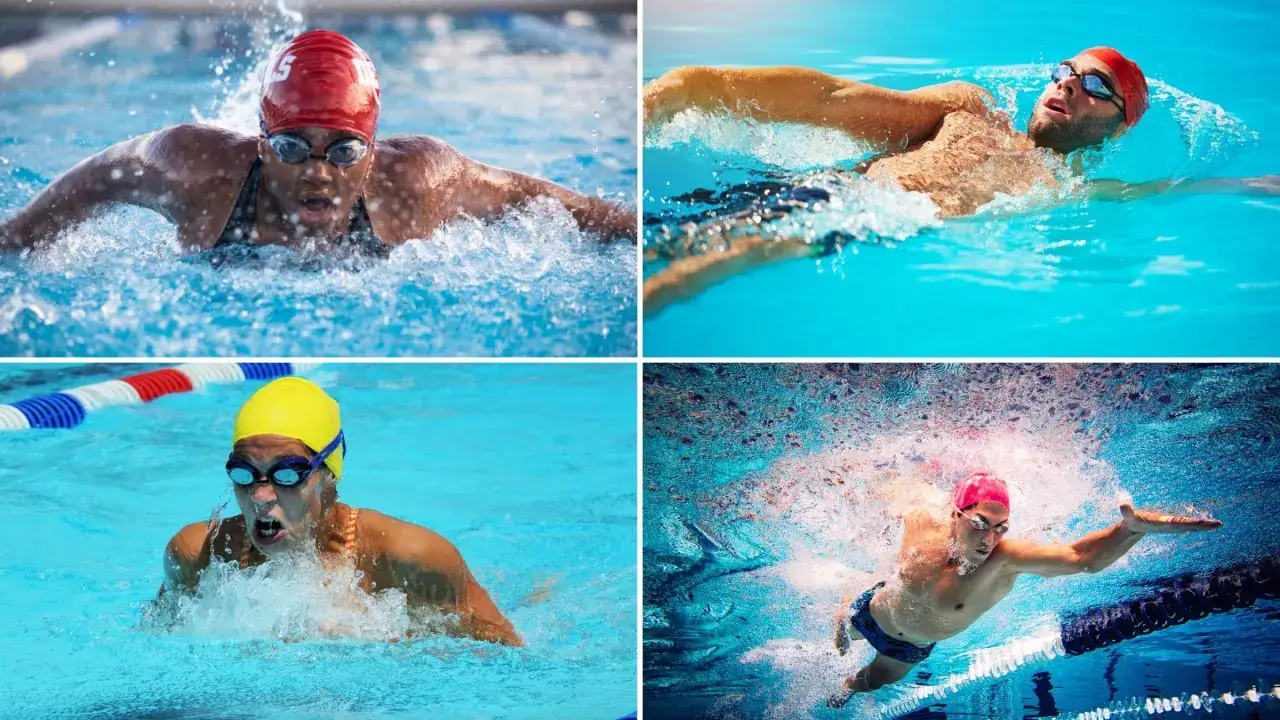
The four competitive strokes all move you forward, but they do it in very different ways. I like to compare them by asking one simple question: what does each stroke ask your body to do repeatedly, and where does it usually break down?
| Stroke | Best for | Main efficiency goal | Common trade-off | My coaching cue |
|---|---|---|---|---|
| Freestyle | Distance, pace control, and most fitness sets | Stay long, breathe without lifting, and use a clean catch | Breathing can ruin body line if it is forced | Keep one eye on the water and keep the pull moving straight back |
| Backstroke | Rhythm, balance, and breathing comfort | Keep the head steady and let rotation help the arms | Hips sink fast if the core turns off | Quiet head, active hips, narrow hand entry |
| Breaststroke | Timing work and recovery swims | Link the pull, breath, kick, and short glide without stalling | Too much pause kills momentum | Pull, breathe, kick, then return to a long line |
| Butterfly | Power, sprinting, and rhythm under fatigue | Keep the wave small and the kicks timed | Big breathing and big recovery make it expensive | Let the hips drive the stroke, not the shoulders alone |
If I am building someone from the ground up, I usually start with freestyle for distance efficiency, backstroke for balance, breaststroke for timing, and butterfly for controlled power. That order is useful because each stroke teaches a different skill, and those skills carry over into the others. From there, freestyle deserves a closer look because it is where most swimmers can reclaim the most easy speed.
Freestyle is usually where the fastest gains appear
Freestyle rewards a long line more than a frantic stroke rate. I want the head in line with the spine, the body rotating just enough to breathe and catch, and the exhale happening underwater instead of at the last second. If you have to lift to get air, the stroke is already leaking energy.
For most swimmers, the useful range for body roll is modest, not dramatic. I look for a smooth rotation that helps the shoulder clear and the hand enter cleanly, not a twist that makes the whole stroke wobble. A common cue is to breathe with only one goggle out of the water, which keeps the head from yanking the torso off balance.
The pull is the next place I look. The hand does not need to carve an elaborate path; it needs to face backward early and then push water straight behind you. Think of the hand and forearm as one paddle. A strong catch sets that paddle, and then the pull finishes with pressure back toward the hip rather than with extra reach or a hard yank.
The kick is where swimmers often overcomplicate things. A two-beat kick is usually the most economical for distance, while a six-beat kick adds more support and speed for racing or sprint work. In between, a four-beat pattern can be a useful compromise. The point is not to kick harder all the time; the point is to kick in a way that helps the body stay balanced.
Recovery matters too. When the recovery arm swings low and wide, the body tends to snake from side to side, and that creates drag you can feel immediately. I prefer a relaxed recovery that returns the arm without disturbing the line of the stroke. The other strokes are built on the same principles, but each asks for a different rhythm.
Backstroke, breaststroke, and butterfly each reward a different rhythm
Backstroke
Backstroke looks simple from the surface, but the small details matter a lot. The head should stay steady, with the ears near the surface and the chin lightly tucked, so the hips do not sink. Most swimmers also benefit from a strong but compact flutter kick rather than a huge one, and many use roughly three kicks per arm stroke to keep the rhythm steady.
I also watch the hand entry closely. If the arm crosses over too much, the body tends to wobble and the shoulders fight the roll. A narrow, controlled entry lets the body rotate cleanly and keeps the pull working in a straight line. Backstroke is one of the best reminders that a calm head often creates a faster body.
Breaststroke
Breaststroke is the stroke that exposes timing problems immediately. The best version feels compact and controlled: pull, breathe, kick, glide, then reset. The kick is the real engine here, but the glide should preserve momentum, not become a dead stop. If the glide gets too long, the next stroke has to restart from zero, and speed disappears.
What I look for most is a legal, compact whip kick with the feet turned out and the knees staying reasonably narrow. If the kick opens too wide, the body loses its line and the knees start creating drag instead of propulsion. Breaststroke works best when the swimmer finishes each action in a streamlined shape and then moves on without hesitation.
Read Also: Flutter Kick - Master Your Swim with Proper Technique
Butterfly
Butterfly demands the most from the body, but it becomes much easier when the motion is rhythmic instead of forced. The two-kick pattern is the key: one kick supports the entry and press of the hands, and the second kick helps drive the recovery and breathing phase. If those kicks are out of sync, the stroke feels heavy very quickly.
Head position is especially important here. A forward-looking butterfly makes the hips drop, and once that happens the stroke turns into a fight. I prefer a low, neutral head position with just enough breath to get in and out quickly. Butterfly should feel like a wave traveling through the body, not like a series of shoulder lifts.
Once the rhythm of each stroke is clear, the next step is making those movements repeatable in training instead of only when you are fresh.
Drills and training habits that make technique stick
Drills are useful only when they solve a specific problem. I do not like drills that feel clever but never change the stroke. The best ones isolate one piece of the movement, let you feel it, and then bring it back into full swimming.
- Streamline pushes. Push off the wall 6 to 8 times and see how long you can hold a tight line before the breakout. This teaches you where free speed lives.
- 6 x 25 drill-swim. Alternate one length of drill with one length of full stroke, resting about 10 to 20 seconds. Use one cue only, such as quiet head or clean catch.
- Side kicking for freestyle. This helps you feel rotation, balance, and breathing without rushing the stroke.
- Backstroke kicking on your back. It is a simple way to check whether the kick is coming from the hips and whether the body stays level.
- Breaststroke timing repeats. Short repeats with a clear pull-breathe-kick pattern are better than long swims where the rhythm falls apart.
- Butterfly with one-arm or three-kick patterns. These are useful when the full stroke is too messy to diagnose in real time.
When I want a drill set to matter, I keep the rest periods honest. Ten to fifteen seconds is enough for short technical repeats, while 25-yard or 25-meter efforts can use a slightly longer pause if the goal is precision rather than fatigue. A little dryland work helps too, especially core control, shoulder stability, and ankle mobility, but it should support what happens in the water rather than replace it.
Good habits are easier to repeat when you know what to avoid, and most swimmers are fixing the same handful of errors.
Common mistakes that waste energy faster than poor conditioning
| Mistake | Why it costs speed | Better habit |
|---|---|---|
| Holding the breath underwater | It raises tension and usually leads to rushed, messy breathing | Exhale steadily so the inhale is quick and calm |
| Lifting the head to breathe | It drops the hips and adds drag across the whole stroke | Keep the head low and let the body roll or rise only as much as needed |
| Overkicking from the knees | It creates a splashy kick with little forward payoff | Kick from the hips with a compact range |
| Letting breaststroke turn into a long pause | Momentum disappears and every stroke has to restart | Keep the glide short and purposeful |
| Crossing over in backstroke | The body wobbles and the pull gets weaker | Enter narrow and controlled, then rotate cleanly |
| Trying to fix everything at once | Technique work gets muddy and inconsistent | Choose one cue per session and repeat it well |
Breathing is the mistake I fix first most often. When breath control falls apart, the body gets tense, the stroke shortens, and the swimmer starts fighting for air instead of swimming. After that, I look at head position, then the kick, then the pull, because those three usually explain most of the visible inefficiency.
The other big mistake is ignoring turns. A swimmer can spend an entire length working hard and then lose the same effort on a weak push-off or a sloppy breakout. That is why I think technique should be trained as a chain, not as isolated arm movements. With that in mind, here is the order I would use in your next session.
What I would change in your next pool session
- Spend the first 10 minutes on streamline and breakout work. Take a few clean push-offs and notice how far you travel before your first stroke. If the line feels loose, fix that before you touch pace work.
- Choose one stroke cue for the main set. Examples: exhale underwater in freestyle, keep the head quiet in backstroke, shorten the pause in breaststroke, or keep the butterfly wave small.
- Use short repeats to protect form. Sets like 8 x 25 or 6 x 50 are better than long, tired laps when you are rebuilding technique.
- Finish with one honest note. Write down the one thing that felt better and the one thing that still leaks speed. That habit keeps progress visible.
If you work this way for even a few sessions each week, the water starts to feel less hostile and more predictable. That is usually the point where a swimmer stops muscling through lengths and starts swimming with intent, and that is the difference that lasts.