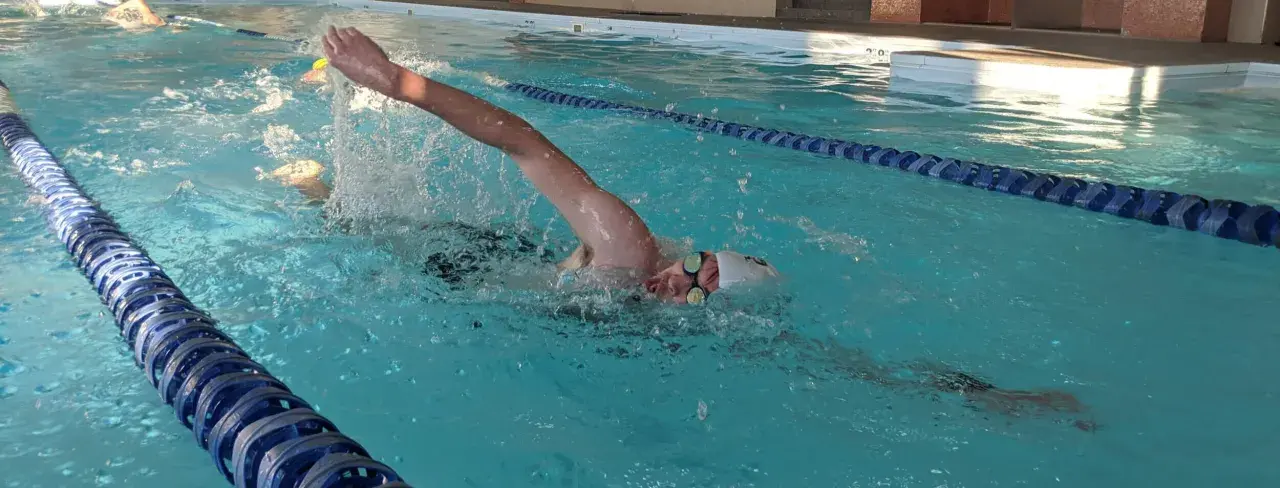
A well-built VO2 max workout in the pool is one of the fastest ways to raise repeat speed without turning every practice into a sprint test. In swimming, the goal is not just to feel breathless; it is to spend enough time at a high oxygen demand that your body learns to recover, hold form, and repeat quality efforts. This guide breaks down what the session should target, how to structure it, which sets work best, and how to fit it into a week without frying your shoulders or your stroke.
The fastest gains come from short, repeatable intervals that keep your stroke intact
- Use hard repeats long enough to drive oxygen use, usually 25 to 200 yards or meters, not endless all-out sprinting.
- Keep the total hard work controlled, often 12 to 24 minutes for most swimmers, so speed stays repeatable.
- Choose rest that is short enough to keep the heart and lungs loaded, but long enough to preserve technique.
- One true high-intensity aerobic session per week is enough for many swimmers; two belongs in a short training block, not as a default.
- Track pace, stroke quality, and recovery between repeats, not just how awful the set felt.
What this session actually trains
VO2 work is about the top end of your aerobic system. The simplest way to think about it is this: your body is trying to use oxygen as fast as possible while you hold a pace that is hard but repeatable. Coaches often call the speed that triggers this ceiling vVO2max, which just means the minimum pace that brings you to maximal oxygen uptake.
That matters in swimming because the pool punishes sloppy pacing. If the first repeat is too fast, you stop training the aerobic ceiling and start practicing survival. If the rest is too long, the demand drops and the set turns into a loose collection of hard swims. The sweet spot is a set that leaves you uncomfortable but still technically organized, usually in repeats that last about 30 to 180 seconds and sit a little faster than threshold but well short of reckless sprinting.
Compared with threshold work, VO2 sessions are shorter and sharper. Compared with pure sprint work, they last longer and ask for more oxygen use. That is why repeat 50s, 100s, and broken 200s are so useful: they sit in the window where the cardio system is under pressure, but the mechanics are still trainable.
How I build a pool set that actually works
When I write a swim session for this goal, I want three pieces: a warm-up that opens the body, a main set that creates the load, and a cool-down that brings the athlete back down without a hard stop. The main set should feel demanding, but it should still look like swimming, not just a battle to the wall.
| Session part | What it should do | Example |
|---|---|---|
| Warm-up | Raise temperature, loosen shoulders, and prime breathing | 400 easy + 4 x 50 build + 4 x 25 fast with full control |
| Main set | Hold high aerobic output long enough to matter | 12 x 50 or 6 x 100 with short, honest rest |
| Recovery | Keep the set repeatable without letting the system fully shut down | 15 to 40 seconds for short repeats, 20 to 60 seconds for longer repeats |
| Cool-down | Lower stress and preserve quality for the next session | 200 to 400 easy swim or pull |
For most swimmers I coach, the hard part of the workout lands in the 12 to 24 minute range. That is enough to create a real stimulus without turning the session into junk volume. Advanced swimmers can go longer, but only if stroke quality stays stable and the session is still repeatable a week later.
Three pool sessions I would actually use
The best set depends on where you are in the season and what kind of swimmer you are, but these three formats cover most use cases in a 25-yard pool. If you train in meters, keep the same work-to-rest rhythm and convert the distances.
| Workout | Best for | Main set | Why it works |
|---|---|---|---|
| Short repeat set | Age-group swimmers and masters swimmers who lose form when the reps get too long | 16 x 50 with about 15 to 20 seconds of rest, holding strong but controlled pace | Short enough to keep speed up, long enough to force high oxygen use across the whole set |
| Classic VO2 ladder | Swimmers who want variety without losing structure | 4 x 50, 4 x 75, 4 x 100, with 15 to 30 seconds of rest between repeats | The rising distance keeps the lungs working while teaching you to hold form under fatigue |
| Broken 200s | Competitive swimmers who need race-specific aerobic pressure | 4 rounds of 50 + 50 + 50 + 50 with 10 to 15 seconds between 50s and 1 to 2 minutes between rounds | You accumulate a lot of fast swimming without letting the system fully reset |
My favorite detail in those sessions is the last repeat. If the final rep falls apart completely, the set was probably too aggressive or too long. If it feels controlled the whole way and the pace only drifts a little, you probably hit the right zone.
How to pace the work so it stays aerobic
VO2 training is not a place for ego pacing. I want swimmers to start fast enough to get into the right zone quickly, then settle into a repeatable rhythm. A useful rule is to finish each rep feeling like you could do one more at similar quality, not three more and not zero more. That is the difference between productive hard work and a blown set.
In practice, I look for three markers. First, the pace should stay close across the set, with only a small drop-off near the end. Second, breathing should be hard but organized, not panicked. Third, stroke count should stay reasonably stable; if it rises sharply, you are probably compensating for fatigue instead of training the system you wanted.
Heart rate can help, but in the pool it is not the cleanest guide because of breathing rhythm, turn frequency, and lag. I trust pace, feel, and stroke quality more. If you can only judge one thing, judge whether your repeat pace is still sharp on the final third of the set.
Where it fits in a swim week and what usually goes wrong
For most swimmers, one high-intensity aerobic session per week is enough to move the needle. Two can work in a short training block, but they should not sit back to back and they should not replace all of your aerobic swimming. The body adapts best when hard work is separated by real recovery.
I usually place VO2 work after a day that is either easy or moderate, not after a heavy dryland session or a brutal sprint day. If you combine too many high-stress pieces, the quality of the swim drops fast and the shoulders often start complaining before the lungs do.
- Going too fast too early turns the set into a lactate test instead of aerobic power work.
- Resting too much lets the system recover so fully that the oxygen demand never stays high.
- Resting too little destroys stroke shape and makes every repeat slower for the wrong reason.
- Doing the session too often leaves you flat and makes the next week worse, not better.
- Ignoring technique creates a fitter swimmer who is still inefficient in the water.
If you want the simplest decision rule, keep the session hard, not heroic. The goal is to finish better adapted, not merely more tired.
What to track over the next few weeks
If I were monitoring progress over a six-week block, I would track four things: repeat pace, stroke count, perceived effort, and how quickly breathing settles between repeats. Those markers tell you much more than a single brutal workout does. A good block usually shows up as tighter pacing, cleaner stroke mechanics, and less panic between hard efforts.
I would also keep the same basic set for at least two or three weeks before changing it. Swimmers often change sessions too quickly, then never learn whether the workout was actually working. Repeating the same format gives you a real comparison point, which is especially useful in the pool because tiny technical changes can hide the effect of the training itself.
For a swimmer in the United States training in a 25-yard pool, that means staying patient with the structure, keeping the main set honest, and using the stopwatch as a guide rather than a verdict. The best aerobic progress usually comes from repeatable quality, and that is exactly what a good pool session should deliver.