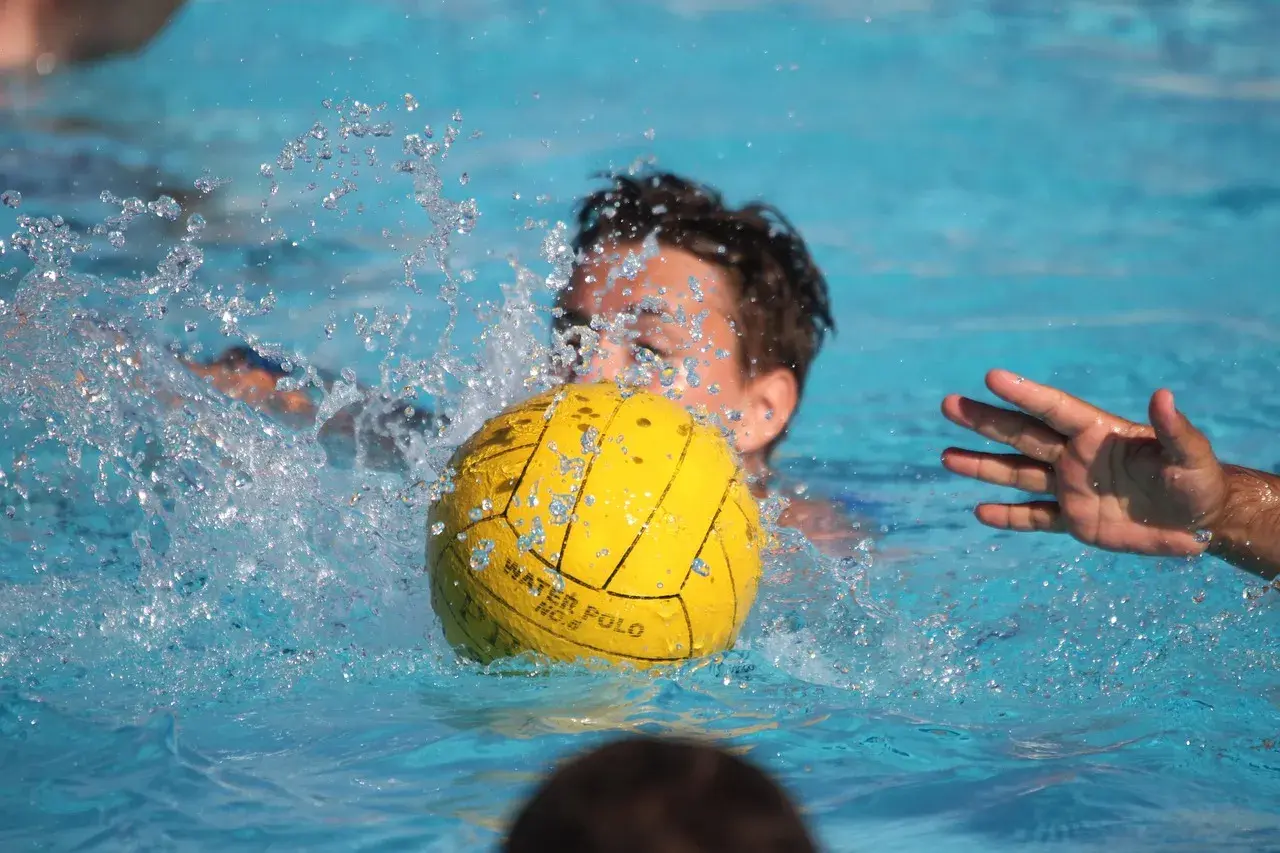
Water polo is one of those sports that looks simple from the stands and complicated the moment you try to play it. It blends swimming, ball handling, spacing, and constant contact in deep water, which is why it appeals to swimmers, divers, and anyone who wants a harder-edged aquatic sport. In this article I break down what the game is, how a match actually works, and what matters most if you are coming from a swimming or diving background.
The sport in one glance
- Water polo is a team sport played in deep water, usually with seven players per side in the water at the start.
- The goal is to score by throwing the ball into the opponent's net while treading water, passing, and defending under pressure.
- At elite level, the field is 25.6 x 20.0 meters, squads can carry up to 14 players, and possession clocks keep the game moving fast.
- The eggbeater kick is the foundation of vertical lift, balance, and quick shooting.
- Swimmers usually adapt fastest to the conditioning load, while divers often bring useful body control and spatial awareness.
What water polo actually is
At its core, water polo is a physical team sport played in deep water. Two teams try to score by moving the ball with one hand, creating space, and shooting past the goalkeeper while staying afloat the entire time. A player cannot stand, push off the bottom, or treat the pool like a lane race; the game is built around balance, leg drive, and quick decisions.
I think the easiest way to picture it is this: swimming gives you the engine, but water polo adds the tactics. You need enough speed to move the ball, enough strength to hold position, and enough composure to make a pass when someone is pulling at your shoulder. That combination is what makes the sport feel so different from both lap swimming and diving.
Water polo also sits inside the same aquatic family as swimming and diving. That shared environment is why people compare them, but the scoring logic is completely different. One sport is judged on form, one is timed, and water polo is a moving mix of endurance, contact, and ball skill.
The next step is understanding how that chaos is organized into an actual match.
How a match flows from sprint to shot
Each side starts with seven players in the water: six field players and one goalkeeper. In current World Aquatics competition rules, elite matches use a 25.6 x 20.0 meter field, a 14-player match roster, and a 25-second men's or 30-second women's possession clock. In many U.S. programs, the exact pool setup can vary, but the structure of the game stays the same. A standard senior match is four eight-minute quarters in most U.S. competition, and that rhythm is part of what gives the sport its pace. At the start of each period, players sprint for possession, then the offense settles into either a structured attack or a counterattack if the defense is late getting back. After each goal, play restarts at mid-pool, which is why transition speed matters so much.Two distance markers matter a lot: the 2-meter line and the 5-meter line. The 2-meter zone protects the goal area and controls where attackers can swim, while fouls inside the 5-meter line can lead to penalty throws when a probable goal is prevented. Most whistles are ordinary fouls that stop play and hand possession back, but major fouls are more serious and can eventually remove a player from the game.
Once you understand those lines, the sport stops looking random and starts looking like a series of recurring tactical decisions. For spectators, the main thing to watch is not just who has the ball, but who has leverage. The best teams create leverage by winning small positional battles before the shot even happens. That is where swimmers and divers start to notice both the similarities and the gaps.
Why swimmers and divers adapt differently
Swimmers usually arrive with a head start in conditioning, pacing, and comfort under fatigue. They know how to move efficiently through water and how to handle hard repeat efforts. What they often lack at first is the constant upper-body fighting, the one-handed ball control, and the need to think while staying vertical instead of horizontal.
Divers, on the other hand, often bring a different kind of advantage. They usually have strong body awareness, clean water comfort, and a good sense of spatial control in the air and at the surface. That helps when a player has to rise for a shot, absorb contact, or stay composed while reading a developing play. The catch is that diving skills do not automatically translate to the repeated contact and endurance demands of a full match.
| Aspect | Swimming background | Diving background | Water polo demand |
|---|---|---|---|
| Movement | Efficient lanes and turns | Explosive takeoffs and body control | Constant repositioning in traffic |
| Breathing | Rhythmic and planned | Brief, controlled exposure | Unpredictable, under pressure |
| Balance | Horizontal and streamlined | Air awareness and alignment | Vertical stability while wrestling for space |
| Scoring skill | Rarely required | Precision matters, but not with a ball | Passing and shooting under contact |
The most honest crossover advice I can give is that swimmers often adapt faster in game fitness, while divers often adapt faster in body control. Neither background is enough on its own. The sport rewards athletes who can combine athletic comfort with fast reading of the play, and that leads directly to the physical skills that decide who becomes useful quickly.
The physical skills that matter most
The single skill I would teach first is the eggbeater kick. It is a circular leg action that lets players stay high in the water, rise for passes, block shots, and maintain position without sinking. If the kick is weak, everything else becomes harder because the player spends the whole match fighting to keep their shoulders above the surface.
Range of motion matters here more than many beginners expect. Tight hips and stiff legs limit how much water the legs can grab, which reduces lift and makes every movement more expensive. Strength helps, but technique and mobility do a lot of the work. That is why elite teams often spend serious time on leg conditioning instead of treating it as a minor side note.
Passing and catching under contact
In water polo, passing is not a clean, stationary motion. Players must catch with one hand, protect the ball, and move it quickly before defenders collapse. A good pass here is less about elegance and more about timing and accuracy under pressure. If you want a simple test of readiness, watch how well a player can receive the ball while being bumped off balance.
Shooting while staying upright
Shooting is a leg-driven skill as much as an arm skill. The best shooters do not just throw harder; they rise high enough to get a clearer release angle and enough power to beat the goalkeeper. That is one reason the sport feels so different from basketball or handball. The body position is unstable, so the shot has to be built from balance first and power second.
Read Also: Pike Position - Master It for Diving, Swimming & Polo
Reading space and reacting fast
Water polo rewards players who see the pool a beat earlier than everyone else. Open space rarely lasts long, so good attackers learn to move before the pass is obvious. Good defenders do the same thing in reverse: they close passing lanes early and force the offense into lower-percentage shots. If you come from diving, this is the part that can feel unfamiliar at first because there is less individual performance and more continuous decision-making.
Once those skills are clear, the beginner mistakes become easier to spot, and they are usually the same ones I see over and over again.
The mistakes beginners make most often
The first mistake is trying to swim the sport like a lap race. A strong freestyle helps, but a water polo athlete cannot spend the whole game moving in straight lines and expecting the ball to arrive on schedule. The sport is stop-start, physical, and reactive. If you only train speed, you will still arrive late to the important moments.
The second mistake is neglecting the legs. Beginners often obsess over arm power because throwing feels obvious, but the real separator is how long a player can stay high and stable in the water. Without that base, passes get rushed, shots get flat, and defenders win the battle by simply making you uncomfortable.
The third mistake is underestimating contact. Water polo is legal contact, but it is not uncontrolled chaos. Good players learn how to hold position, swim through pressure, and keep their head clear when the defense leans on them. The players who struggle most are usually the ones who tense up instead of staying efficient.
For athletes in the United States, the practical takeaway is simple: if you already swim well, do not assume the game will feel easy; if you dive well, do not assume body control alone will carry you. The sport asks for both repetition and adaptation, which is why the best first step is a realistic one.
What I would tell a swimmer or diver before trying it
If you are considering water polo, I would start with three questions. Can you tread hard for long stretches without losing balance? Can you pass and catch while tired? Can you stay calm when the pool turns crowded and physical? If the answer is not yet, that is normal, and it does not mean the sport is not for you.
My advice is to approach the first weeks like skill acquisition, not talent testing. Focus on the eggbeater kick, short sprints, shoulder endurance, and basic ball handling before worrying about tactics. Those building blocks matter more than learning a complicated playbook on day one.It also helps to watch a few matches before stepping in. The game makes much more sense once you can spot the 2-meter area, the counterattack, and the moment a foul creates a free shot or a reset. That kind of visual familiarity shortens the learning curve more than most people realize.
For a swimmer, the sport becomes playable faster than you might expect. For a diver, the early learning curve may feel steeper, but the payoff is real if you enjoy fast, technical, physical aquatic sports. Either way, the move is worth considering only if you are willing to train your legs as seriously as your arms.
Why the sport is worth understanding before you watch or play it
Water polo is best understood as a deep-water, contact-heavy team game built on endurance, position, and quick decisions. That definition sounds simple, but the sport becomes much more interesting once you notice how much of it happens before the shot ever leaves the hand. The best players are not just strong swimmers; they are athletes who can keep their bodies high, think fast, and survive repeated contact without losing shape.
That is also why the sport connects naturally with swimming and diving audiences. Swimmers recognize the fitness demands, divers recognize the body control, and both groups can appreciate how much technique sits behind the surface-level chaos. If you know those differences, the game stops looking like noise and starts looking like a very specific kind of aquatic skill.
For anyone in the U.S. who trains in the pool already, I would treat water polo as a serious crossover option rather than a casual sidestep. It can sharpen conditioning, leg strength, and competitive instincts in ways that transfer back into other aquatic sports, especially when the training is consistent and the expectations are realistic.
