The age range is wide, but the progression is predictable
- Babies can start from birth, and many classes begin around 3 months when parents are ready and the pool is suitable.
- Preschool sessions usually suit ages 2 to 5, with many children moving into more independent lessons around 4 to 5.
- Most children who reach solid water competence do so between about 7 and 11, but only with regular lessons.
- Water confidence is not the same as safety. Floating, treading water, swimming in clothing, and covering 100 metres all matter.
- A good teacher should have recognised training, child safeguarding knowledge, and a clear progression pathway.
What learning to swim really means at each stage
I think many parents picture swimming as one moment: a child jumps in, starts kicking, and that is that. In reality, there are three different layers of ability. First comes water confidence, then stroke control, and finally water competence, which is the point where a child can cope better if things go wrong.
The early wins are simple but important. A child who can enter the water calmly, blow bubbles, put their face in without panic, and return to the side safely is building the right foundation. That does not make them a swimmer yet, but it does make later learning much easier.
Swim England’s minimum water competency standards are a useful benchmark because they are practical rather than romantic. By the time a child is genuinely competent, they should be able to:
- perform a star float for at least 60 seconds
- tread water for at least 30 seconds
- swim in clothing
- swim at least 100 metres with ease and without stopping
That is why a child who can splash happily in the shallow end is still not necessarily safe. Once you separate confidence from competence, the age bands make a lot more sense.

The age ranges I see most often in UK lessons
There is no magic birthday when swimming suddenly clicks. What I see instead is a broad pattern, and it lines up well with the way UK lesson providers tend to organise classes. The NHS says babies can go swimming from a very young age, while many structured baby sessions begin later, once parents feel ready and the pool environment is suitable.
| Age band | Typical lesson style | What usually develops | My practical take |
|---|---|---|---|
| Birth to 3 months | Gentle parent-led water introduction | Comfort, bonding, sensory familiarity | Useful if the family wants to start early, but this is about exposure and confidence, not independence. |
| 3 to 18 months | Baby swimming sessions with a parent in the water | Supported movement, floating, kicking, face comfort | This is the best window for making water feel normal, especially if the pool is warm and the class is calm. |
| 2 to 5 years | Preschool or Duckling-style groups | Following instructions, moving more independently, routine | For many children this is the sweet spot for habit-building and low-pressure progress. |
| 4 to 5 years | More structured preschool-to-school-age lessons | Listening, repetition, longer concentration, basic stroke patterns | Many children are ready for larger group teaching here, especially if they can separate from a parent comfortably. |
| 7 to 11 years | Technique-led lessons aimed at competence | Stroke quality, stamina, survival skills, swimming longer distances | This is the most common age window for real independence, provided lessons continue regularly. |
If I had to compress that into one sentence, I would say this: early lessons build trust, preschool lessons build habits, and school-age lessons build competence. The next question is what the lesson pathway actually looks like once children move past the splashy first stages.
How the lesson pathway builds real ability
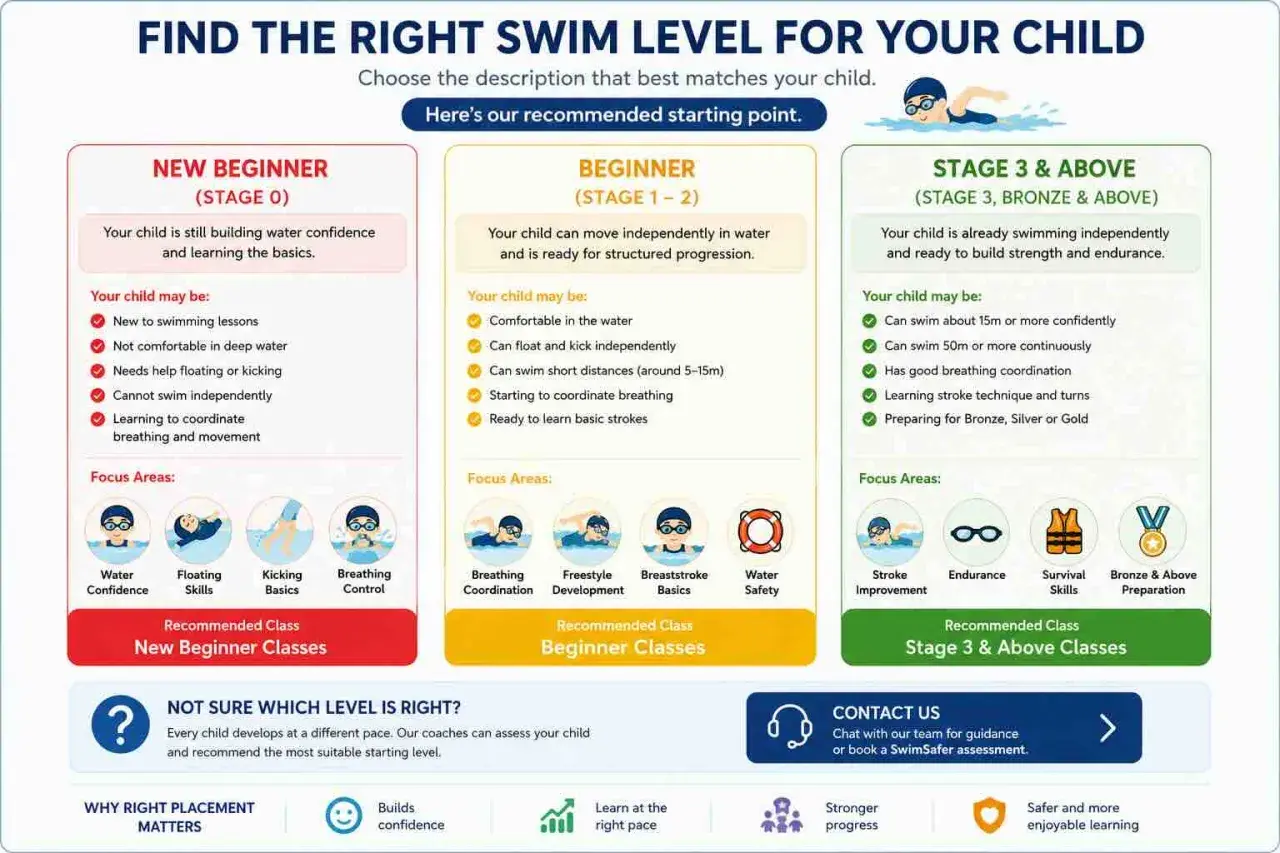
In the UK, the staged framework used by most serious providers is designed to move children from basic comfort to confident swimming in a logical sequence. The early stages focus on entering and exiting the water safely, moving around with support, floating, and gliding. Later stages become more technical and ask for better body position, stronger kicks, and real distance.
The big reason progress slows down later is that the work gets harder. Stages 4 to 7 usually take longer than Stages 1 to 3 because children are no longer just getting used to the water; they are learning to control it.
- Early stages are about confidence, safe entry and exit, and being comfortable with water on the face.
- Middle stages add buoyancy, kicking, sculling, and treading water.
- Later stages introduce better stroke technique, breathing control, swimming in clothing, and longer distances.
- Final stages aim for stamina and quality, not just survival in the pool.
By the time a child reaches the final core stage, they should be able to swim a meaningful distance with control, not just make it from one wall to another. That matters because the difference between “can move through water” and “can keep themselves safe” is huge. From here, the instructor becomes just as important as the syllabus itself.
What I look for in a swim instructor
I would not choose a teacher just because they are cheerful and good with children. Cheerfulness helps, but competence matters more. For babies and toddlers in particular, I want an instructor who has recognised training for that age group, understands safeguarding, and works in a pool setting that feels controlled rather than chaotic.In practical terms, the best swim schools tend to get a few things right consistently:
- teachers hold a recognised swimming qualification appropriate to the age group they teach
- staff working with children have safeguarding checks and a clear reporting process
- baby and toddler sessions are small enough for close attention, ideally with parent participation
- the pool is warm enough for young children to stay relaxed and focused
- the teacher gives specific feedback, not just praise
- the class follows a progression rather than repeating the same games forever
I also look closely at how an instructor handles submersion and fear. A good teacher does not force a child underwater before they are ready. They build trust, make the process voluntary, and use repeated small wins to reduce anxiety. That approach is slower at first, but it usually produces better swimmers and fewer tears.
Once you know what good teaching looks like, the next issue is pace, because parents often want to know how long the journey should take.
How long progress usually takes
The honest answer is that it depends on frequency, temperament, and the kind of lesson your child is taking. A child who attends weekly, practices often, and likes the water will usually move much faster than a child who only swims during holidays. There is no shortcut around consistency.
In my experience, the early confidence stages can move quickly, sometimes within a term or two, while the later technique stages take longer because they ask for better coordination and more stamina. That is one reason many children do not reach strong, independent competence until later primary school.
For UK parents, the most useful benchmark is this: many children achieve competent swimming between 7 and 11 years old, but only if lessons continue long enough. If a child stops too early, they often look confident without actually having the survival skills to back it up.That is also why occasional lessons are a weak substitute for a regular routine. They can maintain familiarity, but they rarely build enough repetition for a child to hold technique under pressure. Once pace is clear, the final question is whether your child is actually ready to move on.
Signs your child is ready for less supervision
This is where I become more cautious, not less. In the UK, children under 8 still need active supervision in and around water, even if they seem capable. Young children are impulsive, easily distracted, and far more likely to overestimate what they can do.
I would only treat a child as genuinely ready for more independence when most of these are true:
- they can float calmly without immediate support
- they can tread water for at least 30 seconds
- they can swim 100 metres without stopping
- they can swim in clothing without panicking
- they understand basic pool rules and follow them reliably
- they stay calm if the water feels a bit colder, deeper, or less familiar than usual
Children who still cling to the wall, panic when their face gets wet, or rely completely on floatation aids are not ready for a “finished” label yet. That does not mean they are behind; it just means they need more time and better repetition. With that in mind, the age question becomes easier to answer in a way that actually helps families.
Why the right milestone is competence, not a birthday
If I were advising a parent in the UK, I would frame the decision like this: start early if it suits your family, move into preschool lessons when your child is ready for more structure, and keep going until they can genuinely look after themselves in the water. A private lesson can help with fear or a specific technical issue, but group lessons usually work better for motivation and routine.
The key mistake I see is stopping when a child looks confident instead of checking whether they are competent. Confidence is useful, but it is only part of the picture. What really protects a child is the ability to float, tread, breathe, recover, and keep moving when conditions are less comfortable than expected.
So the practical answer is simple: babies can start very early, many children begin proper lessons around preschool age, and strong, safe swimming usually arrives later, often between 7 and 11. If you want the shortest route to real progress, choose a qualified teacher, keep sessions regular, and treat water competence as the finish line.
