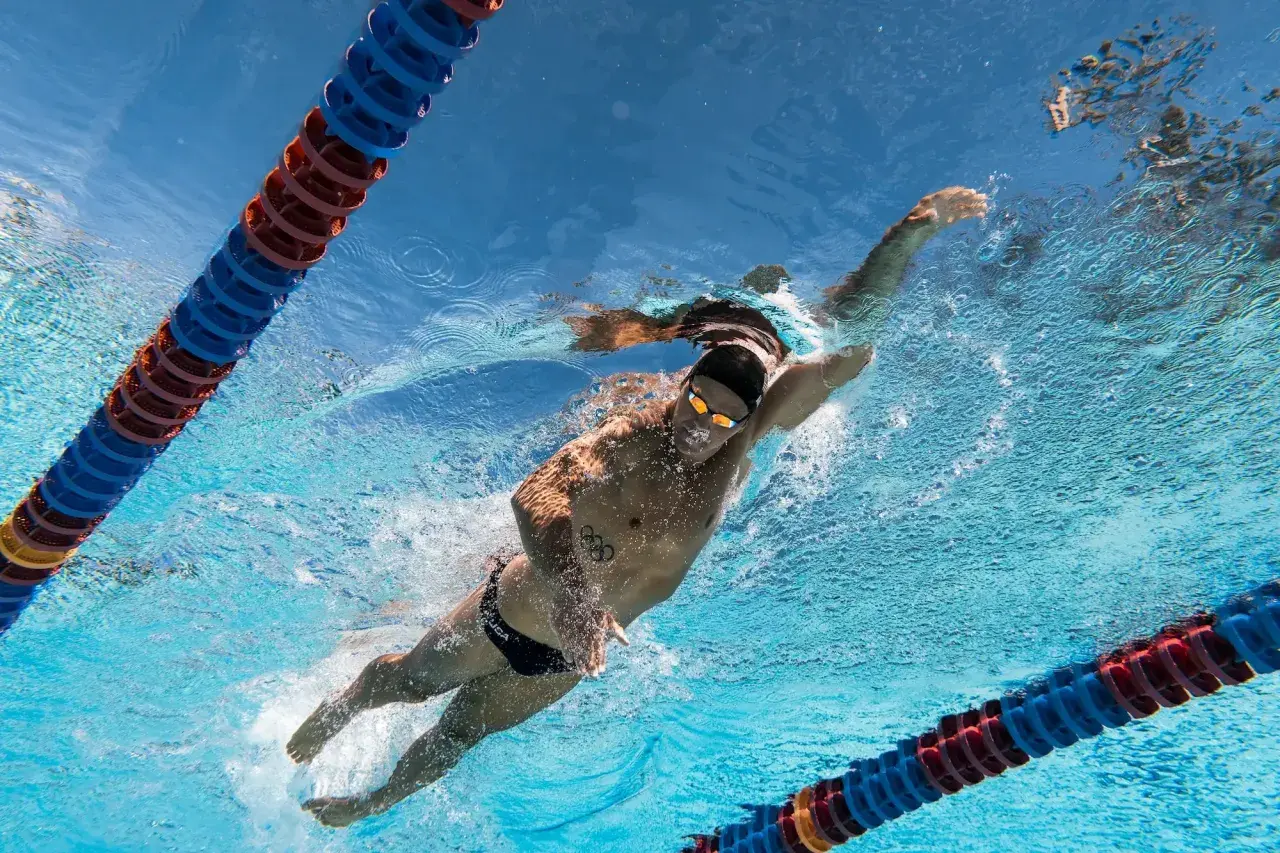
The fastest improvements in backstroke usually come from small technical corrections, not from trying to swim harder. In this article, I focus on the details that change speed the most: body line, arm entry and catch, kick timing, rotation, breathing rhythm, wall work, and drills that transfer to real pace. These backstroke tips are meant for swimmers who want cleaner form and a stroke that holds together when the set gets hard.
The biggest gains come from cleaner alignment, smarter timing, and better wall habits
- Keep the head still and the hips near the surface so drag stays low.
- Let the hand enter cleanly, then catch water early instead of slipping past it.
- Kick from the hips with loose ankles; the knees should stay only softly bent.
- Rotate enough to free the shoulders, but time the roll to the pull.
- Set a repeatable breathing pattern and learn your stroke count into the wall.
Start with a line that lets the stroke breathe
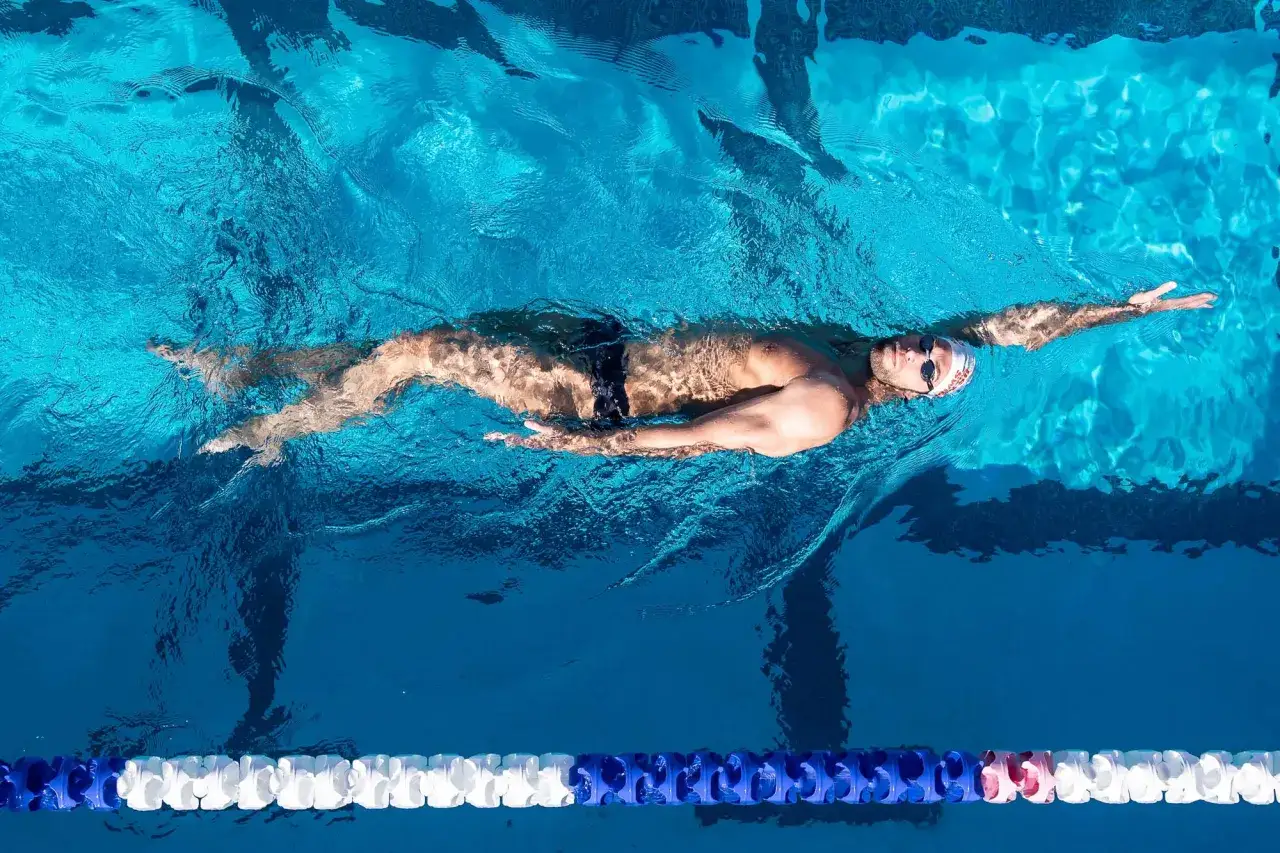
I always start with body position because it reveals everything else. If the head is lifted, the hips sink, the kick gets noisy, and the pull has to work against extra drag. The goal is a long, quiet line on the surface, with the water sitting around the ears and the eyes looking up and slightly back, not searching for the wall.
A small slope from the shoulders down toward the hips is fine if it keeps the legs underwater and the stroke balanced. What I do not want is a broken line that looks stable for one second and then collapses as soon as the tempo rises. Backstroke gets faster when the body stays close to the surface and the neck stays relaxed.
- Keep the chin neutral instead of lifting it.
- Let the ears stay close to the waterline.
- Check whether your hips rise and fall during every stroke, not just the easy ones.
- Use a ceiling point or lane rope as a straight-line reference during practice.
Once that line is stable, the arms can finally pull water instead of rescuing the stroke. From there, the next job is to make the pull itself more useful.
Build the pull around a clean entry and an early catch
One mistake I see constantly is swimmers treating the recovery and the pull as two unrelated actions. They are not. The shoulder should lift the recovering arm smoothly, the hand should enter little finger first, and the entry should stay narrow enough that the arm passes close to the ear without crossing the center line.
After the hand enters, do not rush straight down. Turn the hand so the forearm can begin pressing against the water early, then finish the stroke by driving back until the hand reaches the thigh. That early catch matters because the forearm gives you far more usable surface area than the hand alone. The problem is usually one of two extremes: a straight-arm pull that never really holds water, or an over-bent pull that shortens the effective surface and loses power.
- Let the shoulder lead the recovery, not the hand.
- Enter cleanly instead of splashing wide.
- Think “catch, then press back” rather than “pull down.”
- Finish the stroke past the hip before the next recovery starts.
That detail work only pays off if the legs and body keep the stroke stable, which is where the kick comes in.
Use the kick to support the stroke, not to fight the water
The backstroke kick should feel compact and continuous, not forceful in a way that throws the whole body apart. I look for a tight flutter kick driven from the hips, with relaxed ankles and only a soft bend in the knees. If the knees pop out of the water or the feet start bicycling, the kick is probably coming from the wrong place.
The best way to think about it is simple: the kick stabilizes the line first and adds speed second. In sprint work, swimmers may use a much more aggressive rhythm, while longer repeats usually settle into something quieter and more economical. A useful reference point is a three-kick rhythm per arm cycle, which keeps the stroke connected instead of disconnected.
- Keep the legs close together.
- Kick from the hips.
- Let the ankles stay loose enough to whip the water.
- Use the kick to hold the hips up when the arms recover.
When the kick is doing its job, the next question is how much to rotate without losing the line you just built.
Rotate with timing, not with constant rolling
This is where many swimmers overcomplicate the stroke. The goal is not a slow, endless roll from side to side. I prefer a delayed rotation: stay on one side long enough to finish the pull with power, then rotate quickly to the other side as the recovering arm swings through. That timing gives the pulling shoulder a stronger position and makes the recovery feel cleaner.
Think of the body as the engine and the arms as the connectors. When rotation is late and decisive, the pulling side stays powerful and the recovering side gets a better path over the water. When the stroke gets too flat, the shoulders have to do too much work and the whole motion starts to feel cramped. Good rotation is not about rolling more; it is about rotating at the right moment.
- Let the rotating shoulder lead the transition.
- Do not force the roll before the pull is finished.
- Use arm momentum to help the body move to the opposite side.
That cleaner rotation also makes breathing easier, which matters more than many swimmers admit.
Breathe on purpose instead of letting the rhythm drift
Backstroke gives you the freedom to breathe whenever you want, and that freedom can become a problem. I see swimmers breathe too often when they get tired, which leads to shallow overbreathing and a stroke that starts to unravel. The answer is not to hold your breath; it is to choose a pattern and keep it consistent.
A simple option is to tie the breath to each arm recovery or to every second recovery. What matters most is not the exact count but the repeatability. If breathing stays quiet and predictable, the stroke stays calmer, the tempo is easier to manage, and the swimmer wastes less mental energy thinking about air.
- Avoid huge inhale-exhale swings.
- Keep the breath soft and quick.
- Use the same pattern in easy swims and race-pace repeats.
Once breathing stops interrupting the stroke, the wall becomes the next place to steal free speed.
Get faster at the wall, not just in open water
In U.S. pools, the backstroke flags are your first dependable wall cue, and they are closer than many swimmers think. In a short-course yards pool, the flags sit 5 yards from the wall; in meter pools, they are 5 meters away. I like swimmers to build a stroke count from the flags to the wall so they stop guessing when the pace increases.
For racing, the start and turn matter because the easiest speed often comes from the underwater phase and the clean line off the wall. That means a tight streamline, a strong push-off, and enough underwater work to matter without turning the stroke into a long, sloppy glide. If you train for meets, practice the last 5 meters of the swim as seriously as the first 25.
- Count strokes from the flags in every pool you race in.
- Rotate to the front at the right moment for the turn instead of reaching blindly.
- Push off in a tight streamline with the arms squeezed by the ears.
- Match underwater work to the distance and rules of the race you are swimming.
That wall work is one of the easiest places to gain speed, but it only sticks if the stroke itself is clean. The drills below are the quickest way I know to make those changes hold.
Drills that turn clean form into raceable speed
Drills work when they isolate one problem at a time. I use them to make the body feel the correct line, catch, and rotation before I ask for speed. This is where swimmers often improve fastest, because the stroke stops hiding its mistakes.
| Drill | What it fixes | How I use it |
|---|---|---|
| Single-arm backstroke | Entry, catch, and shoulder control | Swim 4 x 25 with one arm at a time and keep the opposite arm extended and quiet. |
| Backstroke kick on the side | Body line and hip height | Swim 4 to 6 x 25 with one arm overhead, then switch sides on the next repeat. |
| Six-kick switch | Timing and rotation | Pause briefly on each side, then rotate decisively into the next stroke. |
| Stroke-count wall approach | Timing into the flags and wall | Repeat short build-ins and learn the number that gets you home safely and cleanly. |
I like these because they transfer directly to race work. If a drill only looks good in isolation but falls apart at pace, it needs another round of simplification.
The three fixes I would keep if I only had one week
If time is short, I would not chase everything at once. I would fix body line first, then the catch, then the wall count. Those three changes usually produce the biggest return because they reduce drag, improve propulsion, and remove the guessing that causes rushed turns.
- Swim a few easy 25s with a still head and high hips.
- Film one short repeat and check whether the hand enters cleanly near the shoulder line.
- Choose one breathing pattern and one stroke count into the wall, then keep both consistent for the whole session.
That is enough to make a real difference in a single practice block. Once those pieces hold together, the rest of the stroke gets easier to coach and easier to race.