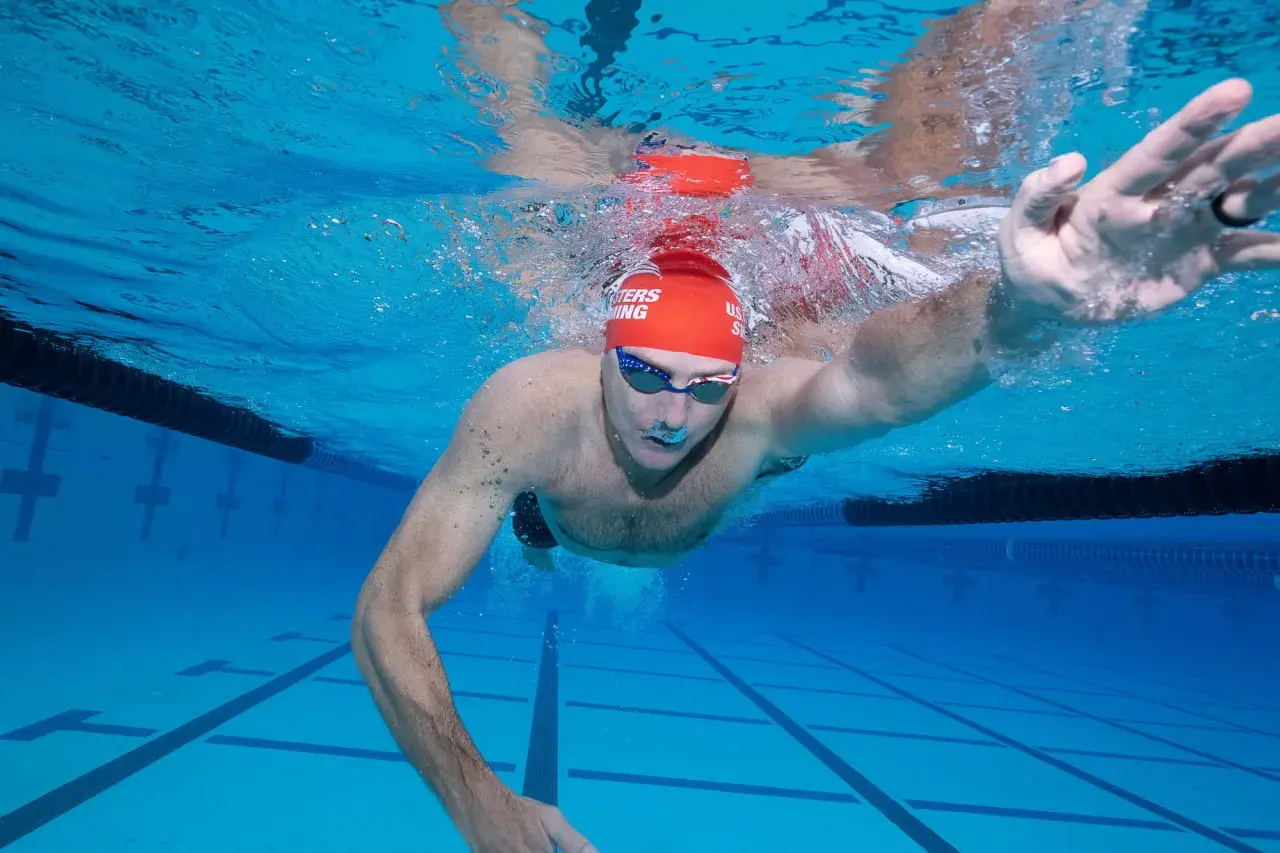
The freestyle swim stroke is fast for a simple reason: it keeps the body long, the propulsion continuous, and the breathing under control. In this guide I break down what the stroke really is, how the body line changes speed, how the arm cycle and kick should work together, and which drills help most when the movement falls apart. I will also show where freestyle beats the other strokes and how to train it without turning every lap into a fight against the water.
The fastest version of freestyle is built on balance, not force
- Front crawl is the race version of freestyle because it keeps propulsion almost continuous.
- Head position and body rotation decide how much drag you create.
- Breathing should happen with the roll, not by lifting the head.
- A small, steady kick usually helps more than a big splashy one.
- Short drills and repeatable sets beat random hard swimming when you want lasting improvement.
What freestyle really is and why it wins on speed
In American pool racing, freestyle is the event name, but front crawl is the stroke almost everyone chooses because it is the most efficient way to travel fast over distance. Coaching guidance from U.S. Masters Swimming keeps coming back to three pressure points: alignment, pull, and breathing. When those three are clean, the stroke looks calm. When they are not, it looks rushed, noisy, and expensive.
I think of freestyle as a problem of drag management. The arms create propulsion, but the body position decides how much of that effort gets wasted. That is why a swimmer with a smooth line can beat a stronger swimmer who simply splashes harder. The goal is not a violent stroke; it is a repeatable one.
- Alternating arms keep the stroke moving without long dead spots.
- A horizontal body line reduces resistance.
- Breathing is done to the side, not upward.
- The kick stabilizes the body more than it drives every yard.
Once that baseline is clear, the next question is where speed is actually lost in the water.
The body line that keeps drag low
Fast freestyle starts before the first pull. I want the head quiet, the hips high, and the spine long enough that the body looks like one connected shape rather than a collection of moving parts. The biggest mistake I see is a swimmer trying to breathe by lifting the head; that move drops the hips, widens the frontal profile, and makes every arm pull work harder.
| Problem | What it does | Better cue |
|---|---|---|
| Eyes forward | Hips sink and the kick becomes less effective | Keep eyes down or slightly ahead |
| Side-to-side wobble | Creates extra drag and unstable breathing | Rotate around the long axis, not across it |
| Raising the chest to inhale | Breaks the line of the stroke | Turn with the body, then sip air |
| Loose core | Legs trail behind and slow the swimmer | Think long and firm through the midline |
Rotation is the part many swimmers misunderstand. You do want the shoulders and hips to roll, but the roll should feel organized, not exaggerated. Used well, it gives the mouth a clean path to air and helps the recovering arm travel forward without strain. Used badly, it turns the stroke into a side-to-side weave. From here, the arms need to fit that body line instead of fighting it.
How the arm cycle should feel
I like to break the arm cycle into four jobs: entry, catch, pull, and recovery. The entry should be controlled, with the hand reaching forward in line with the shoulder rather than crossing the center line. The catch is where the swimmer sets the forearm and hand against the water; this is the start of useful pressure, not a downward stab.
Entry
Let the fingertips enter cleanly and extend forward, but do not throw the arm across the body. A narrow entry often feels powerful for a moment and then creates a crooked stroke that has to be corrected later.
Catch
This is where early vertical forearm matters. That phrase means the forearm starts to face backward early so the hand and forearm can press water in the right direction. I am looking for a firm set, not a jerky yank.
Pull
The pull should move water back past the shoulder line. If the hand slips downward or inward too early, the swimmer is pressing water instead of holding it. Good pulling feels like steady pressure, not a desperate shove.
Read Also: High Elbow Catch - Swim Faster, Not Harder
Recovery
The recovery should be relaxed enough that the stroke can keep its rhythm. A tense overwater recovery usually makes the shoulders work harder than they need to. I want the elbow to stay loose and the hand to return forward without drama.
Once the arm path is stable, breathing becomes the next place where easy speed is usually lost.
Breathing without breaking the stroke
Breathing is where many good-looking strokes collapse. The fix is usually boring: exhale steadily underwater, rotate the body to breathe, and keep the head low enough that one goggle stays in the water. If you wait too long to exhale, the inhale becomes rushed, and rushed breathing makes the rest of the stroke tense.
| Breathing pattern | Best use | Tradeoff |
|---|---|---|
| Every 2 strokes | Sprints, hard intervals, beginner comfort | Less symmetry if used all the time |
| Every 3 strokes | General training and bilateral balance | Can feel awkward at first |
| Every 4 to 5 strokes | Longer aerobic sets or some open-water rhythms | Not ideal if air hunger breaks form |
I do not force bilateral breathing into every set. I use it as a tool for balance. USA Swimming’s progressions also emphasize breathing comfortably on either side, and I keep that standard in mind when I coach symmetry. If your stroke falls apart the moment you try to breathe bilaterally, the priority is not more willpower. The priority is a cleaner body line and a calmer exhale.
- Start the breath as the body rolls, not after the head has already lifted.
- Keep one eye in the water.
- Return the face to neutral before the recovering arm passes the shoulder.
The kick has to support that breathing and balance, not replace them.
Kicking that supports the stroke instead of wasting energy
The kick in freestyle is easier to judge than to execute well: it should stay small, quick, and driven from the hips. A huge knee-bending kick looks energetic, but it usually leaks power and disturbs the body line. For most swimmers I coach, a controlled 2-beat kick works well for distance and open-water pacing, a 4-beat kick can be a useful middle ground, and a 6-beat kick makes more sense when the race is short or the swimmer needs extra stability through fast turns and sprint efforts.
- Toes stay relaxed and pointed.
- The splash is small, not explosive.
- The legs follow the torso instead of leading it.
- The kick supports balance during the breath.
If your ankles are stiff, a stronger kick often just creates more turbulence. Mobility work and short fins can help you feel a better line, but they do not replace body position. That is why the right drill matters more than doing more yardage.
Drills that fix the stroke fastest
Drills are worth using only when they solve a clear problem. I prefer ones that isolate one skill and then give it back to full stroke timing. A pull buoy can help you focus on the upper body, and short fins can sharpen the feel of the kick, but neither one should become a crutch.
| Drill | What it improves | How I use it |
|---|---|---|
| Side kick with one arm extended | Body line, balance, and breath control | 2 x 25 each side, then swim |
| 6-1-6 | Rotation and timing | Short repeats, with a clear pause on each side |
| Catch-up | Extension and stroke rhythm | Use lightly, not as a permanent stroke pattern |
| Fingertip drag | Relaxed recovery and high-elbow feel | Best as a warm-up drill over short repeats |
| Single-arm freestyle | Catch timing and breath coordination | 4 x 25 each arm works well for most swimmers |
| Fist swim | Pressure on the forearm and hand awareness | Use short sets so the feel stays sharp |
These drills are not magic. They work when they are paired with one cue and repeated long enough to feel different. If a drill makes you slower but cleaner, that is usually a good trade. From there, comparing freestyle with the other strokes makes the tradeoffs easier to see.
How freestyle compares with the other strokes
Freestyle is usually the fastest sustained stroke, but that does not make it the easiest stroke for every swimmer. The value of the comparison is not to rank strokes like trophies; it is to understand what each one asks from the body. That helps you choose when to push freestyle harder and when to use another stroke as recovery or cross-training.
| Stroke | Main advantage | Main limitation | Where it fits best |
|---|---|---|---|
| Freestyle | Fast sustained speed and continuous propulsion | Breathing and alignment errors punish efficiency | Racing, fitness, triathlon, open water |
| Backstroke | Easier breathing and good shoulder recovery | Usually slower because the face-up line is less streamlined | Recovery, IM work, balance training |
| Breaststroke | Strong timing and a useful glide phase | High drag when the timing is off | Tactical racing and rhythm work |
| Butterfly | Powerful connection through the trunk and shoulders | Highest energy cost of the four strokes | Short bursts and power development |
The main lesson is simple: freestyle gives you the best mix of speed and sustainability, but only if the technique stays tidy. If your front crawl is weak, every other part of the workout becomes harder than it needs to be. That is why I usually fix the stroke in a very specific order.
The quickest way to make freestyle faster is to improve one piece at a time
If I had only four swims to improve a swimmer’s front crawl, I would work in this order: body line, breathing, catch, then kick. The reason is straightforward. A cleaner line and calmer breath make every later correction easier to hold.
- Swim 4 x 25 easy and keep the head quiet.
- Swim 4 x 25 with a 6-1-6 or side-kick drill.
- Swim 4 x 50 and breathe on one planned pattern.
- Finish with 4 x 25 at moderate speed while keeping the same stroke count.
Track time and stroke count together. If the time drops but the stroke count jumps sharply, you probably traded efficiency for churn. The best freestyle work is rarely glamorous. It is usually a small technical change repeated often enough that the stroke starts to feel cheaper, smoother, and easier to hold when the pace rises.