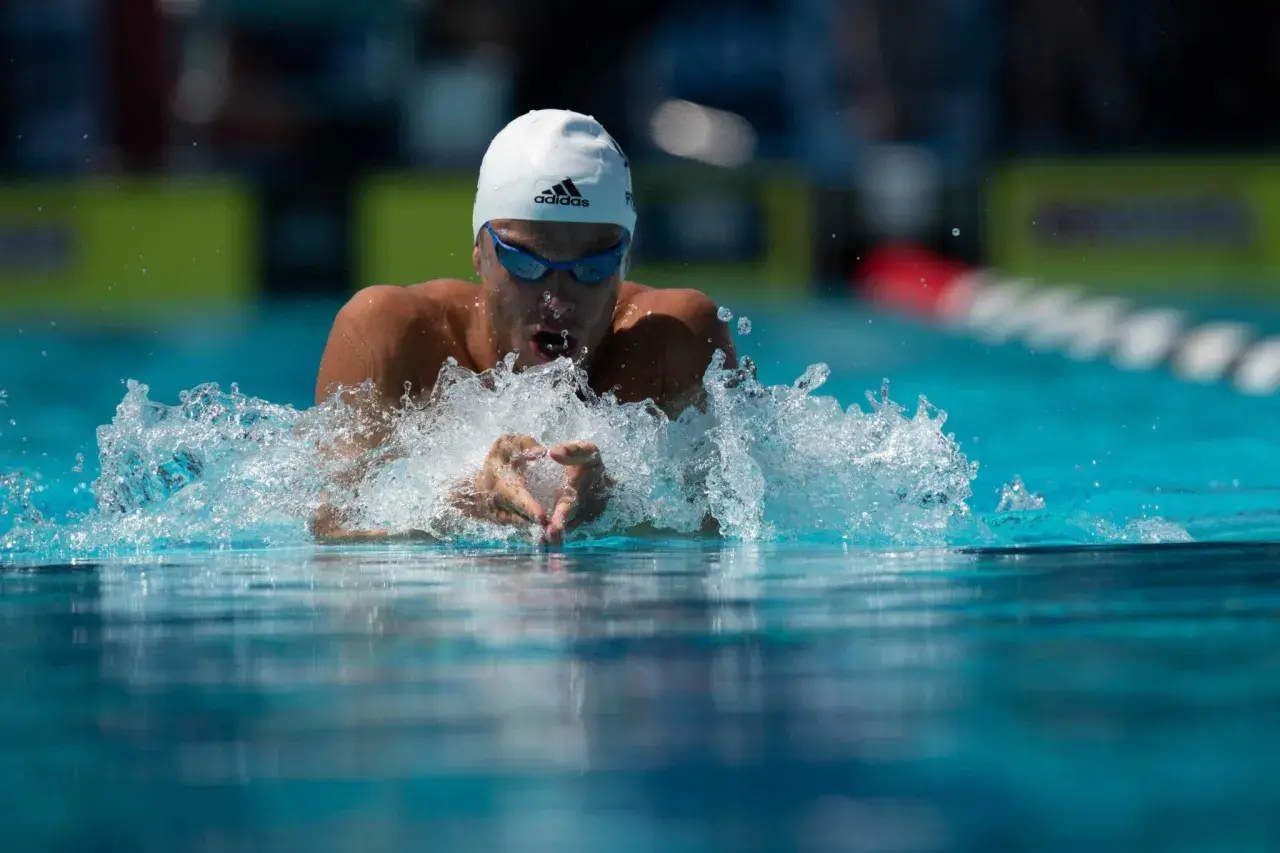
The essentials that change breaststroke fastest
- Keep the body long and calm. A quiet head and a lifted hip line make the stroke feel lighter immediately.
- Let the kick do the heavy lifting. The arms set the rhythm, but the kick usually creates most of the forward drive.
- Use a compact pull. Wide, sweeping arms add drag and usually make the breath too big.
- Time the cycle cleanly. Pull, breathe, kick and glide should flow in sequence, not compete with each other.
- Fix the obvious errors first. Head lift, wide knees and sloppy timing cost more speed than most swimmers realise.
- Train the stroke in short blocks. A few precise repeats are more useful than long, messy swimming.
What efficient breaststroke looks like in the water
I start with body position because everything else sits on top of it. If the chest collapses, the hips drop and the kick has to work against drag instead of helping you move forward. The goal is a long, narrow shape with the head kept quiet, the hips near the surface and the body moving as a single unit rather than folding and unfolding on every stroke.
Swim England’s coaching advice on body position is blunt for a reason: when the hips sink, the stroke gets heavier straight away. I want the swimmer to feel stretched rather than compressed, with the shoulders relaxed and the neck free. That is not a cosmetic detail; it changes how well the kick can finish the stroke and how much water resistance you create before the next pull.
- Head position: keep it in line with the body instead of jabbing it forward for air.
- Hip line: stay as high as your natural timing allows, so the kick pushes you forward rather than upward.
- Shoulders: stay loose enough to let the arms move without tension.
- Shape between strokes: return to a long line every time, even if the glide is short.
Once the body line is set, the next question is how the arms and legs should share the work.
How the pull, kick and recovery should work together
The pull is there to set up the breath and the kick, not to win the race by itself. I want the hands to move in a compact path, the elbows to stay underwater and the recovery to return the arms forward without flaring wide. When the pull gets too broad, the swimmer usually feels busy but travels less.
| Phase | What should happen | What it should feel like |
|---|---|---|
| Pull | Hands sweep out and in under control, with the elbows staying high enough to avoid a collapsed shape. | Firm and compact, not exaggerated. |
| Breath | The shoulders rise enough for air, but the head does not lunge forward. | Quick and low, not dramatic. |
| Kick recovery | Heels draw up, knees stay fairly narrow and the feet turn out. | Small and deliberate. |
| Kick and finish | The legs sweep back together and finish in a tight line. | A clean snap, then stillness. |
The arm pull
The arms should not be treated like a huge engine. They help position the breath and create a little drive, but if the pull becomes wide and aggressive, the hands spend too long moving water sideways. I prefer a shorter, cleaner pull that ends with the hands returning forward in a controlled line.
The kick
The kick is where most of the propulsion comes from, so I pay far more attention to the feet than to dramatic arm movement. The heels should come towards the seat, the knees should not shoot forward too early and the feet should turn out before the push begins. The best kicks feel compact on the recovery and decisive on the finish, with the legs snapping together rather than pedalling.
Read Also: Master the Flip Turn - Speed & Efficiency Guide
The recovery and timing
The easiest cue is still the old rhythm of pull, breathe, kick and glide. It works because one part of the stroke is always preparing while the other is propelling, instead of both fighting for the same space. If the kick starts too early, the arms are still in the way; if the breath lasts too long, the whole stroke stalls.
That leads straight into the part that makes breaststroke feel smooth instead of choppy: the breath and the glide.
Breathing and the glide without stalling
I would rather see a small, well-timed breath than a big breath that wrecks the body line. The face comes up because the shoulders rise, not because the swimmer throws the head forward. When the chin stays close to the surface, the hips have a much better chance of staying up as well.
The glide deserves respect, but it also gets misunderstood. A useful glide is not the same as a dead pause. I want the swimmer to return to a long shape after the kick, keep moving forward and let the water settle around the body before the next pull starts. If you freeze completely, you have to restart momentum from scratch.
- Exhale underwater: do not hold your breath through the entire stroke.
- Inhale quickly: get the breath as the pull finishes and the shoulders rise.
- Return the face early: the head should come back down before the body starts to feel cramped.
- Glide with purpose: short and clean is usually better than long and passive.
Those timing problems usually show up as a handful of repeat mistakes, and they are easier to fix once you can see them clearly.
The mistakes that slow most swimmers down
Most breaststroke problems are not mysterious. They are the same few faults repeating length after length. I like to diagnose them in simple terms first, because once the swimmer knows what is wrong, the correction becomes much easier to hold under fatigue.
| Mistake | Why it slows you down | What I would change |
|---|---|---|
| Lifting the head too high | It drops the hips and increases frontal drag. | Let the shoulders rise just enough for air, then return the face to the water quickly. |
| Kicking from a wide, rushed recovery | The legs lose their line and the kick becomes hard to finish. | Bring the heels in first, keep the knees controlled and turn the feet out before the push. |
| Pulling too wide | The arms create sideways resistance instead of helping the stroke move forward. | Use a shorter pull and finish with the hands returning forward on a narrow path. |
| Pausing too long in the glide | Momentum dies and every new pull has to restart the body. | Keep the glide brief and active, then begin the next stroke before the body goes flat. |
| Letting the stroke become asymmetrical | Uneven movement wastes energy and can make the swimmer snake through the lane. | Keep the arms and legs together, and check that both sides finish evenly. |
If two of those faults appear together, the stroke usually feels twice as hard because one error triggers the next. I fix the head and the kick first, then worry about speed, because speed built on poor shape never lasts.
Once the obvious faults are under control, targeted practice becomes far more useful than endless full-length swimming.
How I would practise it in a focused session
I would rather see eight clean 25-metre repeats than a long swim full of rushed reps. Breaststroke improves fastest when the swimmer has one technical goal at a time, enough rest to hold the shape and enough repetition to make the cue stick.
- 6 x 15m streamline kick off the wall to feel the heels draw in, the feet turn out and the legs finish together.
- 4 x 25m single-cycle swims to keep the stroke controlled and make the glide intentional rather than lazy.
- 4 x 25m pull plus breath only if the kick is breaking down and you want to isolate the front end of the stroke.
- 2 x 50m easy full stroke to put the timing back together once the pieces feel cleaner.
If I had to choose one extra tool, it would be side-on video from the pool deck or a coach watching from the lane line. The problem with breaststroke is that it can feel smooth while the hips are still dropping, so visual feedback often reveals what the swimmer cannot feel yet. That is why short, technical sets beat long laps when you are trying to build a better stroke.
With that foundation in place, the competition rules are worth knowing so good habits do not turn into disqualifications.
The rules that keep race breaststroke legal
For race swimming, the details matter because breaststroke is judged on symmetry and sequence. World Aquatics’ technical rules still require simultaneous arm action, simultaneous leg action and a two-hand touch at each turn and at the finish. After the start and each turn, the underwater phase is limited, and the head must break the surface by 15 metres.
- Arms together: both arms move in the same way, not one after the other.
- Legs together: the kick must be simultaneous, not alternating.
- Feet turned out: the propulsive part of the kick depends on the correct foot angle.
- Two-hand touch: both hands must touch at the wall together, at, above or below the surface.
- Limited underwater work: the start and each turn allow an underwater sequence, but the head must surface by 15 metres.
I treat those rules as technique cues, not just penalties. If the stroke is clean enough to stay legal under pressure, it is usually clean enough to feel efficient in training too. That leaves one final question: what should you keep in your head when the stroke starts to fall apart?
What I would keep in mind when the stroke starts to slip
When breaststroke begins to feel heavy, I do not add more effort. I simplify. My first cue is a quiet head. My second is a narrow, controlled pull. My third is a decisive kick that finishes the body back into a long line. That sequence fixes more problems than trying to “swim harder” ever will.
If I were coaching a swimmer in the UK who wanted a better race stroke and a cleaner training stroke, I would keep the same message repeating through every set: stay long, stay compact and let the kick finish the job. That is the version of breaststroke that holds up when you are tired, when the pool pace rises and when the timing has to survive real speed, not just perfect drill conditions.
The cleanest breaststroke is not the biggest one. It is the one that wastes the least movement, keeps the rhythm under control and makes every part of the stroke help the next one.