A diving score is the number awarded for a single attempt, but the number only makes sense when you know what the judges are rewarding and how difficulty changes the final total. In this guide, I break down the judging scale, the math behind the panel, what counts as a strong mark in practice, and how divers can raise their totals without forcing harder dives than they can control.
The number matters most when you read it in context
- Judges rate execution on a 0-10 scale in half-point steps.
- In major individual events, seven judges are common; the highest and lowest marks are dropped before the total is calculated.
- Degree of difficulty can lift a clean dive, but it cannot fully rescue sloppy mechanics.
- Synchronized events add timing and matching into the equation, so two good divers can still post a weak total if they are out of sync.
- A zero usually signals a failed dive or a serious rule violation, not just a messy entry.
What the judges are actually rewarding
At its core, scoring is about execution. Judges are not trying to guess how hard a dive felt; they are judging how well the diver controlled the approach, takeoff, flight, and entry. That is why a dive can look exciting to a spectator and still earn an average mark if the body line breaks down before the water entry.
World Aquatics keeps the standard set simple: judges award marks from 0 to 10 in half-point increments, and USA Diving uses the same basic scale for domestic competition. The practical meaning of those numbers is straightforward: the cleaner the technique, the higher the mark. A controlled hurdle, a balanced takeoff, a tight shape in the air, and a vertical entry all matter because each one shows the diver stayed in command from start to finish.| Aspect | What clean execution looks like | What usually costs points |
|---|---|---|
| Approach | Rhythmic, controlled, and confident | Rushed steps, hesitation, or broken rhythm |
| Takeoff | Balanced, high, and from the correct platform or board position | Drifting off the end, weak lift, or uneven push |
| Flight | Compact shape, correct timing, and clear line of travel | Loose body position, late twist, or off-line movement |
| Entry | Vertical, straight, tight, and minimal splash | Over-rotated, under-rotated, bent knees, or open arms |
Once you understand those four checkpoints, the next step is seeing how the panel converts them into a final number.

How the panel turns marks into a final total
The math is not complicated, but it is easy to misunderstand if you only watch the scoreboard. In a typical individual event, seven judges each award a mark. The two highest and two lowest marks are removed, the remaining three are added together, and that sum is multiplied by the dive’s degree of difficulty.
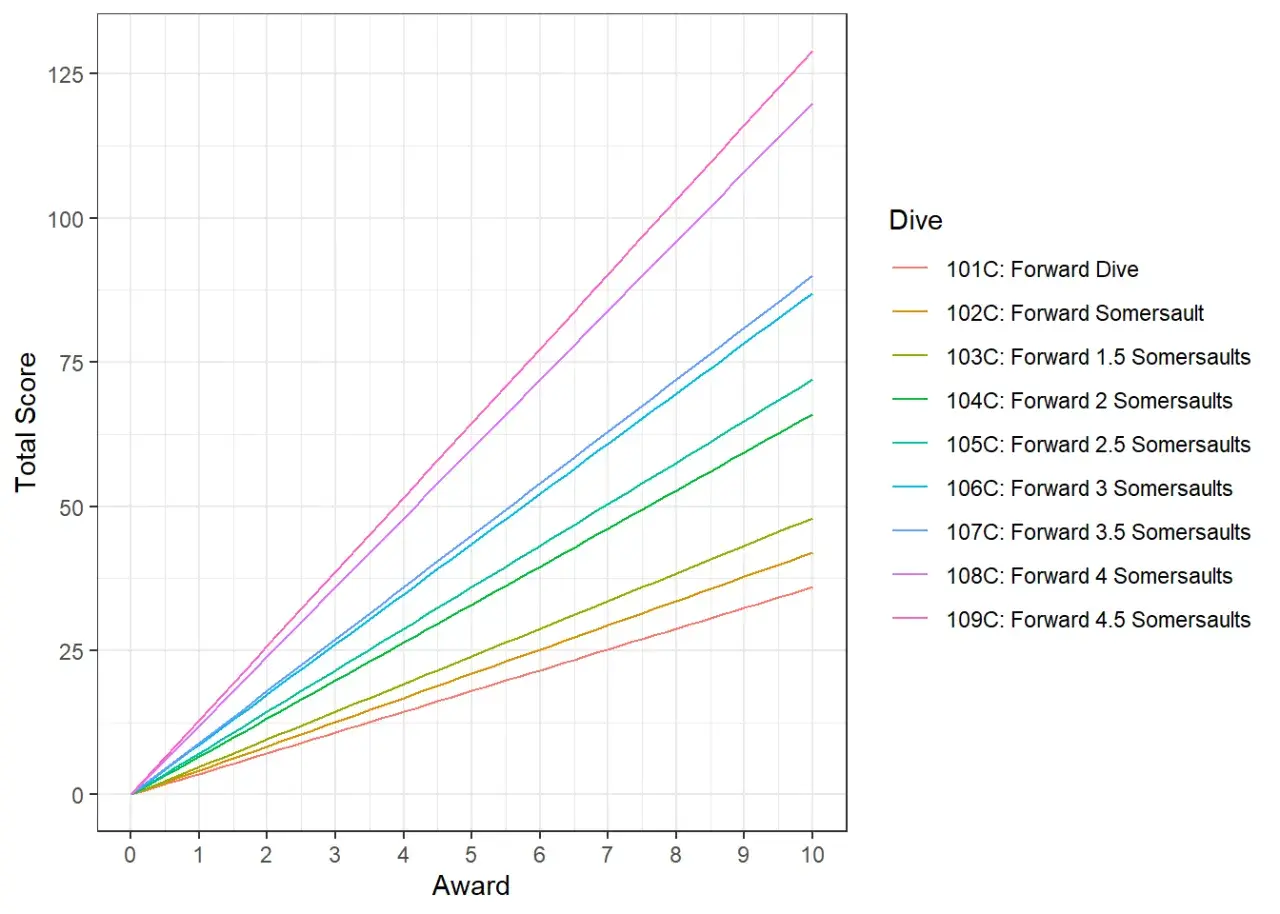
That last part matters. Degree of difficulty, or DD, is the built-in multiplier that reflects how hard the dive is on paper. A clean dive with a modest DD can lose to a more difficult dive that is executed well enough to overcome a few small mistakes. That is why the total score is never just “how pretty it looked.” It is beauty plus difficulty, weighted in a way that rewards both.
| Step | What happens | Why it matters |
|---|---|---|
| 1 | Judges award 0-10 marks in 0.5-point steps | This captures overall execution |
| 2 | The highest and lowest marks are dropped | This limits the effect of outliers |
| 3 | The remaining marks are added | This becomes the execution total |
| 4 | The total is multiplied by DD | This produces the final score for the dive |
For example, if seven judges give 8.0, 7.5, 7.5, 7.5, 7.5, 7.5, and 7.0, the two highest and two lowest marks are removed. The remaining three add up to 22.5, and if the DD is 2.0, the dive finishes at 45.0. That is the kind of number people see on the board, but the real story is the stack of small technical decisions that created it.
In small domestic meets, you may see five judges instead of seven, but the idea stays the same: trim the outliers, trust the middle, and let difficulty do the rest. That is the bridge to the harder question readers usually have next: what actually counts as a good result?
What counts as a strong result in practice
There is no universal “good” number in diving because the context changes from meet to meet. A modest total on a very hard dive can be more impressive than a bigger number on a low-DD attempt. What matters is how the score fits the dive list, the athlete’s level, and the field around them.
When I look at results, I focus less on one isolated number and more on patterns. Are the marks sitting in the good-to-very-good range? Is the diver repeating the same level of execution across several dives? Is the DD appropriate for the athlete’s current consistency? Those questions tell me more than a single splashy round ever will.
- A clean but simple dive usually signals a stable base, not yet a finished competitive package.
- A high-DD dive with mixed marks often shows ambition, but also a ceiling that is being tested too early.
- Consistent mid-to-high marks across a full list are often more valuable than one standout attempt.
- Big totals built on shaky entries rarely hold up when the field gets deeper.
The best divers do not chase the biggest possible number in isolation. They build a list that they can repeat under pressure, then add difficulty only when the base is solid. That balance becomes even more important when a dive can be capped or failed outright.
When a dive gets capped or fails completely
Not every mistake produces a zero, and that distinction is important. Many errors are punished with deductions, while more serious violations can cap the award or invalidate the dive. A sloppy entry is not the same thing as a failed dive, even if both leave the athlete disappointed.
Common situations that can wreck a result include a wrong takeoff, an incorrect twist count, a dive performed with the wrong number or position, or a major entry error. In some cases the referee can cap the maximum award at 4.5 points instead of allowing the judges to go higher. In other cases, the dive is failed and scores become zero. The practical lesson is simple: a small technical error lowers the total, but a rules error can erase it.
- A poor takeoff usually leads to deductions, not an automatic zero.
- A twist that is materially off from what was announced can trigger a failed dive.
- A head-first dive finished feet-first, or the reverse, is far more serious than a messy splash.
- In synchronized diving, if one diver gets ahead of the other in a major way, the pair can lose the dive entirely.
This is why coaches keep stressing fundamentals even when an athlete is ready for harder lists. The higher the DD, the more expensive a technical mistake becomes. From there, synchronized events add one more layer of complexity.
How synchronized diving changes the math
Synchronized diving is not just two individual dives side by side. The panel is also judging how well the pair matches movement, height, timing, and entry. In major events, the standard panel has 11 judges: some score one diver’s execution, some score the other diver’s execution, and the rest judge synchronization.
The total is then built from the middle awards after the outliers are removed, and the result is multiplied by 0.6 before the DD is applied. That factor exists so synchronized scores stay aligned with individual-event scoring. The mechanics matter, but the bigger story is this: a pair can have great individual form and still lose points if they are not truly together in the air and at entry.
| Format | What judges care about most | Common reason scores drop |
|---|---|---|
| Individual | One diver’s body line, control, and entry | Breaks in shape, weak takeoff, or splashy finish |
| Synchronized | Execution plus timing, height, and matching | Different lift, late rotation, or uneven entry timing |
For younger or developing pairs, synchronization is often the harder part to stabilize. One diver can feel “clean” and still drag the pair down if the timing is off by a fraction. That is why synchronized events reward precision in a way that feels unforgiving but fair once you understand the criteria.
With the scoring rules clear, the final question is how to improve the number in a way that actually holds up in competition.
How I would train for a better score
The fastest route to better results is usually not a more dangerous dive list. It is cleaner mechanics. If I were coaching an athlete who wanted to raise totals without chasing reckless difficulty, I would start with the pieces that judges see first and punish most often.
- Lock in the approach so the hurdle or setup never looks rushed.
- Build a stronger takeoff before adding more twist or rotation.
- Make the body line tighter in the air, especially through the hips and knees.
- Practice vertical entries until the last frame looks controlled, not just splash-free.
- Choose DD that matches current consistency instead of potential alone.
- Use video review to isolate one error at a time instead of guessing.
I also like to remind developing divers that the board or platform does not reward bravery by itself. It rewards repeatable precision under pressure. A diver who can deliver the same controlled entry five times in a row will usually outrank a more talented athlete who only lands one perfect attempt out of five. That lesson applies just as much in school and club meets as it does on a bigger stage.
What the scoreboard tells you about a season, not just one dive
A single total can be noisy. A season of totals is much more useful. If I am reading results the way a coach would, I want to know whether the averages are rising, whether the weak dives are getting less severe, and whether the athlete is earning better marks on the exact groups that used to cause trouble.
The smartest way to use the scoreboard is to compare like with like. Compare springboard to springboard, platform to platform, individual to individual, and synchronized to synchronized. Track the average marks on each dive group, not just the final placement. If the scores are improving but the DD has not changed, technique is improving. If DD is rising while the marks fall apart, the list is probably getting ahead of the athlete.
That is the real value of the number: it is not just a ranking line, it is feedback. Read it with difficulty, consistency, and event format in mind, and it becomes a training tool rather than a mystery.