Strength training for triathletes works best when it supports the race plan instead of competing with it. In practice, the goal is to build force, stability, and durability so you can hold form in the final third of a long ride, stay efficient off the bike, and keep the shoulder and hip positions that make swimming and running feel smoother. In this guide, I focus on the exercises, session structure, weekly timing, and common mistakes that matter most.
The most useful strength work is simple, specific, and easy to recover from
- Use gym sessions to improve force production, posture, and injury resistance, not to chase fatigue.
- Prioritize single-leg work, hinging, pulling, calf strength, and anti-rotation core control.
- For most age-group athletes, two quality sessions a week are enough in the middle of the season.
- Keep hard lifting away from your key run and bike sessions when possible, or pair them on the same hard day.
- Reduce volume before races so you stay fresh, even if you keep a little intensity in the program.
Why strength work pays off in all three disciplines
I think of strength training as force insurance. Better force production helps you climb and sprint on the bike, keep posture when the run gets sloppy, and preserve upper-body mechanics in the swim when fatigue starts to pull everything apart. Recent reviews on endurance athletes point to a consistent pattern: heavy resistance work and plyometric work can improve running economy, which means you spend less energy at a given pace; for triathletes, that usually shows up as better late-race durability rather than a dramatic change in VO2 max, your maximum rate of oxygen use.That is why I do not program gym work as a bodybuilding block. The aim is not to chase size or soreness; it is to create a stronger base so swim, bike, and run sessions produce more useful adaptations. Once you accept that goal, the next question becomes obvious: which movement patterns deserve the most attention?
The movement patterns that matter most
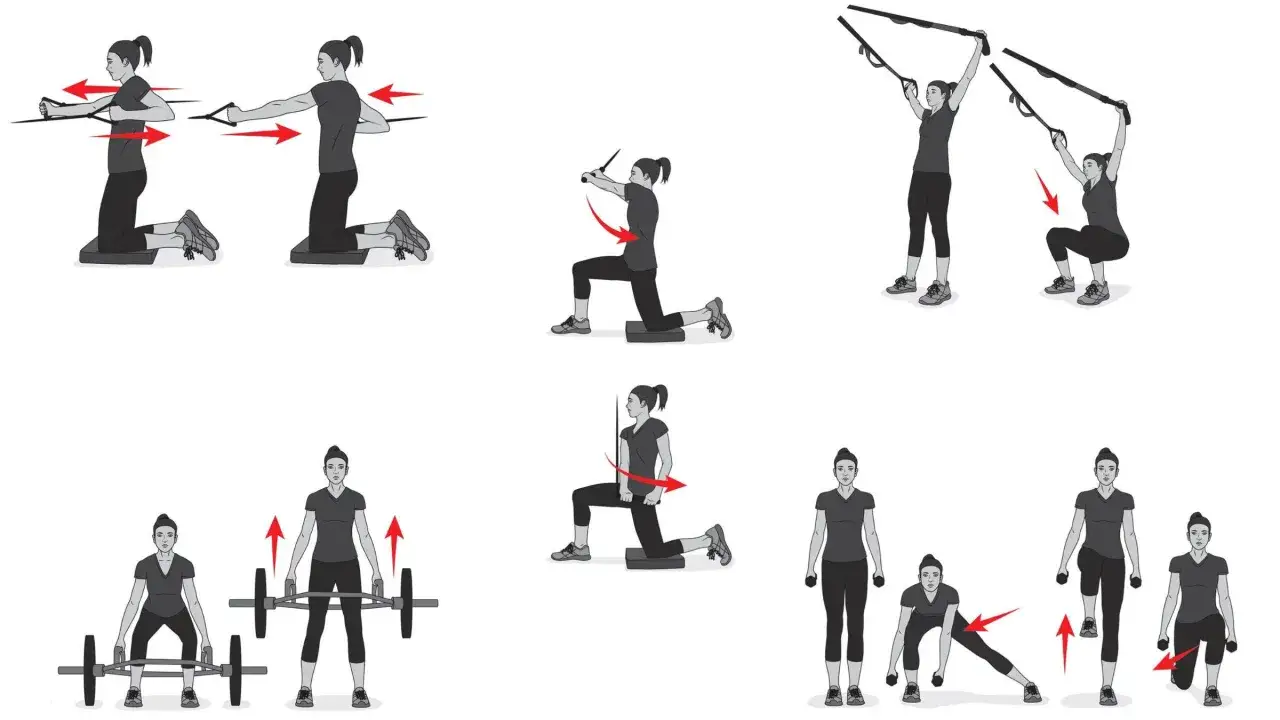
The easiest way to make gym work useful is to match it to the demands of triathlon. The posterior chain, meaning the glutes, hamstrings, and the back side of the trunk, matters in every discipline because it helps you hold posture and transfer force cleanly. I also want enough shoulder control for the swim and enough single-leg stability for the run so the body does not leak energy when fatigue rises.
| Movement pattern | Why it matters | Good examples | What goes wrong if you ignore it |
|---|---|---|---|
| Hip hinge | Builds the glutes and hamstrings for climbing, holding bike posture, and staying tall late in the run. | Romanian deadlift, trap-bar deadlift, kettlebell deadlift | Lower-back takeover, poor hip extension, and late-race collapse. |
| Single-leg squat | Matches the unilateral nature of running and exposes side-to-side weaknesses. | Bulgarian split squat, step-up, rear-foot elevated split squat | Knee collapse, hip drop, and wasted energy every stride. |
| Pulling | Supports the swim catch and keeps the upper back strong enough to resist rounded posture. | Pull-up, lat pulldown, chest-supported row, cable row | Shoulders that fatigue too early and a weaker, less stable catch. |
| Pressing and scapular control | Helps the shoulders stay organized without overloading them. | Push-up, landmine press, incline dumbbell press | Too much anterior shoulder stress and poor swim durability. |
| Calf and ankle stiffness | Improves ground contact efficiency and helps the lower leg act like a spring. | Standing calf raise, seated calf raise, pogo hops, isometric holds | Flat, slow-running mechanics and more impact cost. |
| Anti-rotation core work | Teaches the torso to resist unwanted twisting on the bike and run. | Pallof press, side plank, dead bug, suitcase carry | Energy leaks through the trunk and sloppy posture under fatigue. |
If I had to narrow it down to one principle, it would be this: train the places where triathletes usually leak force, not just the muscles that look obvious in the mirror. With those movement patterns in place, the real payoff comes from choosing exercises that build strength without stealing too much recovery.
The exercises I would actually use in a triathlon program
The best exercise list for a triathlete is shorter than most people expect. I would rather see six well-chosen movements done consistently than a random circuit of twelve exercises that never progresses. In a practical program, the job of each exercise is clear: one or two big lifts for force production, one or two unilateral movements for control, one pull, one push, and one core or calf drill that keeps the system honest.
Lower-body strength
- Trap-bar deadlift - a strong hinge pattern with less technical noise than many barbell lifts, which makes it easier to load safely.
- Romanian deadlift - useful for hamstring strength and hip control, especially if your running form falls apart when tired.
- Bulgarian split squat - one of my favorite choices because it builds single-leg force and exposes stability issues fast.
- Step-up - simple, specific, and low on unnecessary soreness when you keep the box height reasonable.
Upper-body work for swim support
- Pull-up or lat pulldown - helps develop the pulling strength and shoulder control needed for a cleaner swim stroke.
- Chest-supported row - gives you upper-back work without asking the lower back to stabilize every rep.
- Landmine press - a shoulder-friendly press that usually fits triathletes better than aggressive overhead work.
Core and power
- Pallof press - a simple anti-rotation drill that teaches the torso to stay quiet under load.
- Side plank - a reliable way to build lateral trunk endurance for running posture and bike stability.
- Box jump or pogo hop - a small dose of plyometric work can improve stiffness and leg spring without much time cost.
- Standing calf raise - boring, yes, but very useful for ankle capacity and lower-leg durability.
If you want one practical filter for exercise selection, use this: does the movement make you stronger in a way that survives swim, bike, and run volume? If the answer is no, it is probably taking up space. The next step is figuring out when to place that work in the week so it helps instead of hinders.
How to fit lifting into a triathlon week without wrecking key sessions
Timing matters almost as much as exercise choice. USA Triathlon coaches often keep the recommendation simple: a small menu of exercises, moderate loads, and two or three sessions a week at most for many athletes. I agree with that approach because the biggest mistake is not a lack of effort in the gym; it is letting the gym create too much fatigue for the sessions that actually drive race performance.
| Season phase | Frequency | Session length | Main emphasis | What to avoid |
|---|---|---|---|---|
| Off-season | 2 to 3 sessions per week | 45 to 60 minutes | Build general strength, fix asymmetries, and add a little power. | Random high-volume circuits and endless exercise variety. |
| Build phase | 1 to 2 sessions per week | 35 to 50 minutes | Maintain strength while endurance volume rises. | Big soreness or any session that ruins the next quality workout. |
| Race-specific block | 1 to 2 sessions per week | 20 to 40 minutes | Keep strength, keep power, keep movement quality high. | Chasing personal bests in the weight room. |
| Taper | 0 to 1 light session | 15 to 25 minutes | Stay sharp and fresh. | Anything that causes lingering soreness or heavy legs. |
- Pair hard gym work with a hard endurance day when possible, then protect the easy days.
- Leave at least 24 hours, and ideally 36 to 48, before your key long run or interval bike session if the leg workout is heavy.
- If you must lift and train on the same day, I prefer quality endurance work first and lifting later, unless the strength session is the main priority of the block.
- During peak race prep, cut volume before you cut intensity so you keep the nervous system stimulus without much muscle damage.
That schedule usually feels much easier to recover from than a traditional lifting split. Once the week is organized, a simple template makes execution even easier.
A simple two-day template that still leaves room for swim, bike, and run
When athletes ask me for a routine, I usually start with two sessions. One is a hinge and pull day, the other is a squat and single-leg day. That gives enough variation to cover the major movement patterns without turning the gym into a second full-time sport. I also keep most sets one or two reps shy of failure; on an effort scale, that is roughly a 7 to 8 out of 10, which is hard enough to matter but not so hard that recovery falls apart.
Workout A
- Trap-bar deadlift - 3 sets of 4 to 5 reps
- Bulgarian split squat - 3 sets of 6 reps per side
- Chest-supported row - 3 sets of 8 reps
- Side plank - 3 sets of 30 to 45 seconds per side
- Standing calf raise - 3 sets of 10 to 12 reps
Read Also: Half Ironman Times - Your Realistic Finish Guide
Workout B
- Front squat or goblet squat - 3 sets of 5 to 6 reps
- Single-leg Romanian deadlift - 3 sets of 6 reps per side
- Landmine press - 3 sets of 6 to 8 reps
- Lat pulldown or pull-up - 3 sets of 6 to 8 reps
- Box jump - 4 sets of 3 controlled reps
- Pallof press - 3 sets of 10 reps per side
That is enough for most triathletes, especially in the middle of the season. If you want a simple progression, add a small amount of load or one rep per set for two to three weeks, then reduce volume by about 30 to 40 percent in the fourth week. That keeps adaptation moving without piling fatigue on top of fatigue. The last piece is knowing what not to do, because the wrong gym habits can undo a lot of good endurance work.
The mistakes that quietly cancel out good endurance training
- Training to failure too often - once the last few reps slow badly, the fatigue cost rises fast and rarely pays off for triathletes.
- Using too many exercises - long sessions create more soreness and usually less useful work.
- Copying a bodybuilder split - split routines can be fine for general fitness, but they often create too much local fatigue for a triathlon week.
- Placing heavy leg work before key run or bike sessions - the result is usually a flat workout and poor movement quality.
- Chasing upper-body size at the expense of swim mechanics - a stronger pull matters; unnecessary mass does not.
- Ignoring warning signs - if sleep drops, legs stay heavy, or a lingering niggle gets worse, that is a signal to reduce volume, not push harder.
I also pay close attention to when the gym stops adding value. If your stride feels dulled for more than a day or two, your swim catch feels weak after pressing work, or your bike intervals keep slipping because your legs never feel fresh, the strength dose is probably too high for the current block. In that case, the fix is usually to trim sets, not abandon lifting altogether.
The version of gym work I would keep if the season got messy
When the calendar gets crowded, I strip the plan down to the essentials. Two short sessions, five or six exercises, good technique, and no hero lifts is enough to keep strength from fading. If I had to make triathlon strength work survive a busy season, I would keep a hinge, a single-leg squat, a pull, a push, a core drill, and a calf or plyometric movement, then I would keep the total dose low enough that swim, bike, and run still get the best version of me.
- Choose movements that match the demands of the sport, not the trends of the gym floor.
- Use moderate to heavy loads when you are fresh, then cut volume as race day approaches.
- Keep sessions short enough that recovery stays predictable.
- Reassess every 4 to 6 weeks and remove anything that is not clearly helping.
The strongest triathletes are not the ones who lift the most. They are the ones whose strength work quietly makes every swim, ride, and run more stable, more efficient, and easier to repeat week after week.