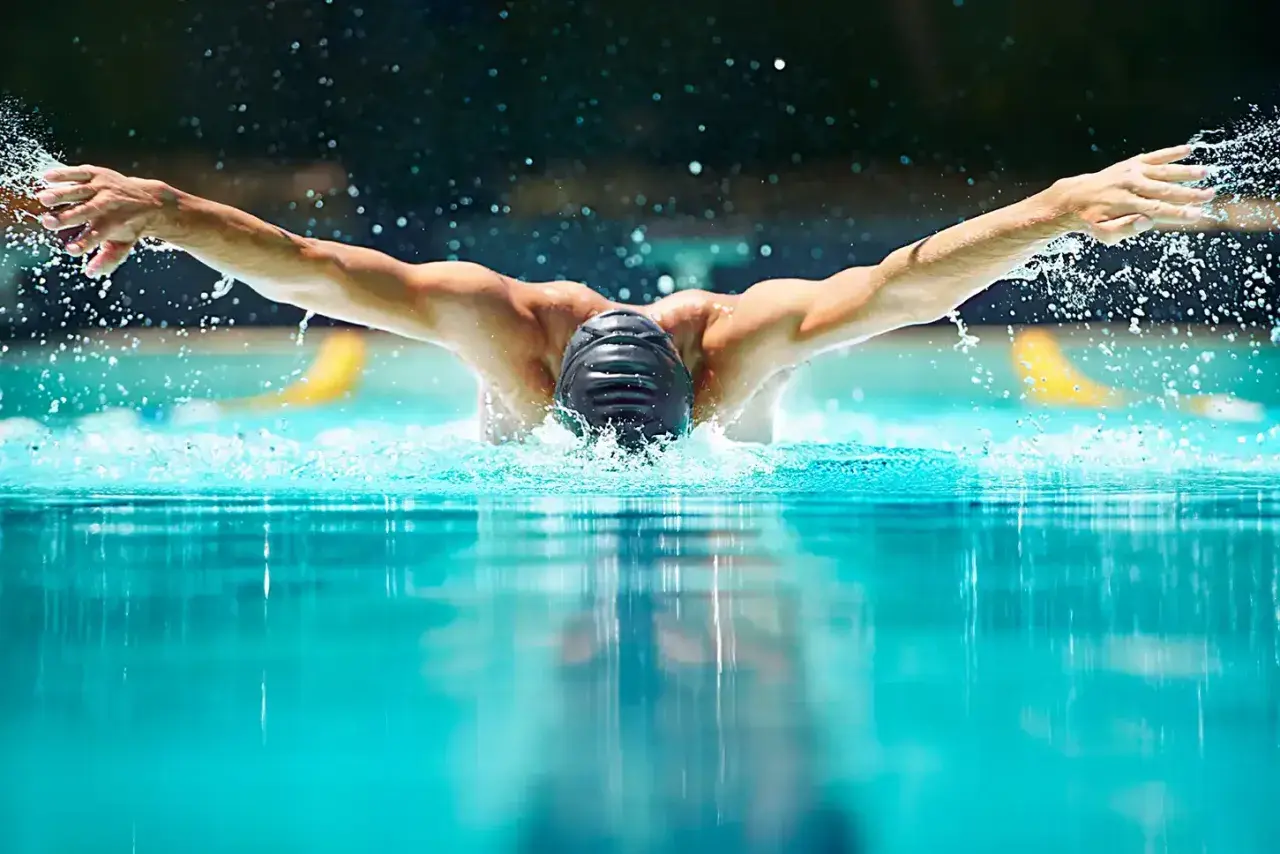
The fastest gains come from cleaner timing, not more full-stroke volume
- Butterfly gets better when the body wave, kick, and breathing line up. If one part is late, the whole stroke pays for it.
- Short repeats beat long grind sets for most swimmers. Technique stays usable when fatigue is controlled.
- Dryland work matters, but only the right kind. Core control, shoulder stability, and trunk mobility transfer best.
- Fins are useful, but only as a temporary teaching aid. They can hide timing errors if you rely on them too much.
- Two focused fly sessions a week are enough for many club swimmers. More volume is not automatically better.
What a good butterfly session really trains
I like to treat fly work as a precision session first and a conditioning session second. The stroke asks for a narrow set of skills at the same time: a stable body line, a strong but compact dolphin kick, a late and low breath, and enough shoulder endurance to repeat the pattern without the hips dropping.
- Timing so the pull, kick, and recovery happen in the right order instead of fighting each other.
- Body control so the chest drives the wave and the hips stay near the surface.
- Breathing rhythm so the head comes up briefly without breaking momentum.
- Speed endurance so you can hold shape for more than a handful of strokes.
If a set only leaves you exhausted, it is usually too blunt. If it feels neat but never challenges you, it is probably too easy. The sweet spot is short enough for quality and demanding enough that the technique has to survive pressure, which is where the right drills come in.
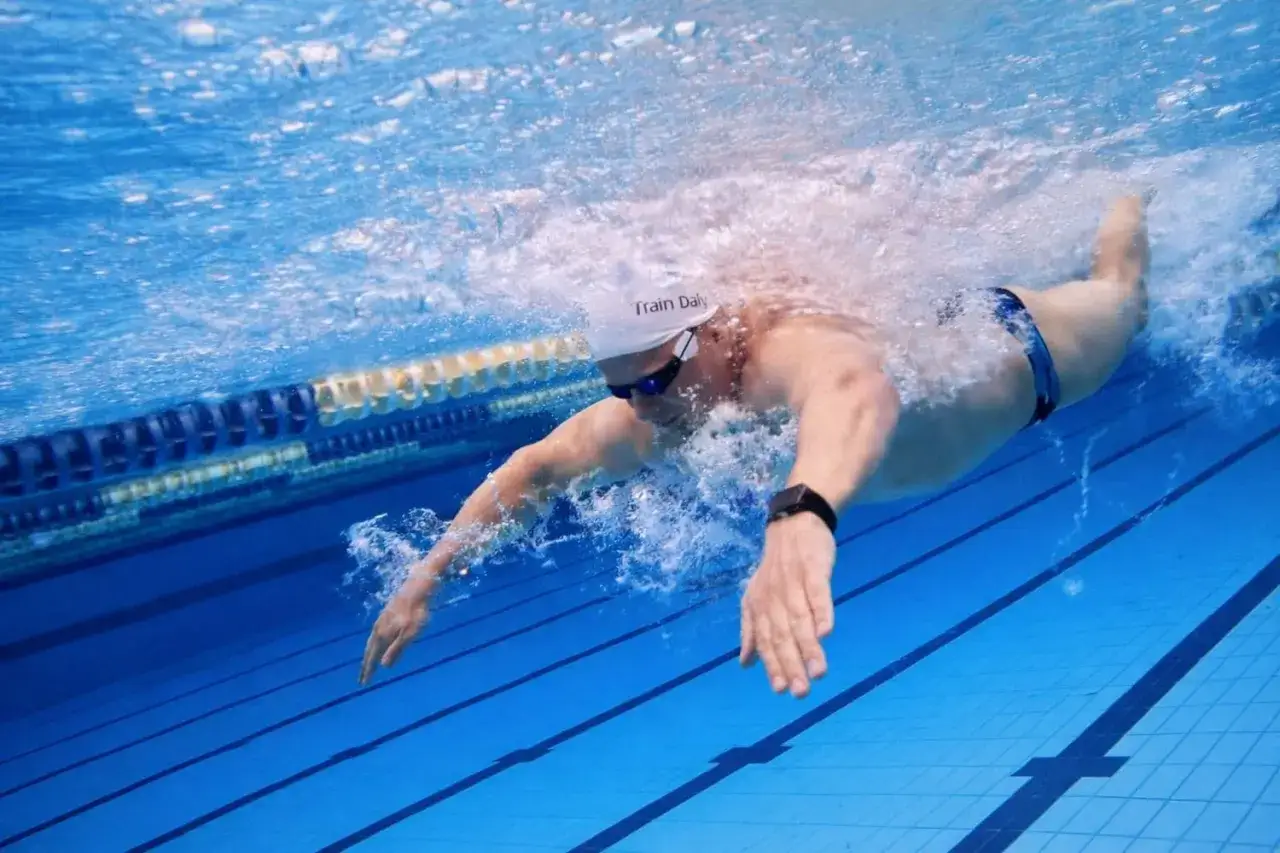
Drills that clean up body line and timing
The best butterfly drills do not add extra complexity. They strip the stroke back until the swimmer can feel one piece at a time, then reassemble the motion. I use the smallest drill that fixes the biggest fault, because too many drill variations can leave a swimmer looking busy without swimming any better.| Drill | What it fixes | How I would use it |
|---|---|---|
| Front dolphin kick in streamline | Core tension, wave initiation, and keeping the kick narrow | 6 x 10-15m with 15-20 seconds rest, focusing on the chest leading the motion |
| Body dolphin on the front and back | Feeling the body wave without arm distraction | 4 x 25m each way, keeping the kick smooth rather than forceful |
| One-arm butterfly | Breathing timing and a cleaner catch | 4 x 25m each arm, with the non-working arm extended and the breath kept low |
| 3 kicks, 1 pull fly | Rhythm and patient timing through the stroke cycle | 4 to 6 x 25m, using the pause to make sure the kick and pull are connected |
| Butterfly with fins | Water feel and tempo when technique is already close | 4 x 25m easy to moderate, then repeat without fins once the pattern feels stable |
The main cue I give is simple: let the chest start the wave, let the hips follow, and keep the breath quick. Once that feels familiar, the next step is to make the stroke stronger without letting the shoulders take all the load.
Dryland work that carries over to the pool
Fly swimming is hard on the body in a very specific way, so random gym work is not enough. I want dryland exercises that improve trunk stiffness, shoulder control, and the kind of hip-to-rib connection that helps the stroke stay organised under fatigue. That matches the broad approach in Aquatics GB's injury-prevention guidance, which groups preparation around mobility, stability, strength, and functional movement.- Hollow body hold for 3 x 20-30 seconds. This teaches the swimmer to keep the ribs down and the midline firm.
- Dead bug with a long exhale for 2 to 3 x 8 each side. This helps the swimmer keep control while breathing in the stroke.
- Scapular push-ups for 2 to 3 x 10-12. These build shoulder-blade stability, which matters every time the arms recover over the water.
- Band lat pull-downs or straight-arm pull-downs for 3 x 8-10. These reinforce the pulling muscles without forcing a heavy overhead press pattern.
- Medicine-ball slams for 3 x 6-8. These are useful for explosive trunk drive, as long as the movement stays crisp.
- Thoracic rotations and wall slides for 2 x 8-10. Better upper-back mobility makes the recovery feel less jammed.
Fifteen to twenty minutes is usually enough if the work is focused. I would rather see a swimmer do a short, tidy prep circuit before the pool than spend an hour on exercises that do not change the stroke at all. From there, the next question is how to turn those pieces into a real swim set.
Sample sessions for different training levels
These examples use metres because that is the cleanest fit for most UK pools. I am not chasing huge butterfly volumes here; I am trying to keep the stroke honest, repeatable, and useful inside a broader swim programme.
| Session type | Main work | Fly volume | Best use |
|---|---|---|---|
| Technique reset | 200 easy swim, 6 x 25m dolphin kick streamline, 6 x 25m one-arm fly, 6 x 25m full fly on generous rest, 200 easy | 150-250m | Beginners, returning swimmers, or anyone whose stroke falls apart quickly |
| Rhythm builder | 300 warm-up, 8 x 25m drill/swim by 25, 6 x 50m fly on controlled intervals, 4 x 25m strong but tidy, 200 easy | 350-550m | Club swimmers who need better pacing and stroke consistency |
| Race-pace touch | 400 warm-up, 6 x 15m underwater kick and breakout, 8 x 25m at target pace with full recovery, 4 x 50m easy swim, 4 x 25m fly from a push at fast but clean effort, 200 cool-down | 300-500m | More advanced swimmers who can hold form at higher speed |
What matters most is not the exact distance but the quality of each repeat. If the last two reps look ugly, I cut the set or switch to drills, because there is no useful training value in rehearsing bad butterfly. That makes weekly structure just as important as the session itself.
How to build a week around fly without overcooking the shoulders
Most swimmers do better with a smaller amount of high-quality fly than with one heroic session that ruins the next two practices. As a rule of thumb, I would plan one technical touchpoint and one faster touchpoint for most club swimmers, then add a third only if the shoulders recover well and the mechanics stay sharp.
- Recreational or developing swimmer: 1 fly-focused touchpoint a week, usually 100-300m of true butterfly work inside a longer session.
- Club swimmer: 2 touchpoints a week, one drill-heavy and one pace-heavy, usually 200-600m of true fly per session.
- Advanced swimmer: 2 to 3 touchpoints a week, but only one hard butterfly set. The rest should stay low-volume and technical.
- Recovery gap: leave 24-48 hours between hard fly sessions whenever possible.
- Session order: place butterfly after the warm-up, before fatigue turns the stroke into survival swimming.
I also like to keep fly work early in a practice if the rest of the session is demanding. Once shoulders and timing degrade, the stroke changes character very quickly. The next section shows the mistakes that usually cause that collapse.
The mistakes that drain speed fastest
Most butterfly problems are not mysterious. They are usually the same few habits showing up again and again, and they are easy to spot once you know what to look for. Fixing them is often more valuable than adding another hard set.
| Mistake | What it looks like | Better fix |
|---|---|---|
| Breathing too high | The hips sink, the stroke stalls, and the swimmer feels lifted out of the water | Take a quicker, lower breath and let the face return to the water earlier |
| Pulling too wide | The shoulders tire early and the hands sweep out instead of back | Keep the catch narrower and focus on accelerating the hands under the body |
| Overkicking from the knees | Lots of splash, not much lift, and a tired lower back | Start the wave from the chest and hips, then let the feet finish the motion |
| Too much full-stroke volume | Form breaks after a few repeats and the swimmer starts muscling every length | Replace some full fly with drill work or short controlled repeats |
| Heavy recovery | The arms feel dragged over the water and the stroke tempo slows down | Recover with relaxed shoulders and a lighter, faster hand path |
When I see a swimmer blame fitness for these issues, I usually disagree. In many cases the stroke is leaking energy through timing and shape, not effort. Once those leaks are closed, the final sign of progress is easy to see in the next few sessions.
What to measure after the next few sessions
The best feedback from fly work is simple and practical. I would track a small set of markers rather than chase vague feelings, because butterfly can feel hard even when it is getting better.
- Stroke count stays steadier across the set instead of climbing as fatigue builds.
- Breathing no longer breaks the line through the hips and lower back.
- Repeat times stay close together, usually within about 1-2 seconds on 25m repeats if the set is well controlled.
- Shoulders feel worked, not battered the next day.
If those markers improve, the session is doing its job. I would rather see a swimmer finish with one rep fewer and a cleaner stroke than force extra distance and lose the movement pattern that makes butterfly fast in the first place.