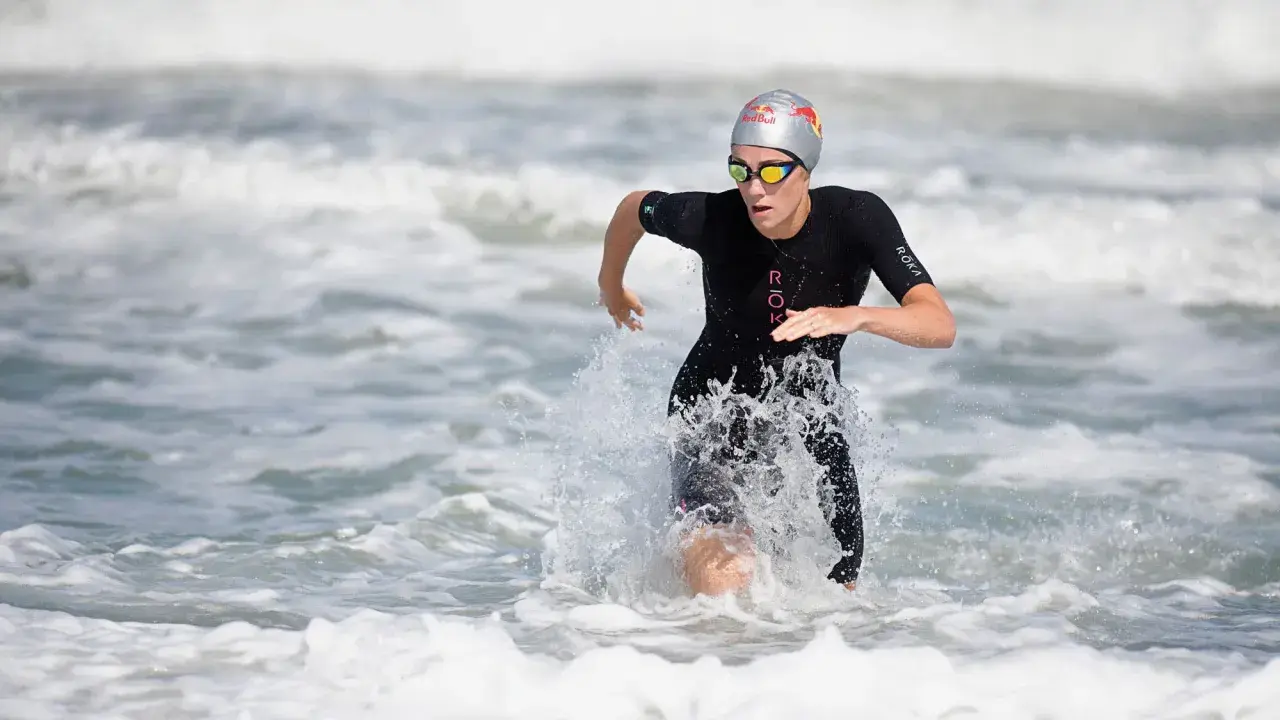
What her career says about swimming-based triathlon success
- She moved from a long competitive swimming background into triathlon and quickly became a world-class long-course athlete.
- Her 2023 Kona victory in 8:24:31 and her 2025 70.3 World Championship win in 4:14:54 show that her racing is built on more than swim speed.
- Her greatest advantage is early-race control, but the real difference is how well she protects that advantage across the full race.
- For age-group athletes, the most useful lesson is not to copy her volume, but to copy her discipline in pacing, fueling, and bike durability.
- She remains a strong reference point for swimmers who want to move into triathlon without losing their strengths in the water.
Who she is and why she matters in triathlon
Lucy Charles-Barclay came into triathlon with a serious swimming background, not as a casual crossover athlete. She spent roughly a decade in competitive swimming, began in the pool at a young age, and later moved through open-water racing before triathlon became the better fit. That matters because it explains why her swim leg is so decisive, but it also explains why her career is more interesting than a simple “fast swimmer wins” story.What I find most useful about her path is the timing. She entered her first IRONMAN in 2014, picked up age-group world titles in 2015, and turned professional the following year. That progression tells you she did not wait for every piece to be perfect before racing bigger events. She tested herself, learned fast, and then built the rest of her game around that early foundation. That transition is where the useful lessons begin.
How she turned swim speed into a full triathlon weapon
A strong swim can buy position, confidence, and a bit of psychological pressure on the field. It cannot, by itself, win long-course triathlon. Charles-Barclay’s career works because she turned her swim into an advantage that shaped the rest of the day instead of wasting it on overexertion.
| Swimming trait | Triathlon advantage | Limitation if overused |
|---|---|---|
| Open-water comfort | Cleaner starts, better sighting, and less panic in crowded races | Too much early aggression can burn matches before the bike even begins |
| High aerobic capacity | Strong first-leg pacing and good recovery between surges | Bike and run durability still need separate training, especially in long races |
| Efficient water technique | Lower energy cost, so more usable energy later in the race | If the rest of the race is underdeveloped, the swim advantage gets neutralised |
The pattern is simple: in long-course racing, the swim is a sorting mechanism, not the finish line. Charles-Barclay’s strength is that she uses the swim to race from the front without treating it like the whole event. That distinction sounds small, but it is the difference between an athlete who looks good for 20 minutes and one who can still win after eight hours.

What her biggest results say about race execution
The races that define her career are useful because they show different versions of the same idea: front-load the race, stay composed, and finish with enough control to close it out. Her Kona win in 2023 was the cleanest example. She won the IRONMAN World Championship in 8:24:31 and broke the long-standing course record. That performance was not only about power; it was about not letting a fast start become a chaotic middle or a fragile run.
| Race | Result | Why it matters |
|---|---|---|
| 2023 IRONMAN World Championship, Kona | 8:24:31, victory and course record | Shows she can turn swim dominance into a complete world-class long-course performance |
| 2025 IRONMAN 70.3 World Championship, Marbella | 4:14:54, second 70.3 world title | Shows resilience after a difficult stretch earlier in the season and proves she still converts pressure into wins |
| 2025 IRONMAN 70.3 Eagleman | 3:58:10, victory | Shows that her form travels well outside championship environments too |
The lesson I take from those results is that she does not race like a swimmer trying to survive triathlon. She races like a triathlete who happens to have a world-class swim engine. That is a very different thing, and it is the reason her wins keep showing up at the highest level. Once you see that pattern, the training advice becomes much clearer.
Training lessons I would actually take from her
If I were coaching a strong swimmer who wanted to move into triathlon, I would not start by chasing elite volume. I would start by protecting the swim strength while building the parts that swimmers usually underestimate: sustained bike power, run durability, and race nutrition. That is the real bridge between pool fitness and long-course results.- Keep swim quality high, but do not let the swim become the only session that feels important.
- Build bike durability with long aero sessions, not just short power work.
- Practice brick runs when the legs feel flat, because that is what race day feels like.
- Fuel early and consistently instead of waiting until the body is already behind.
- Use strength and mobility work to protect position and reduce late-race breakdown.
For most age-group athletes, that means consistency beats hero training. A strong swimmer can get away with a lot in the water; triathlon quickly exposes weak links on land. The smartest athletes accept that reality early and train for it directly. From there, the question becomes what gear and setup best supports that style of racing.
Gear, pacing and fueling that fit the way she races
Her career is a good reminder that gear matters most when it supports repeatable execution. The most expensive setup is useless if it does not let you hold position, stay comfortable, and avoid avoidable mistakes. For a swimmer-turned-triathlete, I would prioritise fit and reliability over novelty every time.
That usually means five practical things. First, a wetsuit that fits the shoulders cleanly matters more than any marketing claim about buoyancy. Second, goggles have to stay stable in crowded water, because a great swimmer still loses time if they keep adjusting equipment. Third, the bike fit needs to hold aero comfort for hours, not just for a test ride. Fourth, pacing should be conservative enough to preserve the run, even when the swim feels easy. Fifth, fueling has to be trained, not improvised; for many long-course athletes, 60 to 90 grams of carbohydrate per hour on the bike is the realistic working range, and anything higher should be built up gradually in training.
What stands out to me is that this style of racing rewards calm, repeatable habits. It is not glamorous, but it is effective. That leads directly to what her recent seasons say about where she stands now.
Why she remains the benchmark for swimmer-to-triathlete conversion
By 2026, Charles-Barclay is still one of the cleanest examples of how to convert swim talent into triathlon success without becoming one-dimensional. Her 2025 results, including the 70.3 world title in Marbella and the win at Eagleman, show that she is not surviving on reputation. She is still racing with purpose, and she is still a benchmark for what happens when a swimmer learns to respect the bike and run instead of assuming the water will solve everything.
If I had to reduce her career to one practical takeaway, it would be this: keep the swim as your advantage, but build the rest of the race until that advantage becomes hard to beat. For UK swimmers thinking about triathlon, that is the real opportunity. Start with one controlled race, learn transitions, build bike durability, and let the results come from balance rather than from one strong leg alone.