
An Ironman is less about one heroic day and more about building a body that can keep working for a very long time. This guide is the practical version of how to train for an Ironman: what to prioritise, how to structure the weeks, and where athletes usually lose time, energy, or confidence. I’m keeping it grounded in what actually helps on race day, not in the fantasy of endless hard sessions.
That matters even more if you’re training in the UK, where weather, daylight, and pool access often shape the plan as much as motivation does. The goal is not to do everything all at once. It is to prepare the swim, bike, run, fueling, and recovery so they all hold together when the race gets long.
The essentials before you start
- A full-distance race is 3.8 km of swimming, 180 km of cycling, and a marathon, so durability matters more than one-off fitness.
- Most athletes do best with a plan that lasts 16-30 weeks, depending on current base fitness and how much time they can train.
- A realistic build usually includes 2-3 swims, 3 bikes, 2-4 runs, plus 1-2 strength sessions each week.
- The biggest mistakes are under-fuelling, running too hard, and leaving open-water practice until the last minute.
- Brick sessions, race-pace work, and one or two rehearsal weekends are more useful than constant maximal efforts.
- In the UK, winter pool work and indoor bike sessions are often the backbone of the plan, with open-water work added as conditions improve.
Start with the actual demands of the race
Before I write any training plan, I like to strip the event down to its real demands. An Ironman is not just three sports back to back; it is a test of pacing, fueling, and decision-making over many hours. The swim can feel short compared with the rest of the day, but it sets the tone. The bike is where you either protect the run or quietly sabotage it. The marathon is where every small mistake starts to show up.
That is why the question is never only “how fit am I?” It is also “how well can I stay controlled when I am tired?” If you are chasing a first finish, the smartest goal is usually to arrive at the run with enough reserve left to keep moving. If you are chasing a time, the same logic applies, just at a higher level: better pacing, better aerodynamics, and better fueling buy more time than random extra intensity.
| Discipline | What matters most | What usually goes wrong |
|---|---|---|
| Swim | Efficient technique, calm starts, straight sighting, open-water comfort | Overkicking, panicking in traffic, poor body position, no race-simulation practice |
| Bike | Steady power, aero comfort, fuel intake, leg preservation for the run | Riding too hard early, ignoring nutrition, poor position on the bike |
| Run | Durability, pacing discipline, injury resistance, gut tolerance late in the day | Starting too fast, long runs that are too aggressive, trying to “save” the race with fitness alone |
Once you understand those demands, the training structure becomes much clearer. You are not building three separate sports. You are building one long, connected engine.
Build the plan in phases
I prefer to think in phases because full-distance preparation falls apart when every week looks the same. A simple structure is enough for most age-group athletes: base, build, peak, and taper. The exact length depends on how much background fitness you already have, but in practice I would rarely rush a newcomer through the process. If you already swim, bike, and run consistently, a shorter block may work. If you are coming in with gaps, you need more time to absorb the work.
| Phase | Typical length | Main goal | What it looks like |
|---|---|---|---|
| Base | 8-12 weeks | Build routine and aerobic capacity | Mostly easy volume, technique work, strength, and low-drama consistency |
| Build | 6-8 weeks | Add race-specific load | Longer rides, longer runs, controlled tempo work, and the first brick sessions |
| Peak | 2-4 weeks | Rehearse race demands | Key long workouts, pacing practice, and a full nutrition trial |
| Taper | 2-3 weeks | Freshen up without losing sharpness | Reduced volume, a little intensity, lots of recovery, and tighter logistics |
The most useful session in the whole build is often a race rehearsal weekend. I like one substantial benchmark block roughly one to two weeks before taper begins: a long ride with planned fueling, followed by a short run off the bike, or a swim-bike-run sequence that gives you a real feel for race effort. That kind of rehearsal tells you more than a dozen random hard workouts. It also exposes the practical problems: too much fatigue, the wrong shoes, poor bottle setup, or a fueling plan your stomach cannot tolerate.
From there, the plan gets simpler, not more complicated. You increase the work only if you can recover from it, and you keep moving toward race-specific habits instead of collecting fitness for its own sake.
Make the swim the least negotiable skill
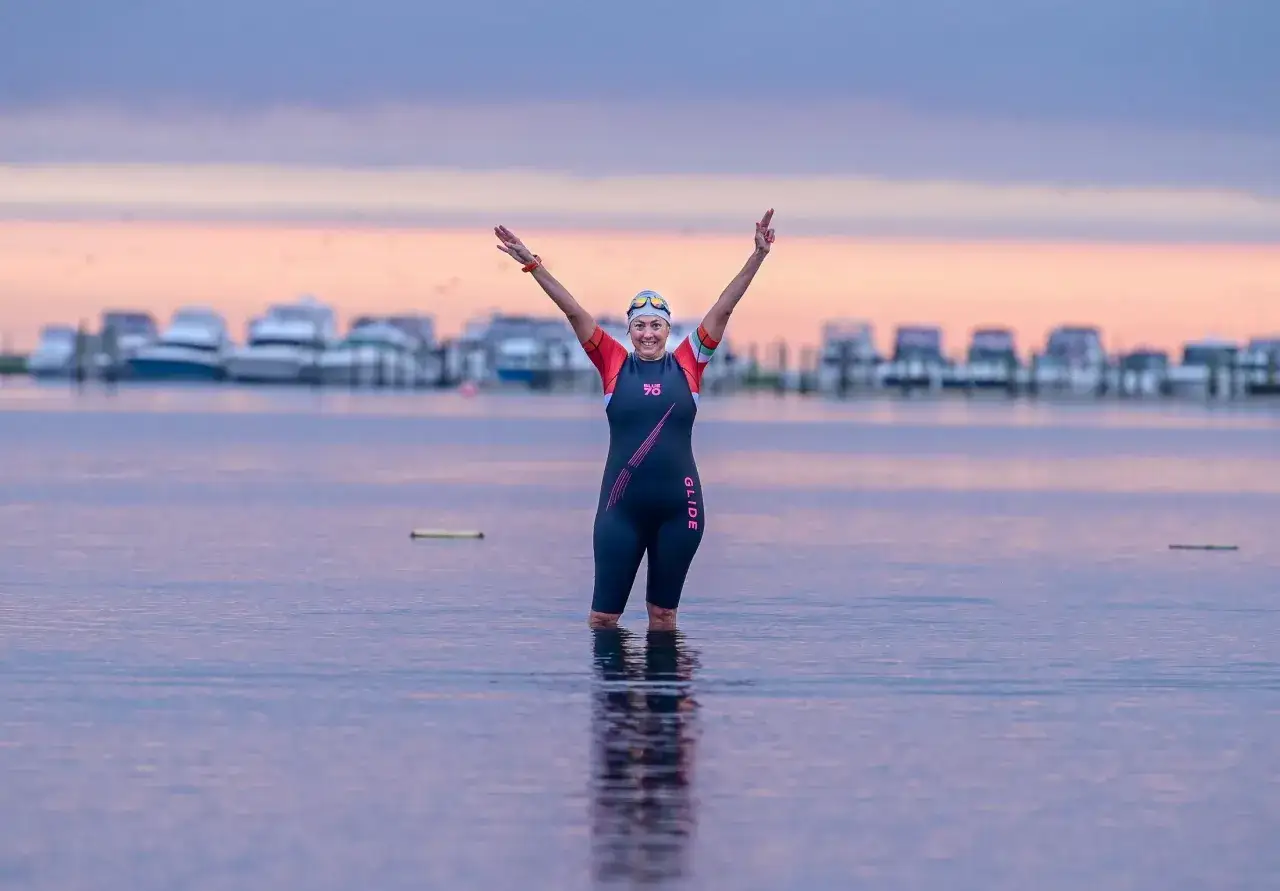
Most first-timers fear the swim, but I see the opposite problem far more often: swimmers who can survive the distance but lose too much energy because their technique is inefficient. In a full-distance race, the swim is long enough to matter and short enough that small technical gains pay off fast. If you can hold a calmer body position, sight efficiently, and breathe without panic, you save energy for everything that follows.For that reason, I would treat swim quality as a priority, not an afterthought. Three swims a week is a strong target if the water still makes you nervous, and even two good swims can be valuable if they are focused. Use the pool for technique, stroke count, pacing, and controlled intervals. Then move as quickly as you reasonably can into open water, because race day should never be your first time dealing with waves, contact, low visibility, or a wetsuit.
- Practise sighting every few strokes without lifting your head too high.
- Do short starts from a crowded position so race-day contact feels normal.
- Swim with a group when possible, because the pack feel is part of the event.
- Get used to cold water gradually, especially if you train through a UK winter.
- Use pool sessions to simulate open-water rhythm with longer continuous swims and fewer wall breaks.
If you want one simple rule, use this: technique first, then endurance. I would rather see a swimmer shave a few unnecessary strokes than grind out another mindless interval set. In the water, efficiency is still the cheapest speed available.
Train the bike and run for durability, not hero sessions
The bike is the biggest opportunity in an Ironman build because it gives you the most room to create fitness without the same injury cost as running. That does not mean you can hammer every ride. It means you need a long ride that teaches pacing, a tempo or threshold ride that lifts your ceiling, and regular easy volume that keeps you comfortable on the saddle. If you are training through British weather, indoor trainer work is a gift rather than a compromise: it lets you control effort, build discipline, and protect consistency when conditions are poor.
The run deserves respect, but not recklessness. I do not like marathon-length training runs for most athletes in Ironman preparation. They create more fatigue than they solve. A long run of 90 to 150 minutes is usually enough for many age-groupers, provided the rest of the week is structured well. The real goal is to arrive with legs that can still move after the bike, not to prove you can suffer through a huge standalone run.
| Session type | Why it helps | How I’d use it |
|---|---|---|
| Long ride | Builds endurance, pacing discipline, and fueling practice | Usually the biggest weekly session; keep it controlled rather than hard |
| Tempo or steady bike | Lifts sustainable power and helps race-effort feel manageable | Best done midweek or on the turbo when time is limited |
| Brick run | Teaches the legs to switch from bike to run | Start with 10-20 minutes off the bike, then build gradually |
| Long run | Improves durability and late-race confidence | Keep most of it easy; avoid turning it into a race |
| Easy run | Supports volume without piling on fatigue | Use it to build frequency and protect the joints |
I usually start brick workouts around 12-16 weeks from race day, once the athlete has enough base to benefit from them. Early bricks do not need to be dramatic. A short run after a bike ride is enough to teach the transition. Later on, the brick becomes a race rehearsal tool: Can you settle the legs, keep your cadence under control, and avoid the temptation to surge out of T2? That is the real question.
Use a weekly structure you can actually repeat
The best training plan is the one you can keep following when work, family, and weather get in the way. I want the week to feel organised, not heroic. Most athletes do well with one long ride, one long run, a couple of focused bike sessions, two or three swims, and enough recovery to absorb it all. You do not need to be exhausted every week to become Ironman-ready. In fact, chronic exhaustion is usually a sign that the load is badly arranged.
| Day | Main work | Purpose |
|---|---|---|
| Monday | Rest or mobility | Absorb the weekend load and reset |
| Tuesday | Swim technique plus bike intervals | Sharpen efficiency and aerobic power |
| Wednesday | Easy run plus strength | Keep impact controlled and build durability |
| Thursday | Swim endurance plus steady bike | Reinforce race-specific rhythm |
| Friday | Easy swim or full rest | Arrive fresher for the weekend sessions |
| Saturday | Long ride plus short brick run | Biggest race-specific day of the week |
| Sunday | Long run plus recovery swim | Build run resilience without forcing intensity |
If you only have six training days, I would usually drop the least important easy session before I cut the long ride or long run. That said, quality still matters more than collecting volume. A tight, well-executed week beats a messy, overstuffed one almost every time. For many UK athletes, this is where the plan becomes realistic: weekday pool or turbo sessions, one strong weekend ride, and one structured run that does not wreck the next day.
Fuel, recover, and stay healthy enough to absorb the work
Endurance training only works if the body can recover from it. That sounds obvious, but it is where a lot of Ironman plans quietly fail. Athletes train on tired legs, under-eat after long sessions, skip strength work, and then wonder why the fitness never shows up. I treat fueling and recovery as part of the plan, not optional extras.
For long sessions, practise race fueling in training rather than waiting until event day. A useful range for many athletes is roughly 60-90 grams of carbohydrate per hour on the bike, with the bike being the easiest place to absorb food and fluid. On the run, intake usually has to be simpler and smaller. Hydration needs to be regular and deliberate, especially in warmer conditions or when you sweat heavily. You do not want to discover your limits in the middle of the marathon.- Eat early in long sessions rather than trying to catch up later.
- Use long rides to test drink mix, gels, bars, and sodium strategy.
- Recover from hard or long workouts with carbohydrates plus protein.
- Keep strength and mobility in the plan, even if it is only 20-30 minutes twice a week.
- Protect sleep aggressively during heavy training blocks.
Just as important, know when a small issue is becoming a real problem. A niggle that changes your stride or a shoulder that starts to alter your swim stroke is not something to “push through” for weeks. Back off early, fix the cause, and keep the larger plan intact.
Avoid the mistakes that wreck most Ironman builds
The biggest Ironman mistakes are usually not dramatic. They are boring and repeated. The athlete who trains too hard on easy days, skips open-water practice, rides every long session like a time trial, or ignores nutrition until race week is often the one who ends up struggling. That is why I am so direct about the basics: consistency beats chaos, and specificity beats random suffering.- Do not turn every session into a test.
- Do not leave open-water skills until the final few weeks.
- Do not run long too often or too fast.
- Do not let your fueling plan be an experiment on race day.
- Do not buy more gear to solve a fitness problem.
- Do not taper by doing nothing for two weeks.
There is also a mindset error that catches a lot of athletes: they confuse fatigue with progress. A good Ironman block is demanding, but it should still look repeatable. If the workload is constantly smashing you, the plan is too aggressive or too poorly balanced. That is especially important for masters athletes and anyone training around a full-time job, which is the reality for most people in the UK amateur scene.
The final six weeks are about proving the plan
By the time you are six weeks out, the main job is not to reinvent anything. It is to confirm that your race-day habits work under pressure. I want one last solid rehearsal, a clear taper, and a calm approach to logistics. That means using the kit you will race in, practising your nutrition at full effort, and keeping the sessions specific without stacking unnecessary fatigue.
- Lock in your bike setup, shoes, nutrition, and race kit.
- Keep one key brick session, but reduce overall volume.
- Maintain a little intensity so you do not feel flat.
- Practise transitions until they feel automatic.
- Sort travel, timing, and breakfast plans early.
If you keep the final block simple, you give the fitness time to emerge. That is the quiet truth behind a good Ironman build: not more and more work, but the right work repeated long enough to become reliable when it counts.